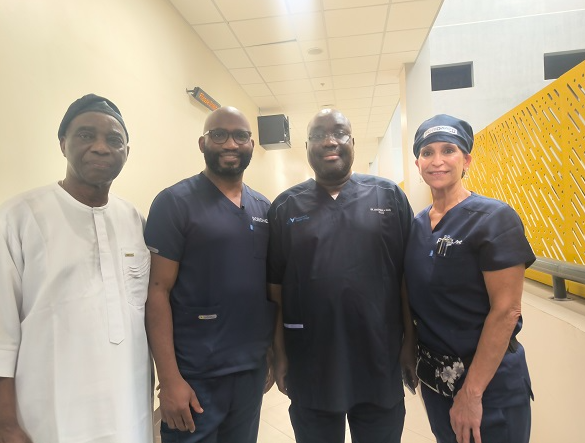
ABUJA, NIGERIA — Nigerian medical specialists have successfully removed a cancerous kidney using a remotely guided robotic platform. According to clinical statements released by participating hospitals, the successful procedure marks the country’s first tele-robotic kidney surgery and the first telesurgery procedure of its kind in West Africa.
The operation—a telesurgery-assisted right radical nephrectomy—was conducted in real time between Redeemer’s Health Village and Nisa Premier Hospital in Abuja. Executed in collaboration with RoboMed Global, the three-hour procedure utilized a Toumai surgical console for remote guidance. Lead surgeon Prof. Obi Ekwenna-Davis confirmed the patient remained in good condition following the operation, with discharge scheduled within 24 hours.
Key clinical metrics and institutional details surrounding the breakthrough procedure include:
Clinical Parameter
Operational Details
Surgical Procedure
Telesurgery-assisted robot-assisted right radical nephrectomy
Collaborating Institutions
Redeemer’s Health Village & Nisa Premier Hospital (Abuja)
Technology Platform
Toumai remote surgical console (RoboMed Global)
Recovery Status
Discharged within 24 hours following successful operation
Clinical Significance of First Tele-Robotic Kidney Surgery
Executing the first tele-robotic kidney surgery demonstrates how advanced digital platforms can overcome specialist shortages across West Africa. Radical nephrectomy removes localized renal tumors through minimal incisions, offering reduced blood loss, tremor-filtered precision, and accelerated recovery times. Operating from a remote network console allows scarce surgical specialists to treat patients across dispersed regions without requiring physical travel.
However, widespread clinical adoption depends heavily on digital infrastructure and capital investment. Successful remote tele-robotics requires ultra-low latency network connections, dedicated bedside clinical teams prepared for manual intervention, and substantial capital for consumable medical equipment. While currently limited to private healthcare facilities, establishing reliable connectivity could eventually help extend specialized surgical care into public health institutions.
Why It Matters: Remote robotic surgery can extend scarce specialist reach across multiple facilities, provided connectivity infrastructure and patient costs allow.
Landmark Achievement: First-Ever Whole Eye… In a groundbreaking medical achievement, a surgical team from NYU Langone Health in the United States has successfully performed the world's first-ever whole-eye transplant. This remarkable procedure marks a significant milestone in the field of…
Triple Negative Breast Cancer: What It Means for Treatment If your report says triple negative, you have probably already searched the phrase and found something frightening. Triple negative breast cancer is more aggressive than other types, and there is no point pretending otherwise. What…
Chronic Pain Management in African Women: A… Chronic pain, characterized by persistent discomfort lasting for more than three to six months, is a global health challenge that affects millions of individuals. In the context of Africa, chronic pain poses unique considerations, and…
Newly Diagnosed With Breast Cancer? Your First 30 Days Guide If you have just been newly diagnosed with breast cancer, start here. You do not need to understand everything today. You need to know what to do next, and in what order. This guide breaks…