When the naira lost more than half its value in 2023 and 2024, Nigerians felt it at the pharmacy counter before they felt it almost anywhere else. Prices of common medicines climbed sharply because most of them, or the ingredients inside them, are bought in dollars. That shock turned local drug manufacturing in Nigeria from an industrial policy talking point into a question of health security. Two years after the government’s boldest intervention, it is fair to ask what has actually changed for manufacturers, investors and patients.
Why import dependence became a health risk
Industry estimates have long put the share of medicines consumed in Nigeria that are imported, either as finished products or as active pharmaceutical ingredients (APIs), at between 70% and 90%. Even products labelled as made in Nigeria usually depend on imported APIs, excipients and packaging materials, much of it from India and China.
Import dependence carries three costs. The first is price: every movement in the exchange rate passes straight to the patient. The second is supply: when foreign exchange is scarce or shipping is disrupted, shelves empty. The third is quality control: the further a product travels through loosely regulated channels, the more room there is for substandard and falsified products to enter.
The exit or scaling back of several multinational pharmaceutical companies in 2023, including GSK Consumer Nigeria’s 2023 decision to cease operations and move to third-party distribution, sharpened the point. Brands patients had trusted for decades shifted to third-party distribution or disappeared, and local firms were left to fill the gap.
What the government has done
The policy response came in two main steps.
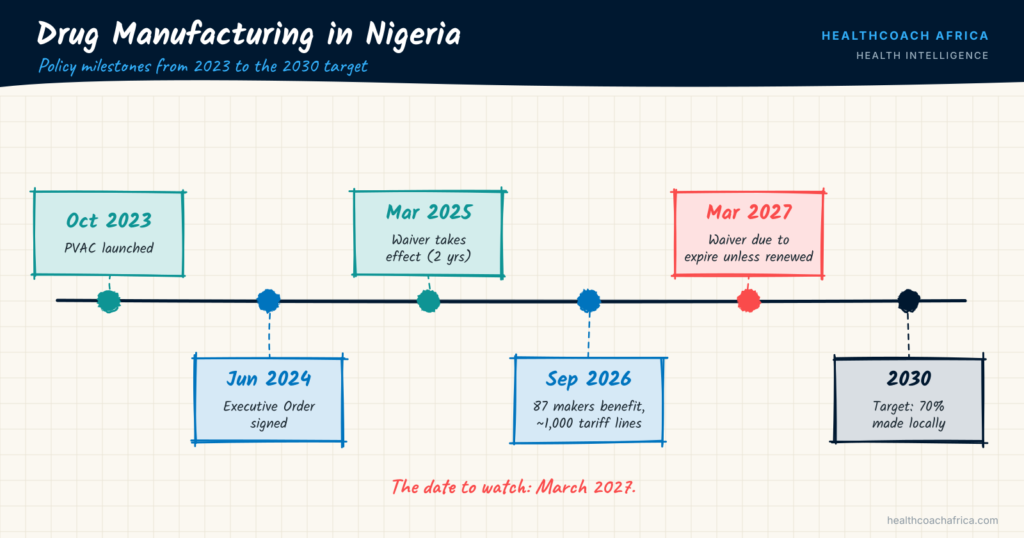
October 2023: the Presidential Initiative for Unlocking the Healthcare Value Chain (PVAC). PVAC set out to coordinate ministries, regulators and investors around domestic production of medicines, diagnostics and medical devices. Its headline ambition is to raise local manufacturing to 70% of Nigeria’s needs by 2030.
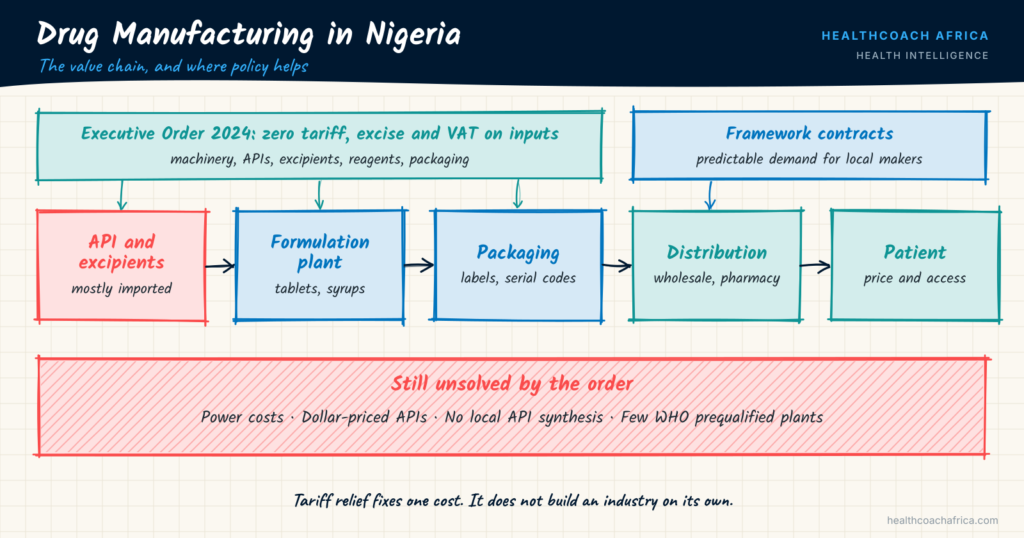
June 2024: the Executive Order on pharmaceutical inputs. On 28 June 2024, President Bola Tinubu signed an order introducing zero tariffs, excise duties and VAT on specified pharmaceutical machinery, equipment, APIs and other raw materials, including inputs for diagnostic kits and insecticide-treated nets. It also provided for market-shaping tools such as framework contracts and volume guarantees, so that local producers can plan around predictable demand.
Local drug manufacturing in Nigeria: what changed on the ground
Policy on paper and policy at the port are different things, and the first year was frustrating. Through late 2024, manufacturers complained publicly that the order was not being applied by customs, and that they were still paying full duties on imported inputs while the currency kept sliding.
Implementation eventually moved. A Ministry of Finance circular made the duty and VAT exemption effective from 5 March 2025, for a period of two years, and manufacturers’ groups welcomed waivers covering APIs, excipients, reagents and packaging materials. By September 2026, the Minister of State for Health reported that 87 local manufacturers were benefiting from zero tariffs across almost 1,000 customs tariff lines. Federal officials have also claimed the order has cut production costs by around 12%, a figure that has not yet been independently verified.
Those are real gains. They are not yet a transformation.
Timeline of policy milestones for drug manufacturing in Nigeria from 2023 to the 2030 target
Key milestones, and the 2027 date every manufacturer should have on their calendar.
What has not changed
Tariff relief addresses one cost. Manufacturers face several others that no executive order can waive:
Energy. Many plants run on diesel generators, and power costs can exceed what they save on duties.
Foreign exchange. Zero tariffs on APIs help, but the APIs still have to be bought in dollars.
The API gap. Nigeria formulates medicines; it barely synthesises active ingredients. Until that changes, local manufacturing remains assembly with local packaging.
Quality certification. To sell to global buyers such as the Global Fund or UNICEF, plants need WHO prequalification, which takes years and significant capital. Only a handful of Nigerian facilities hold it.
Demand certainty. Framework contracts and volume guarantees are promised, but public procurement remains slow and payment delays are common.
There is also a calendar risk. If the two-year exemption runs from March 2025, it expires in March 2027 unless renewed. Investors pricing a new production line need to know whether the incentive will outlast the build.
Where the business opportunity sits
For founders and investors, the policy shift creates openings, but not evenly across the value chain.
Contract manufacturing. Brand owners who lost multinational supply need capacity. Plants with spare lines and good quality systems can earn steady revenue producing for others.
High-volume essentials. Antimalarials, antibiotics, oral rehydration salts and diabetes and hypertension medicines have large, predictable demand. They are where framework contracts are most likely to land.
Diagnostics. Rapid test kits for malaria and HIV are simpler to localise than complex drugs, and the executive order explicitly covers their inputs.
Distribution and data. Local production only helps patients if medicines reach them. Companies that connect manufacturers to pharmacies, hospitals and insurers, with demand data flowing back to the factory, solve a problem the policy does not address.
Upstream ingredients. API synthesis is the long, expensive bet. It needs patient capital, likely blended with development finance, but it is the only route to genuine independence.
What investors should check before backing a plant
For anyone weighing an investment in drug manufacturing in Nigeria, the policy story is only the starting point. Five questions separate a durable plant from a stranded asset:
Quality status. Does the facility hold NAFDAC good manufacturing practice certification, and is there a credible plan toward WHO prequalification?
Offtake. Are there signed supply agreements with distributors, hospitals, insurers or public programmes, or only expressions of interest?
Power. What does a kilowatt-hour actually cost the plant, and is there a plan to reduce it through gas, solar or grid agreements?
Currency exposure. How much of the cost base is in dollars, and how is that risk managed?
Portfolio. Is the product mix built around high-volume essentials with steady demand, or around a few products that are easy to undercut?
A plant that answers these well can survive the end of an incentive. One that cannot will struggle even with it.
What it means for patients
For patients, the test is simple: are essential medicines becoming more available and more affordable? The answer so far is mixed. Supply of locally made generics has improved, but prices remain far higher than before the 2023 devaluation. Patients with chronic conditions, who need the same medicine every month, feel this most.
From the HubPharm pharmacy desk. A locally made generic, approved by NAFDAC, can work just as well as the imported brand at a lower monthly cost. If your chronic care medicines have become hard to afford, send the code HC-HB01 on WhatsApp to +234 705 050 5001. A HubPharm pharmacist will review your prescription and show you verified, NAFDAC-registered options, delivered on a monthly schedule.
The bottom line
Local drug manufacturing in Nigeria has more policy support today than at any point in a generation, and the executive order is finally being applied at the border. But tariff relief alone cannot offset expensive power, scarce dollars and a missing API industry. The next two years will decide whether this is the start of a real industry or another incentive that expires before the factories are built. Watch three signals: renewal of the input waiver, the first large framework contracts, and new WHO prequalifications.
Federal Ministry of Information. Salako reaffirms FG’s commitment to pharmaceutical manufacturing, medicine security. September 2026. https://fmino.gov.ng/?p=57776
Mondaq (Stren & Blan Partners). President Tinubu signs Executive Order introducing zero tax on imported pharmaceutical products. 12 July 2024.
Please follow and like us:
Views:172
Related Posts:
Nigeria Grants Drug Manufacturers N24bn in Tax… ABUJA, NIGERIA Nigeria granted pharmaceutical manufacturers tax waivers worth N24 billion in 2025 and 2026 under a presidential executive order to boost local production of medicines and health products, Coordinating Minister of Health and Social…
Reliance on Imported Drug Ingredients Threatens… ABUJA, NIGERIA — Nigeria’s heavy dependence on imported raw materials for medicines threatens its medicine security, government officials and development partners said at a meeting in Abuja on Friday, calling for a practical roadmap…
Diabetes in Nigeria: Why Blood Sugar Control Fails Diabetes in Nigeria does not usually fail in the clinic. Among people who reach a specialist and stay in care, control is often reasonable. It fails in the years before anyone tests you, and it…
Nigeria’s 70% Local Medicine Target Will Be Won or… What is Nigeria’s 70% local medicine production target for 2030? As industry analysts examine how the nigeria local medicine target power bills dilemma impacts national healthcare, the Federal Government has set an ambitious goal to…