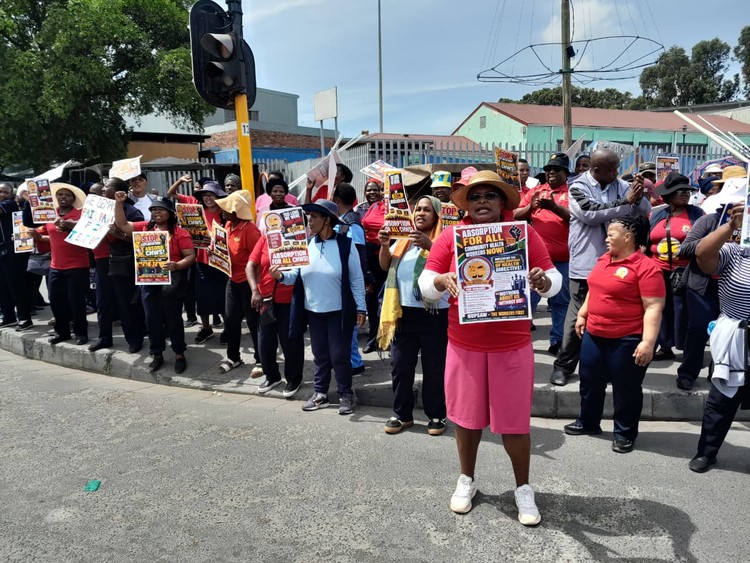
CAPE TOWN, SOUTH AFRICA — Community health workers protest action in Cape Town has moved to the labour dispute body, with a union asking the Commission for Conciliation, Mediation and Arbitration (CCMA) to decide who legally employs the workers who deliver home-based care across the Western Cape, GroundUp reported on 28 October.
About 60 community health workers picketed outside the Zolani Centre in Nyanga on Tuesday, demanding to be employed directly by the government. Workers have held protests across Cape Town this month calling for permanent jobs, according to the report.
Why the community health workers protest
The workers are employed by non-profit organisations (NPOs) contracted by the Western Cape Department of Health and Wellness. Those spoken to by GroundUp worked for organisations operating in Lusaka, Lower Crossroads, KTC and New Rest.
Most earn R6,300 a month, health worker Salaama Abrahams said. Jabu Khanyile, a provincial organiser for the National Union of Public Service and Allied Workers (NUPSAW), said some workers do not earn enough to cover their expenses and their children rely on school feeding schemes. “We will picket until we all get employed permanently,” Khanyile said. On medical aid, he added: “We will have medical aid. Now we just drink water when we are sick.”
Vuyani Shwane, NUPSAW’s provincial office manager, said the union had referred the dispute to the CCMA under section 200A of the Labour Relations Act. The union wants the CCMA to determine who the real employer is, regardless of what written contracts say.
Section 200A sets out a presumption about who is an employee, based on factors such as who controls and directs the work, rather than only what a contract states. Such cases can determine whether workers are entitled to the benefits of permanent public servants.
Department says no plans to absorb workers
The department told GroundUp the province currently has no plans to permanently absorb the workers. Spokesperson Dwayne Evans said the services were procured “through an open, competitive tender process”, and that the department funds the workers’ stipends “taking into account applicable national minimum wage requirements”. He said the contracted NPOs are responsible for employing and managing the workers.
Community health workers are a backbone of South Africa’s primary health care system. They visit households to check on patients with HIV, tuberculosis, diabetes and high blood pressure, trace people who have missed clinic appointments or stopped treatment, support pregnant women and new mothers, and screen for illness. Their work helps keep patients on lifelong treatment and reduces pressure on overstretched clinics.
Disputes over employment status have run for years in several provinces, as many community health workers were hired through NPOs on stipends rather than as public servants. Workers argue that the arrangement leaves them without job security, pensions or medical aid despite doing work that is central to public health. Governments have cited budget constraints and the cost of absorbing large numbers of staff.
The dispute comes as South Africa prepares for National Health Insurance, under which ward-based primary health care outreach teams, including community health workers, are expected to play a large role. How these workers are employed and paid will affect how well that system functions.
Instability in the workforce can affect patients directly. When community health workers strike or leave for better-paid work, home visits stop, defaulter tracing slows and the people most at risk of falling out of care can be missed. A community health workers protest is therefore a health service issue as well as a labour one.
The workers want permanent employment, medical aid and job security, according to GroundUp, while the department maintains that the NPOs are their employers. Similar disputes in other provinces have led to protests and legal challenges over several years.
For clinics, community health workers extend care into homes that formal services rarely reach. Losing experienced workers means losing relationships with patients built over years, which are hard to replace. The community health workers protest is set to continue: Khanyile said pickets would go on until all workers are employed permanently.
NUPSAW said the CCMA referral is intended to settle the question of who is responsible for the workers’ terms and conditions.
The CCMA process could take months, and its outcome may influence similar claims elsewhere in the country.
GroundUp did not report how many community health workers are employed through NPOs in the Western Cape or the total value of the department’s contracts.
Why it matters: Community health workers keep patients on HIV, TB and chronic disease treatment, so their job security directly affects primary care.
Rhodes University Probes Campus Water After Gastro… MAKHANDA, SOUTH AFRICA — Rhodes University has launched a water probe with the Department of Water and Sanitation to establish whether its internal water system caused a gastrointestinal outbreak that sent more than 100 students…
Breast Cancer Screening in Nigeria: Where to Go and Costs Breast cancer screening in Nigeria confuses people for a simple reason: nobody tells you which test you need. A woman of 32 asks for a mammogram and is told she does not need one. A…
Health Workers’ Warning Strike Disrupts Hospital… KATSINA, NIGERIA — Public healthcare delivery across Katsina State has been severely paralyzed following the commencement of a one-week warning strike declared by the Assembly of Health Professionals, forcing patients and caregivers to plead for…
Pharmaceutical Sovereignty: Learning from Big… Stakeholders in the healthcare sector are shedding light on the harsh realities faced by developing nations when dealing with major pharmaceutical companies. The recent revelation of South Africa's vaccine contracts with Big Pharma has ignited…