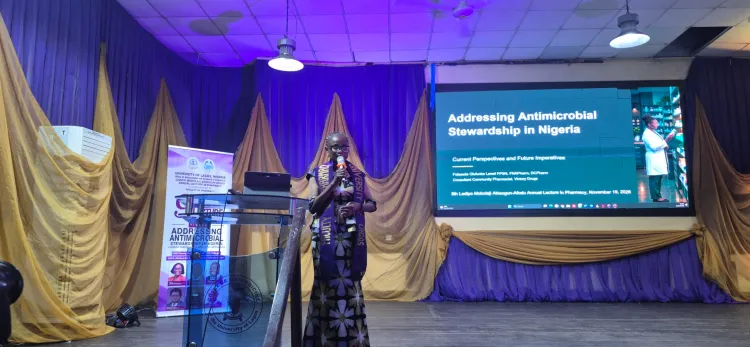
LAGOS, NIGERIA — Nigeria must strengthen antimicrobial stewardship in Nigeria by enforcing rules on antibiotic sales and funding programmes that promote responsible use, pharmacist Folashade Lawal said in a lecture at the University of Lagos, Premium Times reported on 19 November.
“The challenge now lies not in planning but in implementation,” said Lawal, Managing Director and Chief Executive Officer of Victory Drugs.
Why antimicrobial stewardship in Nigeria is lagging
Lawal delivered the ninth Ladipo Mobolaji Abisogun-Afodu Annual Lecture in Pharmacy at the College of Medicine, University of Lagos, on Thursday, during World AMR Awareness Week, which runs from 18 to 24 November. Her lecture was titled “Addressing Antimicrobial Stewardship in Nigeria: Current Perspectives and Future Imperatives.”
Nigeria’s first National Action Plan on antimicrobial resistance (AMR) covered 2017 to 2022, and an assessment found that only 44 per cent of its activities were completed, according to the report. The second One Health National Action Plan covers 2024 to 2028 and has six strategic objectives.
Lawal described AMR as a “silent pandemic.” She cited about 4.7 million deaths globally associated with bacterial AMR in 2021, including 1.14 million directly attributable. For Nigeria, she cited 50,500 deaths directly attributable to AMR and about 227,000 associated deaths in 2021.
Drivers of resistance
She named self-medication, inappropriate prescribing, unrestricted access to antibiotics and weak enforcement of regulations as key drivers, Premium Times reported.
Lawal called for stronger enforcement of rules on the sale of antimicrobials and sustainable funding for stewardship programmes. Community pharmacists should refuse to supply antibiotics without a valid prescription, she said.
As general background, Nigeria’s pharmacy regulations already require a prescription for antibiotics, but enforcement is weak and many outlets, including unlicensed medicine shops, sell them freely. Patients often request antibiotics directly, and some outlets fear losing customers if they refuse.
Strengthening antimicrobial stewardship in Nigeria therefore requires public education alongside enforcement, so that patients understand why antibiotics will not help viral infections such as colds and most sore throats.
Dean of the Faculty of Pharmacy Sunday Adesegun said “antimicrobial stewardship is not merely a professional responsibility,” according to the report. Olumide Akintayo, a former President of the Pharmaceutical Society of Nigeria, chaired the event.
Nigeria will host the fifth Global High-Level Ministerial Conference on AMR in December, the report said.
Hosting the ministerial conference gives Nigeria an opportunity to show progress on its national plan and to attract support for implementation, health experts say. The conference brings together health, agriculture and environment ministers from around the world.
Olusegun Ajala of the University of Lagos won the 2026 research grant of N2.7 million, while second place went to Deborah Ogundemuren and colleagues and third place to Osideko Oluwaseun and colleagues.
The annual lecture series honours a pharmacist and is used by the University of Lagos faculty to spotlight issues facing the profession, with this year’s focus on antimicrobial stewardship in Nigeria timed to coincide with the global awareness week. As general background, hospital stewardship programmes typically review antibiotic prescriptions, set local treatment guidelines and track resistance data so that doctors know which drugs still work.
The role of pharmacists
As general background, many Nigerians buy antibiotics directly from pharmacies and patent medicine stores without seeing a doctor, often for colds, diarrhoea or other illnesses that do not need antibiotics. Incomplete courses, low-quality or falsified products and the use of antibiotics in livestock all add to resistance.
Pharmacists are well placed to promote antimicrobial stewardship in Nigeria because they are often the first point of contact for patients. Counselling patients on when antibiotics are and are not needed, encouraging completion of prescribed courses and reporting suspected substandard products to NAFDAC are practical steps.
Better access to diagnostic tests can also reduce guesswork. When health workers can confirm bacterial infections and test which antibiotics will work, they can prescribe more precisely and save broader-spectrum drugs for when they are truly needed.
A continental concern
WHO’s Regional Director for Africa this week urged all 47 African member states to turn their AMR plans into funded actions, and Kenya and Ghana launched new national AMR reports and strategies during the awareness week. HealthCoach Africa has explained the causes and impact of antimicrobial resistance in Africa.
For the public, the message is simple: use antibiotics only when prescribed, complete the course and never share leftover medicines. Strengthening antimicrobial stewardship in Nigeria will require patients, prescribers, pharmacists and regulators to act together.
Why it matters: Drug-resistant infections already kill tens of thousands of Nigerians a year, and weak enforcement of antibiotic sales is making the problem worse.
Antibiotic Overuse and Resistance: A Call to Action… Antibiotic overuse and resistance pose significant dangers to public health . Overuse refers to the unnecessary or excessive use of antibiotics, while resistance occurs when bacteria develop the ability to withstand the effects of antibiotics, rendering…
How Misuse of Antibiotics Fuels Superbugs in Africa Antimicrobial resistance (AMR) is one of the biggest public health threats of the 21st century. Across the globe, the misuse and overuse of antibiotics have led to the rise of “superbugs” – bacteria, viruses, fungi,…
Rwanda Steps Up Fight Against Antibiotic Misuse With… KIGALI, RWANDA — Rwanda is tightening its response to antimicrobial resistance (AMR) through a new livestock law that turns the One Health approach into a legal duty, though experts say the Rwanda antibiotic misuse law…
Impact of Antimicrobial Resistance (AMR) Poses… Abuja, Nigeria - World Antimicrobial Awareness Week (WAAW) Commemoration As Nigeria aligns with the global community to observe World Antimicrobial Awareness Week (WAAW), the Nigeria Centre for Disease Control and Prevention (NCDC) has emphasized the…