Rwanda needs to improve how it implements its Rwanda AMR action plan after fewer than four in 10 planned activities were carried out, health experts have said, The New Times reported on 24 November during World AMR Awareness Week.
The report, by Joan Mbabazi, said Rwanda must strengthen implementation of its national plan on antimicrobial resistance (AMR), the process by which bacteria and other microbes stop responding to the medicines used to treat them.
Where the Rwanda AMR action plan stands
Earlier reporting by The New Times on 18 November gave detail on the gap. Marcel Ishimwe, founder of AMR Initiative Rwanda, said “only 34 per cent of planned activities were achieved under the first plan.” Rwanda’s Second National Action Plan on AMR, covering 2025 to 2029, has been endorsed by key ministries and is costed at Rwf40.1 billion, he said.
Rwanda has made progress in surveillance. Bacteriology laboratory capacity has expanded from four hospitals to 19 facilities, 18 for human health and one for animal health, and the country participates in WHO’s Global Antimicrobial Resistance and Use Surveillance System, according to the earlier report. A December 2024 Rwanda Food and Drugs Authority notice prohibits dispensing specified medicines without a prescription.
A new law on animal husbandry and fisheries, published in September, makes the One Health approach a legal duty for farmers and vets, and ministerial orders to implement it are being drafted.
Delivering the Rwanda AMR action plan will depend on translating such laws and strategies into daily practice in hospitals, pharmacies, farms and laboratories. Experts quoted last week called for affordable veterinary diagnostics, national treatment guidelines and stronger enforcement of rules on antibiotic sales.
Dr Emmanuel Irimaso of the University of Rwanda’s College of Veterinary Medicine and Animal Sciences said last week that many vets rely on guesswork because antimicrobial susceptibility testing is unavailable or unaffordable. Dr Marie Fausta Dutuze of the Rwanda Institute for Conservation Agriculture warned that antimicrobial residues can enter soil and water through manure and farm effluent, The New Times reported on 18 November. Both point to areas where the Rwanda AMR action plan will need investment.
Climate change could also increase animal disease pressure and antibiotic demand, Dutuze said, making prevention through vaccines, good husbandry and biosecurity on farms increasingly important for protecting both animal and human health.
Why implementation lags
As general background, AMR plans span many sectors, including human health, agriculture, environment and trade, so they require coordination, dedicated funding and clear responsibilities. Activities such as training prescribers, regulating agro-vet shops, monitoring antibiotic residues in food and running public campaigns often compete with other priorities for limited budgets.
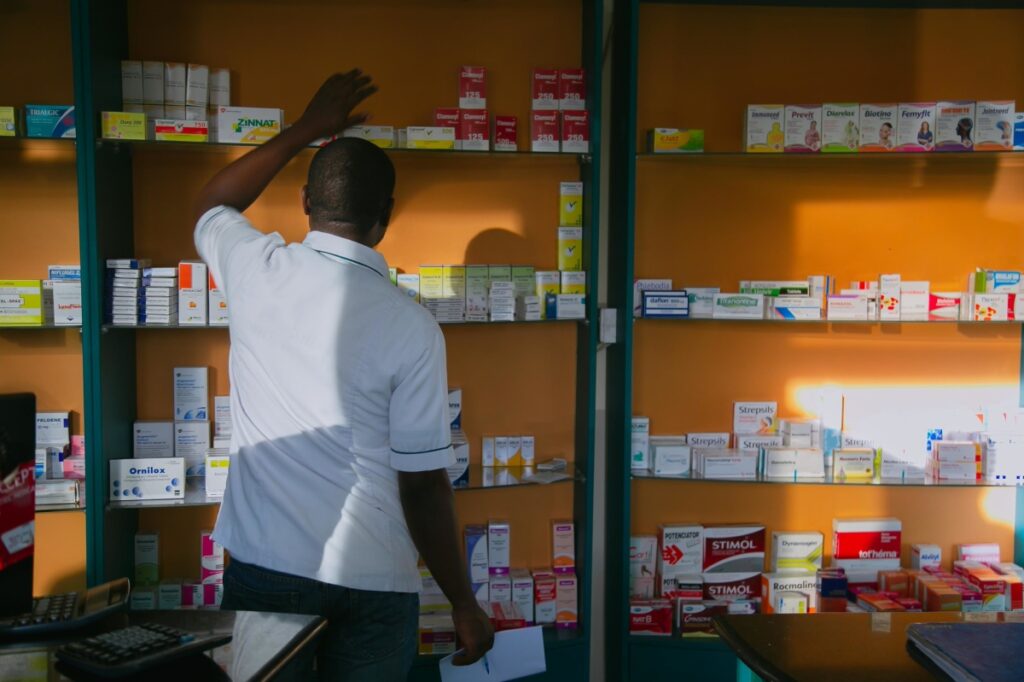
The New Times photo accompanying the 24 November report showed a pharmacist searching for medicines in Kisimenti, Kigali, a reminder that pharmacies are on the front line of controlling antibiotic sales.
As general background, pharmacists can refuse to sell antibiotics without a prescription, counsel patients on completing treatment and report suspected substandard products. Community pharmacies in Kigali and other cities are often the first stop for people seeking treatment for coughs, fevers and diarrhoea.
A continental challenge
Rwanda is not alone. Nigeria completed only 44 per cent of the activities in its first AMR action plan, and WHO’s Regional Director for Africa urged all 47 African member states this month to turn their plans into “adequately funded interventions with clear responsibilities and measurable results.” Kenya launched a new national AMR report on 18 November showing that 64 per cent of Acinetobacter isolates resist carbapenems, among the last effective antibiotics.
Bacterial AMR was associated with an estimated 4.7 million deaths globally in 2021, with sub-Saharan Africa having the highest AMR-associated death rates, according to WHO.
Health diplomacy at CPHIA
Separately, Prime Minister Justin Nsengiyumva met Gavi Chief Executive Dr Sania Nishtar and Global Fund Executive Director Peter Sands in Ethiopia, on the sidelines of the CPHIA 2026 conference, to discuss health cooperation, The New Times reported on 25 November. Details of the discussions were not available.
Gavi and the Global Fund are major funders of vaccines and of HIV, tuberculosis and malaria programmes in Rwanda, as general background, and both have faced funding pressure as global health aid declines.
Implementing the Rwanda AMR action plan will require sustained funding, stronger enforcement of prescription rules and affordable diagnostics, experts have said. HealthCoach Africa has explained the causes and impact of antimicrobial resistance in Africa.
Why it matters: Rwanda has a costed plan against drug resistance, but with only a third of past actions delivered, resistant infections could keep rising.
Rwanda Steps Up Fight Against Antibiotic Misuse With… KIGALI, RWANDA — Rwanda is tightening its response to antimicrobial resistance (AMR) through a new livestock law that turns the One Health approach into a legal duty, though experts say the Rwanda antibiotic misuse law…
How Misuse of Antibiotics Fuels Superbugs in Africa Antimicrobial resistance (AMR) is one of the biggest public health threats of the 21st century. Across the globe, the misuse and overuse of antibiotics have led to the rise of “superbugs” – bacteria, viruses, fungi,…
Pharmacist Urges Nigeria to Move From Planning to… LAGOS, NIGERIA — Nigeria must strengthen antimicrobial stewardship in Nigeria by enforcing rules on antibiotic sales and funding programmes that promote responsible use, pharmacist Folashade Lawal said in a lecture at the University of Lagos,…
Kenya Launches National AMR Report as Resistance to… NAIROBI, KENYA — Kenya has launched its Kenya national AMR report for 2026, along with new guidelines on surveillance in meat and farm biosecurity, as World AMR Awareness Week opened in Nairobi on 18 November, the…