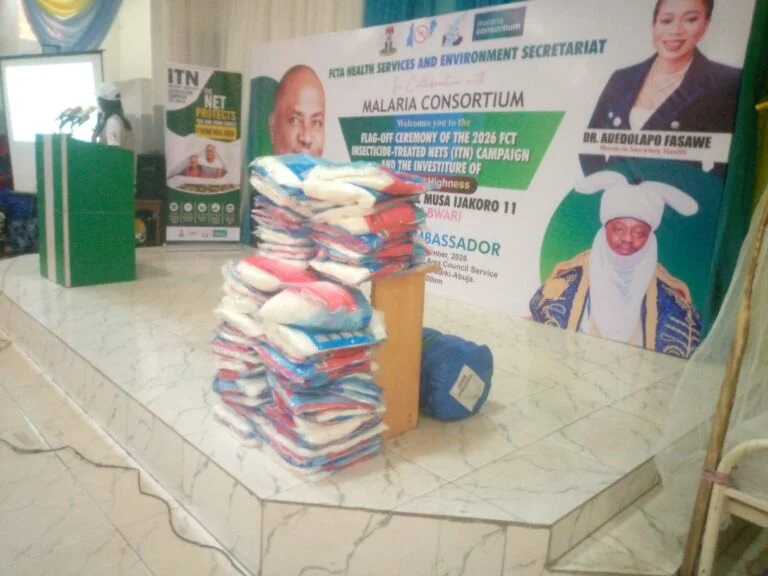
ABUJA, NIGERIA — The Federal Capital Territory Administration (FCTA) has launched an FCT mosquito net campaign to distribute 4.9 million insecticide-treated nets across the territory’s six area councils, the first mass net distribution in the FCT since 2011, the News Agency of Nigeria (NAN) reported on 15 November.
The 2026 Insecticide-Treated Nets campaign, run with Malaria Consortium, was inaugurated on Saturday. Alhaji Awwal Musa Ijakoro, the Sarkin Bwari, was invested as the FCT Mosquito Net Distribution Ambassador.
How the FCT mosquito net campaign will work
Dr Kolawole Maxwell, West and Central Africa Programme Director at Malaria Consortium, said nets will be distributed in Abaji, Kwali, Gwagwalada, Kuje, Bwari and the Abuja Municipal Area Council (AMAC), covering 62 wards through about 1,580 distribution hubs.
Dr Adedolapo Fasawe, Mandate Secretary of the FCTA Health Services and Environment Secretariat, spoke at the launch and set out the malaria burden the FCT mosquito net campaign is designed to reduce.
The National Malaria Elimination Programme, represented by Philip Okoro, put the campaign target at 4.8 million nets, slightly different from the 4.9 million figure in the headline announcement. Over 350 million nets have been distributed nationwide since Nigeria’s first mass campaign in 2009, but the FCT’s last mass distribution was in 2011, with no replacement campaign since, NMEP said.
That gap means many nets distributed in the past have long since worn out, torn or lost their insecticide, leaving households with little protection even where a net is still hanging.
Progress against malaria in the FCT
Malaria prevalence in the FCT has fallen from 18.8 per cent to 7.9 per cent, about half the national level, which has fallen from 22 per cent to 15.3 per cent, according to figures presented at the launch. “That means the progress is real, but it is fragile. We must protect it, and we must build on it,” he said.
Net coverage remains low. Fasawe said only about 22 per cent of residents had access to a net and 14 per cent of households slept under one.
Fasawe cited WHO’s World Malaria Report, which estimated about 282 million malaria cases worldwide in 2024, with Nigeria accounting for 68 million, or 24.3 per cent, and 30.3 per cent of global malaria deaths, mainly among children under five. In June, seasonal malaria chemoprevention reached 1,015,240 children in the FCT, she said.
“Chemoprevention protects the child. The net protects the whole household, every night, while everyone sleeps,” Fasawe said.
Why nets still matter
Insecticide-treated nets are among the most cost-effective malaria prevention tools. They protect people while they sleep, when malaria-carrying mosquitoes bite most, and reduce mosquito numbers when widely used in a community. Nets typically last about three years, which is why replacement campaigns are needed.
As general background, mass campaigns in Nigeria usually begin with household enumeration, when volunteers count the people in each home and issue a card, followed by distribution at fixed points where cards are exchanged for nets. Accurate counting is essential so that every sleeping space can be covered.
As general background, mosquito resistance to the insecticides used on older nets has spread in many parts of Nigeria, and newer nets combine two active ingredients to remain effective. The type of net used in a campaign can therefore affect how much protection it gives.
Malaria remains the leading cause of outpatient visits in many Nigerian health facilities, and severe malaria is a major cause of death among young children and of anaemia and complications in pregnancy.
The FCT includes fast-growing urban areas around Abuja and rural communities in councils such as Abaji, Kwali and Kuje, where access to health services can be limited and malaria transmission higher.
Abuja’s rapid population growth, including informal settlements on the edges of the city, also adds to the challenge. Many residents moved to the territory after the last mass distribution in 2011 and may never have received a free net, which makes the FCT mosquito net campaign an important chance to reach them.
Making nets count
For the campaign to succeed, households must hang nets correctly, sleep under them every night and avoid using them for fishing or farming. Community volunteers and leaders can encourage use, especially among pregnant women and children.
Nets work best alongside prompt testing and treatment of fever, seasonal chemoprevention for young children in eligible areas, malaria vaccines where available and clearing stagnant water around homes.
The FCT mosquito net campaign is the territory’s first mass distribution in 15 years, and its success will be judged by how many households are still sleeping under the nets months after the launch.
Why it matters: Malaria in the FCT has halved since 2021, but with few households owning enough nets, the gains could reverse without this campaign.
Kogi Begins Distributing 3.8 Million Mosquito Nets… LOKOJA, NIGERIA — Kogi State has launched Kogi mosquito net distribution of 3,810,985 insecticide-treated nets (ITNs) to 1,130,935 households across all 21 local government areas, and Malaria Consortium has named the state’s First Lady as…
Mosquito Control at Home: Protecting Your Family… Mosquitoes are more than a nuisance. In Nigeria, the Anopheles mosquito carries malaria, which kills many children every year. Other mosquitoes spread dengue, yellow fever and other infections. Much of the fight against mosquitoes happens…
Nigerians Still Pay 62% of Health Costs Out of… ABUJA, NIGERIA Nigeria out-of-pocket health spending fell from 71.7 per cent of total health expenditure in 2022 to 62.2 per cent in 2024, but households still pay most of the country’s health bill directly, officials…
Adamawa State Aims to Safeguard 388,180 Girls from… The Adamawa State Primary Healthcare Development Agency has embarked on a vital mission to vaccinate 388,180 girls aged nine to 14 against the Human Papilloma Virus (HPV). The overarching goal of this initiative is to…