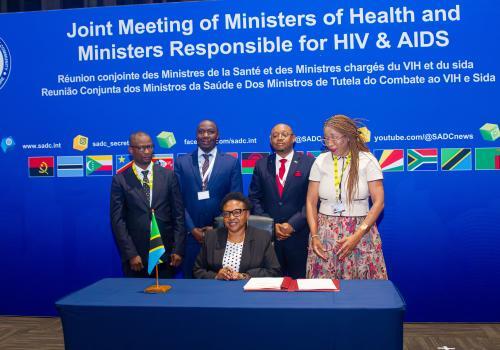
Southern African Development Community (SADC) health ministers have signed the charter establishing the SADC Pooled Procurement Services (SPPS), a step towards SADC pooled medicine procurement for the region, the SADC Secretariat said in a statement published by allAfrica on 13 November.
The charter was signed on 12 November during the meeting of SADC Ministers of Health in Durban, South Africa, which ran from 9 to 12 November. Tanzania was the first member state to sign, according to the statement.
The ministers’ meeting in Durban covered a range of regional health priorities, with the signing of the charter one of its main outcomes, the statement said.
What SADC pooled medicine procurement means
Pooled procurement allows several countries to buy medicines and health products together. As general background, combining orders can give countries greater bargaining power with manufacturers, lower prices, improved quality assurance and more reliable supply, particularly for smaller countries that buy in small volumes.
South Africa’s Deputy Minister of Health, Dr Joe Phaahla, said the region must take greater responsibility for its own health security. “Our future cannot rest on the goodwill of others alone,” he said, according to the statement.
SADC Executive Secretary Elias Magosi also addressed the meeting, the statement said.
SADC has 16 member states, ranging from large economies such as South Africa to small countries such as Eswatini, Lesotho and the island states, which as general background often pay higher prices because they buy small volumes.
Why it matters now
Many African countries depend on international partners and global procurement mechanisms for essential medicines, vaccines, HIV, tuberculosis and malaria commodities, and diagnostics. Recent cuts in donor funding have exposed the risks of that dependence and increased interest in regional solutions.
SADC pooled medicine procurement could help member states secure supplies of medicines for chronic conditions such as HIV, diabetes, hypertension and cancer, as well as products for maternal and child health.
As general background, stock-outs of essential medicines are common in many public health systems in the region, and pooled buying combined with better forecasting is one way to reduce them. Patients with chronic conditions are hit hardest when supply breaks down, because missed doses can lead to complications or, in the case of HIV, drug resistance.
As general background, SADC pooled medicine procurement has been discussed for many years, and the signing of the charter moves it from strategy towards a formal institution.
The African Union and Africa CDC have also promoted pooled procurement through the African Pooled Procurement Mechanism, alongside efforts to increase local manufacturing on the continent.
As general background, regional procurement within SADC could complement continental mechanisms, giving countries more than one route to secure quality medicines at lower prices. Coordination between the two will be important to avoid duplication.
Links to local manufacturing
Regional procurement can support African manufacturers by offering larger, more predictable orders. Manufacturers need stable demand to justify investment in new production lines and quality certification.
However, African drug makers face high costs. In Nigeria, local manufacturers have said power costs swallow a large share of revenue, as HealthCoach Africa has reported in coverage of Nigerian drug makers and power costs. Pooled procurement alone will not solve such constraints, but it can improve the business case for local production.
As general background, Africa imports most of the medicines it uses, and the continent’s leaders have set goals to increase the share produced locally. Pooled procurement that gives preference to quality-assured regional products is one of the tools discussed to support that goal.
Challenges ahead
As general background, pooled procurement schemes require countries to agree common standards for product registration, quality assurance and specifications, as well as reliable financing so that suppliers are paid on time. Differences in regulatory systems, currencies and payment capacity can slow implementation.
Regulatory harmonisation, such as joint assessments of medicines by regional regulators, can help products reach multiple markets faster.
The African Medicines Agency, which is being established to strengthen regulation across the continent, is expected to support such harmonisation over time, as general background.
Success will depend on how quickly other member states sign and ratify the charter, how the SPPS is financed and governed, and whether it can deliver lower prices and more reliable supply than countries achieve on their own. If it works, SADC pooled medicine procurement could become a model for other regional economic communities, including ECOWAS in West Africa.
Why it matters: Buying medicines together can lower prices and protect supply for southern Africa as donor funding declines and dependence risks grow.
Southern Africa partners with China to strengthen… JOHANNESBURG, SOUTH AFRICA — The Southern African Development Community (SADC), UNAIDS, and the Global Health Innovation Institute convened high-level pharmaceutical executives, health ministers, and investment leaders from August 31 to September 4, 2026. The strategic…
Mental Health Challenges in Nigeria: Funding,… The World Health Organization (WHO) has consistently emphasized the critical importance of mental health, making it a global concern for the past three years through their World Mental Health Day themes. In 2021, the WHO…
Africa Health Data Forum Opens in Nairobi as WHO… NAIROBI, KENYA The first Africa Health Data Forum opened in Nairobi on 10 November, bringing together more than 300 participants from 51 countries as the World Health Organization (WHO) reported that health information systems in…
Climate Crisis Is Now a Health Emergency of Pandemic… ANTALYA, TURKIYE The climate crisis health emergency has reached “pandemic proportions,” UN Climate Change Executive Secretary Simon Stiell said at the opening of the COP31 climate summit, as WHO Director-General Dr Tedros Adhanom Ghebreyesus warned…