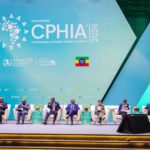
Africa must build an Africa HIV financing firewall funded from its own budgets after donor funding for HIV fell 25 per cent last year to its lowest level since 2007, the United Nations Economic Commission for Africa (UNECA) said at the CPHIA 2026 conference in Addis Ababa, in a statement issued on 26 November.
“Most African countries are renting the firewall, not owning it,” speakers said at a side event titled “Financing our own firewall.”
Building an Africa HIV financing firewall
Aboubakri Diaw, UNECA Chief of Staff and health financing lead, said more than 20 million Africans are on HIV treatment, and called for HIV to be built into national budgets and medium-term expenditure frameworks. “What the budget does not see, the budget does not protect,” he said, according to the statement.
“Treatment for life cannot be financed by a time-limited grant,” speakers said.
Diaw argued that HIV must be treated as a long-term public expenditure rather than a short-term project, so that medicines, testing and health workers are funded through national budgets year after year. As general background, integrating HIV into national health insurance schemes and primary health care is one way countries are trying to do this.
Debt service takes about 46 per cent of budgets in many African countries, and more than 32 African countries spend more on debt than on health, the statement said.
Those figures illustrate why building an Africa HIV financing firewall is difficult: governments face competing demands on limited revenue, and debt repayments leave less room for health. As general background, African finance ministers have called for debt relief and new financing tools to protect social spending.
Country examples
South Africa’s Health Minister Dr Aaron Motsoaledi said the country finances 90 per cent of its antiretroviral medicines domestically and has moved 62,000 key-population patients to 3,772 state clinics, according to UNECA.
Zimbabwe’s National AIDS Trust Fund, financed by a 3 per cent levy on income tax, raises about $80 million a year against a peak need of $430 million, the statement said. Zimbabwe has created more than 14,000 health worker posts and plans to move community health workers onto the government payroll by 2027.
Zimbabwe’s levy is often cited as an example of a dedicated domestic funding source for HIV, but the gap between its yield and the peak need shows that such mechanisms must be combined with other funding, as general background.
Other countries are watching such models closely.
Five Southern African Development Community states have signed a joint procurement work programme that could save $200 million to $300 million a year, according to UNECA. Africa produces only 1 to 3 per cent of its own medicines, the statement said.
Joint procurement allows countries to buy larger volumes at lower prices and with better quality assurance, as general background. Southern African health ministers signed a charter for a regional pooled procurement service in Durban earlier this month.
Why domestic HIV funding matters now
As general background, international donors, led by PEPFAR and the Global Fund, have paid for a large share of HIV medicines, testing, health workers and data systems in Africa for two decades. Cuts in US funding since 2025 and pressure on the Global Fund have left many countries with gaps in services.
Nigeria’s NACA will unveil a National HIV Domestic Resource Mobilisation and Sustainability Strategy on 1 December, and Lagos State has raised its HIV budget by 35 per cent and begun buying its own antiretroviral drugs. In South Africa, a 20-year study warns that progress against new infections has stalled as PEPFAR funding ends.
Local manufacturing could reduce costs and supply risks, but African producers face high costs, as HealthCoach Africa has reported on Nigerian drug makers and power costs.
What comes next
The statement was issued on the fourth day of CPHIA 2026, which closes on 27 November. As general background, health financing options discussed by African governments include earmarked health taxes, national health insurance, trust funds such as Zimbabwe’s, debt swaps and improving the efficiency of existing spending.
For the more than 20 million Africans on HIV treatment, an Africa HIV financing firewall built on predictable domestic funding would protect access to life-saving medicines regardless of donor decisions.
Advocates say the true test of the Africa HIV financing firewall will be whether HIV commitments appear in 2027 national budgets and are released on time.
Why it matters: With HIV aid at an 18-year low, millions of Africans on treatment depend on governments building HIV into their own budgets.
Africa’s Flagship Public Health Conference CPHIA… ADDIS ABABA, ETHIOPIA, The fifth International Conference on Public Health in Africa opened in Addis Ababa on Monday, 23 November, with CPHIA 2026 health sovereignty as its central theme, Fana Media Corporation reported, as African leaders…
CPHIA 2026 Delegates Call for Permanent Pandemic… ADDIS ABABA, ETHIOPIA, Speakers at the CPHIA 2026 conference in Addis Ababa have called for permanent pandemic preparedness Africa can sustain between outbreaks, rather than rebuilding emergency systems each time a new disease strikes, Africa…
Nigeria Issues Addis Ababa Travel Advisory After 16… Nigeria’s Ministry of Foreign Affairs has issued an Addis Ababa travel advisory after at least 16 Nigerians died from complications linked to the Ethiopian capital’s high altitude, Premium Times reported on 14 November. The Addis…
Global Health Funding Falls to Lowest Level Since… ACCRA, GHANA — Global health funding is estimated to fall to $42.6 billion in 2026, its lowest level since 2012, according to new estimates from the Institute for Health Metrics and Evaluation (IHME), reported by…