Almost everyone has been taught to look for a lump. That teaching is not wrong, but it is dangerously incomplete, because several of the early signs of breast cancer never involve a lump at all. Some of the most aggressive forms produce no mass that anyone can feel.
This is the gap that costs Nigerian women months. A woman notices her breast has become red and swollen, so she takes antibiotics. Another notices a scaly patch on her nipple, so she buys a cream. Both wait. Meanwhile the disease that caused the change keeps growing.
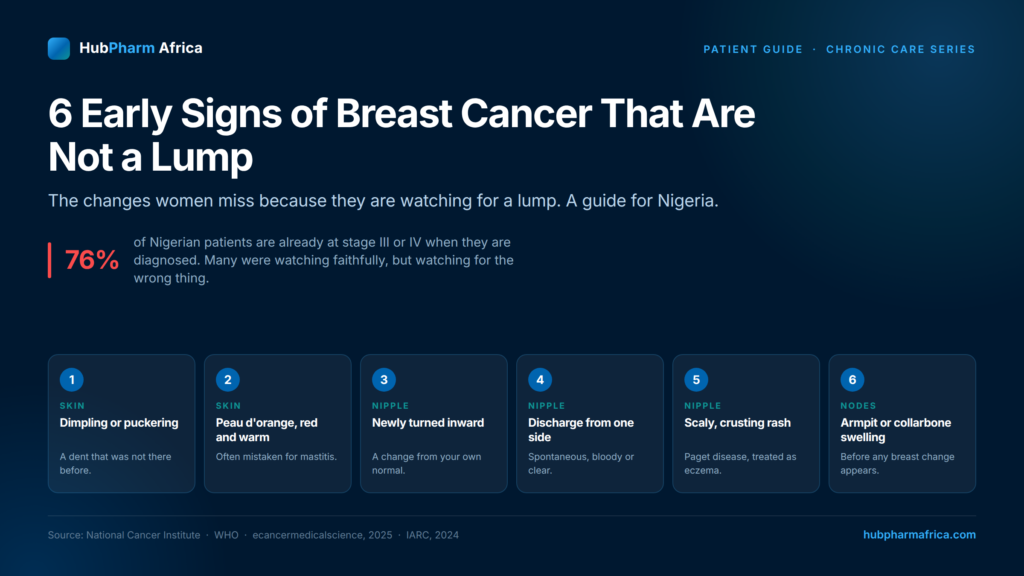
Here are six early signs of breast cancer worth knowing, what each one usually means, and when to stop waiting.
Why the early signs of breast cancer get missed
Breast cancer is the most common cancer in Nigerian women, with roughly 44,196 new cases and 21,309 deaths estimated for 2024. A 2025 review of Nigerian studies found that about 76 percent of patients had already reached stage III or IV by diagnosis.
Late presentation is usually explained by cost, distance or fear. Those matter. However, another cause gets far less attention: many women were watching for the wrong thing. They checked for lumps faithfully, found none, and felt reassured, because nobody had told them the early signs of breast cancer can look like nothing of the sort.
The National Cancer Institute is blunt about one form in particular. Inflammatory breast cancer, it notes, usually does not form a lump you can feel, and it usually cannot be seen on a mammogram either. So a normal self-check and even a normal scan can both miss it.
The 6 early signs of breast cancer that are not a lump
1. Skin dimpling or puckering
A small area of skin pulls inward, like a dent or a crease that was not there before. It often shows only in certain positions, which is why raising your arms while looking in the mirror matters when you check your breasts properly.
This happens because a tumour tethers the ligaments that run through the breast and drags the skin down with it. The dent is small, but the cause underneath rarely is.
2. Peau d’orange, especially with a red, warm, swollen breast
The skin thickens and the pores become prominent, so the surface looks and feels like orange peel. Doctors call it peau d’orange, and it comes from cancer cells blocking the lymph vessels in the skin.
When peau d’orange appears alongside a breast that turns red, warm, heavy and swollen over days or weeks, that combination is the classic picture of inflammatory breast cancer. It develops fast, it usually produces no lump, and it looks almost exactly like an infection. More on that below, because in Nigeria this is where most of the delay happens.
3. A nipple that has newly turned inward
A nipple that flattens, pulls inward or points in a different direction than it used to can signal a tumour pulling on the ducts behind it.
The word that matters is newly. Plenty of women have had inverted nipples since puberty, and that is simply their anatomy. A change from your own normal is the warning, not the inversion itself.
4. Discharge from one nipple, on its own
Fluid that appears without you squeezing, from one breast rather than both, and particularly if it is bloody or clear and watery, needs investigation.
By contrast, milky discharge from both breasts is usually hormonal and often relates to prolactin, medicines or pregnancy rather than cancer. So the pattern matters more than the presence of fluid. One side, spontaneous, and bloody or clear is the combination that should send you to a doctor.
5. A scaly, crusting or itchy rash on the nipple
Persistent flaking, crusting, itching or redness on the nipple and areola can be Paget disease of the breast. The National Cancer Institute notes that it looks very much like dermatitis or eczema, which is exactly why it gets creamed for months instead of biopsied.
Paget disease usually signals cancer underneath, either ductal carcinoma in situ or invasive disease, even when nothing abnormal can be felt in the breast. If a rash on one nipple has not cleared after a full course of treatment, that is the point to ask for a biopsy rather than a stronger cream.
6. Swelling in the armpit or above the collarbone
Sometimes the first thing anyone notices is a swollen lymph node in the armpit or just above the collarbone, before any change appears in the breast itself.
Swollen nodes have many innocent causes, including infection anywhere in the arm or chest. Even so, a node that persists for more than two or three weeks without an obvious infection deserves imaging.
What is usually not cancer
Fear stops women from looking at all, so this part matters too. Knowing the early signs of breast cancer also means knowing what is ordinary.
Nipples that have always been inverted are anatomy, not a symptom. Milky discharge from both breasts is usually hormonal. Breast tenderness that comes before your period and eases afterwards is your cycle. Smooth, rubbery lumps that move easily under the fingers are commonly fibroadenomas, and tender lumps that change through the month are often cysts.
None of that means ignore it. It means most findings turn out to be benign, so getting checked is far less frightening than most women expect.
Why these early signs of breast cancer get treated as something else here
Two patterns account for a great deal of lost time in Nigeria, and both begin with a reasonable diagnosis that happens to be wrong.
The antibiotic pattern. A woman presents with a hot, red, swollen breast. Mastitis and breast abscess are genuinely common, especially while breastfeeding, so she receives antibiotics. Sometimes she receives a second course, or the breast gets drained. Inflammatory breast cancer produces the same picture, and because antibiotics are easy to obtain without review, weeks can pass before anyone questions the diagnosis. This form of the disease moves quickly, so those weeks are expensive.
The cream pattern. A woman presents with a scaly, itchy nipple. It looks like eczema or ringworm, so she uses a steroid or antifungal cream, often bought over the counter. Paget disease responds to neither, but the itching may settle enough to feel like progress.
The rule that fixes both
If a breast infection has not clearly resolved after one full, properly taken course of antibiotics, or a nipple rash has not cleared after one full course of treatment, stop repeating the treatment. Ask for imaging and, where the change persists, a biopsy.
That single rule would catch a large share of the cases currently reaching hospital at stage III. Say it plainly to your doctor: this has not settled, and I would like it imaged.
What to do if you notice any of these
Any of the early signs of breast cancer above justifies a proper examination, so treat the following as one sequence rather than a menu.
Book an appointment within the week. Any hospital, clinic or family doctor can carry out a clinical breast examination and refer you onward.
Say what changed and when. Bring dates. “The redness started three weeks ago and has not improved on antibiotics” moves things faster than “my breast hurts”.
Ask for imaging. Doctors generally order ultrasound for women under 35 and mammography for women over 40. Ask directly whether the change needs a biopsy, since scans alone cannot rule cancer in or out.
Keep every result. Photograph each report and keep the originals together. You will be asked for them repeatedly.
If a diagnosis does follow, our companion guide sets out exactly what happens next, week by week through the first 30 days.
Common questions
Can you have breast cancer without a lump?
Yes. Several of the early signs of breast cancer involve no lump at all, including skin dimpling, peau d’orange, nipple changes and Paget disease. Inflammatory breast cancer in particular usually produces no palpable mass and frequently does not appear on a mammogram either.
How do I tell inflammatory breast cancer from mastitis?
You often cannot tell by looking, which is the problem. Both cause a red, warm, swollen, tender breast. The practical distinction is the response to treatment: mastitis improves on antibiotics within days, while inflammatory breast cancer does not. So if a full course brings no clear improvement, push for imaging rather than another course.
Is nipple discharge always serious?
No. Milky discharge from both breasts is usually hormonal and often relates to medicines, pregnancy or prolactin. The pattern that needs investigation is discharge from one breast that appears spontaneously, especially when it is bloody or clear and watery.
My nipple has always been inverted. Should I worry?
No. Long-standing inversion is simply your anatomy. A nipple that changes, flattening or turning inward when it never did before, is the warning sign.
Does breast pain mean cancer?
Usually not. Most breast pain is hormonal, affects both breasts and shifts with your cycle. However, pain that stays in one fixed spot month after month deserves examination, and cancer can be painless, so an absence of pain proves nothing either way.
Knowing the signs is the cheapest medicine there is
Recognising the early signs of breast cancer costs nothing and can save years. What it needs is the willingness to question a diagnosis that is not improving, which is often the harder part.
At HubPharm Africa we support patients through long-term treatment across Nigeria, with verified medicines, nationwide delivery, refill coordination and pharmacist-led adherence support. If you have noticed a change, or someone in your family has just been diagnosed, our pharmacists can help you work out the next step.
Written by Fawzi Rufai, Medically reviewed by Pharm. Sesan Kareem, B.Pharm, MPA, MBA.
This article is for general information and does not replace examination by a qualified health professional. See a doctor about any new breast change.
References
National Cancer Institute, Inflammatory Breast Cancer fact sheet.
National Cancer Institute, Paget Disease of the Breast fact sheet.
World Health Organization, Breast cancer fact sheet, Global Breast Cancer Initiative.
International Agency for Research on Cancer, Nigeria fact sheet, Global Cancer Observatory, 2024 estimates.
Nigeria’s 6-year (2018–2023) stage distribution of breast cancer at diagnosis. ecancermedicalscience, 2025.
Please follow and like us:
Views:176
Related Posts:
How to Check for Breast Cancer at Home: 5 Simple, Safe Steps Most Nigerian women who find breast cancer find it themselves. Not at a screening centre, and not during a routine check-up, but in the shower or while dressing. So learning how to check for breast…
Breast Cancer Warning Signs: What Every Woman Should Check Breast cancer is the most common cancer in Nigeria. Sadly, many women reach hospital only when the disease is advanced and harder to treat. Knowing the breast cancer warning signs, and acting on them quickly,…
Breast Cancer Screening in Nigeria: Where to Go and Costs Breast cancer screening in Nigeria confuses people for a simple reason: nobody tells you which test you need. A woman of 32 asks for a mammogram and is told she does not need one. A…
Bacterial Vaginosis Treatment Options: Restoring the Balance A thin, grey discharge with a fishy smell, especially after sex, is a common reason women visit a pharmacy. The cause is often bacterial vaginosis, or BV. It is the most common cause of unusual…