Breast cancer is the most common cancer in Nigeria. Sadly, many women reach hospital only when the disease is advanced and harder to treat. Knowing the breast cancer warning signs, and acting on them quickly, is one of the most powerful things you can do for your health. This guide explains what to look for, how to check your breasts and what happens when you see a doctor.
Why early detection changes everything
When breast cancer is found while it is small and still inside the breast, treatment is simpler and survival is high. Once it spreads to the bones, liver or lungs, it can be controlled but rarely cured. According to the World Health Organization, countries that improve early diagnosis save many lives, even before they add expensive new treatments.
In Nigeria, delay is often caused by fear, cost, belief in spiritual or herbal cures, and the idea that a painless lump is harmless. However, most breast cancers are painless in the early stages. Pain is not a reliable guide, and waiting for it to hurt wastes precious months.
Eight breast cancer warning signs
A lump is the best-known sign, but it is not the only one. See a doctor if you notice any of these changes in one breast or armpit:
A new lump or thickening in the breast or armpit that feels different from the surrounding tissue
A change in size or shape of one breast
Dimpling or puckering of the skin, sometimes looking like the skin of an orange
A nipple that turns inward when it used to point outward
Discharge from the nipple, especially if it is bloody or comes from one side only
Redness, scaling or crusting of the nipple or the dark area around it
Swelling of part or all of the breast, even without a lump you can feel
A sore or wound on the breast that does not heal
These breast cancer warning signs do not always mean cancer. Nevertheless, every one of them deserves a medical examination within two to three weeks.
Most lumps are not cancer, but every lump needs a check
Many breast lumps are harmless. Fibroadenomas, which are smooth and rubbery, are common in young women. Fluid-filled cysts often appear in the years before menopause. Breast infections cause pain, heat and redness, especially during breastfeeding.
Only a health professional can tell these apart from cancer, usually with a scan and sometimes a small sample of tissue. Therefore, do not decide for yourself that a lump is “just a gland” or “only hormones”. Get it checked, and if the first visit does not give a clear answer, ask for a referral.
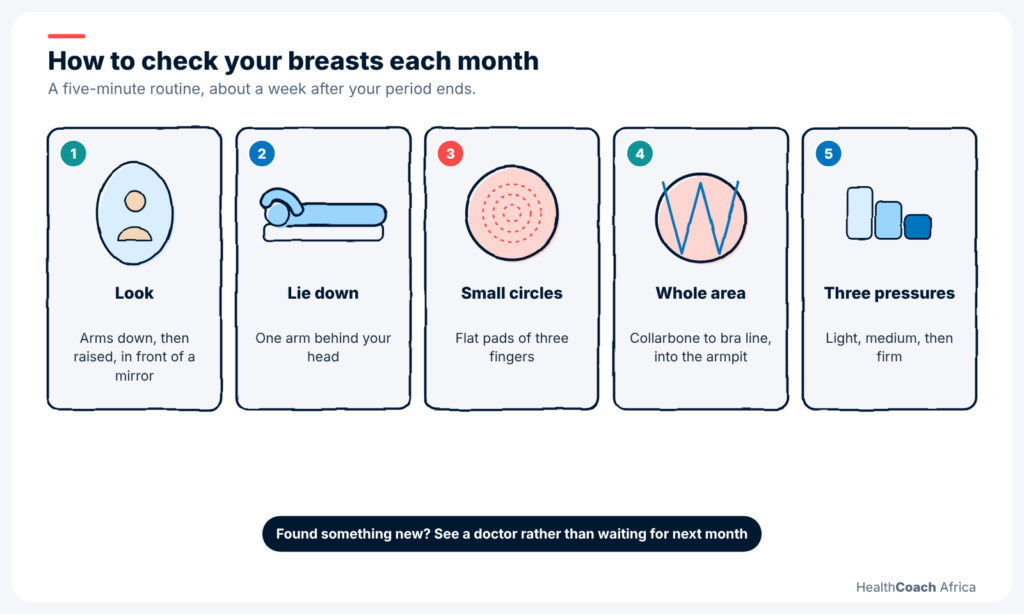
How to check your breasts each month
Breast self-examination will not prevent cancer. Its value is that it helps you learn what is normal for you, so that you notice changes early. Choose a regular day each month. If you still have periods, pick a day about a week after your period ends, when the breasts are least tender.
Look. Stand in front of a mirror with your arms by your sides, then raised above your head. Check for changes in size, shape, skin or nipples.
Feel lying down. Lie on your back with one arm behind your head. Use the flat pads of three fingers on the other hand to press in small circles.
Cover the whole area. Move from the collarbone to below the bra line, and from the middle of the chest into the armpit.
Use three levels of pressure. Press lightly, then medium, then firmly, to feel the skin, the middle tissue and the deeper tissue.
Check the nipples. Look for discharge or crusting, but do not squeeze them hard.
If you find something new, do not panic. Write down where it is and see a doctor rather than waiting for your next check.
Learn what is normal for you, so that any change stands out quickly.
Breast changes during pregnancy and breastfeeding
Pregnancy and breastfeeding change the breasts a great deal. They become larger, firmer and sometimes lumpy, and blocked milk ducts are common. These normal changes can hide breast cancer warning signs, and some women delay a check because they assume every lump is milk.
A blocked duct usually feels tender and improves within a few days of regular feeding and gentle massage. An infection, called mastitis, causes pain, heat, redness and often fever, and it needs prompt treatment. By contrast, a lump that stays the same or grows over two weeks, or redness that does not settle with antibiotics, should be checked with an ultrasound scan. Breast scans and biopsies are safe during pregnancy and breastfeeding.
Who is at higher risk?
Any woman can develop breast cancer, and men can too, although this is rare. The risk rises with age, but in Nigeria many women are diagnosed in their thirties and forties. Factors that raise risk include:
A mother, sister or daughter who had breast or ovarian cancer, especially at a young age
Inherited gene changes such as BRCA1 or BRCA2
Starting periods early or reaching menopause late
Having a first child after 30, or never breastfeeding
Obesity after menopause, lack of exercise and regular alcohol use
Previous radiotherapy to the chest
You cannot change some of these. However, staying active, keeping a healthy weight, limiting alcohol and breastfeeding where possible all lower the risk. Women with a strong family history should ask a doctor about earlier and more regular checks.
Screening: clinical examination and mammograms
Self-checks are useful, but they do not replace screening. A clinical breast examination by a trained nurse or doctor is quick, cheap and widely available. A mammogram is a low-dose X-ray that can find cancers too small to feel.
Guidelines differ between countries. In general, many recommend a mammogram every one to two years from around age 40 or 50, depending on your risk. Ask your doctor which plan suits you. Young women usually have an ultrasound scan instead, because their breast tissue is denser.
HUBPHARM PHARMACIST’S NOTE Hormone tablets 1 such as tamoxifen are usually taken for five years or more, and side effects like hot flushes are a common reason people stop early. Before you stop, talk to a HubPharm pharmacist. We can suggest ways to manage side effects and remind you about refills.
What happens when you see a doctor
Doctors use a “triple assessment” to check breast cancer warning signs. First, they examine your breasts and armpits. Next, you have an ultrasound scan, a mammogram or both. Finally, if anything looks suspicious, a needle takes a small sample of tissue for testing. This is called a biopsy.
Some people fear that a biopsy makes cancer spread. It does not. A biopsy is the only way to confirm the diagnosis and to learn the type of cancer, which guides treatment. Without it, doctors cannot plan the right care.
How breast cancer is treated
Treatment depends on the stage and type of cancer. Most women need a combination of:
Surgery to remove the lump or the whole breast, often with some lymph nodes from the armpit
Chemotherapy to shrink the tumour or destroy cells that may have spread
Radiotherapy to lower the chance of the cancer returning in the same area
Hormone tablets for cancers that grow in response to oestrogen, usually taken for five years or more
Targeted injections 2 for cancers with high levels of a protein called HER2
The full course can last many months. Missing doses of hormone tablets 3 because of side effects or cost is common, and it raises the risk of the cancer coming back. Speak to your care team or pharmacist before stopping any medicine.
Men can get breast cancer too
Men have a small amount of breast tissue, so they can also develop breast cancer. It is rare, but it is often found late because men do not expect it. The breast cancer warning signs in men are similar: a firm, painless lump behind the nipple, a nipple that turns in, discharge or a sore that will not heal. Men with a strong family history of breast cancer, or with a BRCA2 gene change, have a higher risk and should report any change promptly.
Myths that cost lives
“Only older women get breast cancer.” Many Nigerian women are diagnosed before 50, so age is no protection.
“A painless lump is nothing to worry about.” Early breast cancer is usually painless. That is exactly why breast cancer warning signs must be checked.
“Herbs can dissolve the lump.” No herb has been shown to cure breast cancer. Time spent on unproven remedies allows a curable cancer to grow.
Getting help
If you notice any of the breast cancer warning signs, book an appointment at a general hospital, a teaching hospital or a cancer screening centre. To learn more about related conditions, browse our cancer care articles.For confidential questions about your medicines or test results, message a HubPharm pharmacist or chat with Afiya on WhatsApp in your own language.
Medicines and products in this article
#
Medicine or product
What to know
1
Tamoxifen
Prescription only
Hormone tablet for oestrogen-sensitive breast cancer, usually taken daily for five years or more. Hot flushes are common.
2
Trastuzumab
Prescription only, keep refrigerated
Targeted injection for HER2-positive breast cancer, given in hospital. It must be kept cold from the supplier to the clinic.
3
Letrozole or anastrozole
Prescription only
Hormone tablets used mainly after menopause. They can cause joint aches and thinning of the bones, so bone health is monitored.
To order any of these, or to ask a pharmacist a question first, message HubPharm on WhatsApp or visit hubpharmafrica.com. Prescription medicines are supplied against a valid prescription.
How to Check for Breast Cancer at Home: 5 Simple, Safe Steps Most Nigerian women who find breast cancer find it themselves. Not at a screening centre, and not during a routine check-up, but in the shower or while dressing. So learning how to check for breast…
Breast Cancer Screening in Nigeria: Where to Go and Costs Breast cancer screening in Nigeria confuses people for a simple reason: nobody tells you which test you need. A woman of 32 asks for a mammogram and is told she does not need one. A…
Diabetes in Nigeria: Why Blood Sugar Control Fails Diabetes in Nigeria does not usually fail in the clinic. Among people who reach a specialist and stay in care, control is often reasonable. It fails in the years before anyone tests you, and it…
6 Early Signs of Breast Cancer That Are Not a Lump Almost everyone has been taught to look for a lump. That teaching is not wrong, but it is dangerously incomplete, because several of the early signs of breast cancer never involve a lump at all.…