Diabetes in Nigeria does not usually fail in the clinic. Among people who reach a specialist and stay in care, control is often reasonable. It fails in the years before anyone tests you, and it fails in the quiet decisions made at home afterwards: the tablet stopped because it upset your stomach, the herbal mixture taken instead of the prescription, the strips you could not afford so you stopped checking.
This guide names those failure points, because they are specific and fixable. It also covers the complication that takes more Nigerian limbs than any other, and the six week delay that makes it possible.
Not sure where you stand? Take the free two minute Diabetes Risk Test before you read on.
What the numbers say about diabetes in Nigeria
A 2024 systematic review pooling 60 studies and 124,876 participants put prevalence at 7.0 percent of adults, roughly 8 million people. That is nearly double the 3.7 percent the International Diabetes Federation estimated in 2019.
Prevalence of diabetes in Nigeria varies enormously by zone.
Zone
Prevalence
South South
11.35 percent
North West
8.49 percent
North Central
2.03 percent
Now the more interesting figure. A 2024 study of 1,030 adults across five facilities in Enugu State found that 67.8 percent had good glycaemic control, meaning HbA1c below 7 percent.
Read that carefully, because it is not a national control rate. Those were people already attending specialist clinics, which means they had been diagnosed, had reached care and had stayed in it. For them, treatment largely works.
The losses happen to everyone else. That is what makes diabetes in Nigeria a different problem from hypertension, where the collapse sits between being treated and being controlled. Here, the collapse sits before diagnosis and around complications.
Why treatment for diabetes in Nigeria stops working
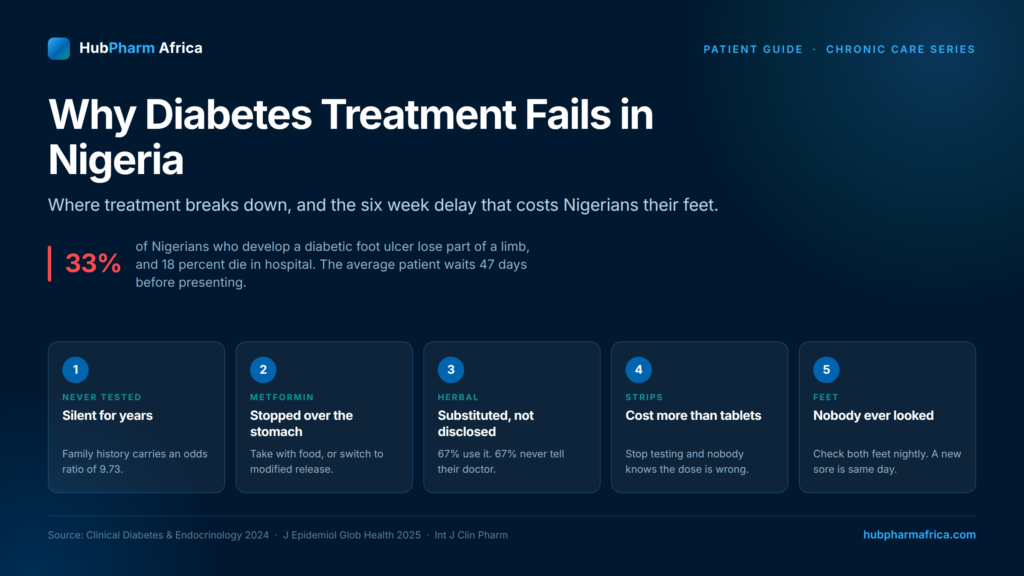
1. Nobody ever tested you
Type 2 diabetes causes no symptoms for years. By the time thirst, weight loss and frequent urination appear, the condition is usually well established, and damage to nerves, kidneys and eyes may already have begun.
The strongest single risk factor in the Nigerian data is a family history of diabetes, which carried an odds ratio of 9.73. Physical inactivity, urban living, a BMI above 25 and abdominal obesity all raise it further. If any of those describe you, a test is overdue.
2. Metformin upset your stomach and you stopped
Metformin commonly causes nausea, diarrhoea and abdominal discomfort, particularly in the first few weeks. Most people are never warned, so they conclude the drug does not suit them and stop it without telling anyone.
Nearly always this is solvable. Take it with or just after food, start low and increase slowly, or switch to the modified release form, which is considerably gentler. Almost nobody needs to abandon metformin over this.
3. Herbal medicine replaced the tablets instead of sitting alongside them
This is the largest and least discussed problem in Nigerian diabetes care, and the numbers are striking.
A study of 453 people with type 2 diabetes across five secondary facilities in Lagos found that 67.3 percent used herbal medicine, most commonly bitter leaf, moringa, scent leaf and akuamma. More importantly, 67.5 percent of those users never told their doctor. A systematic review across Africa found the same pattern, with non-disclosure between 63.8 and 91.3 percent.
So roughly two thirds use it and roughly two thirds hide it. The harm is rarely the plant itself. The harm is substitution, and silence. People stop metformin, feel completely well for months because high blood sugar is silent, and return later with an infected foot or in ketoacidosis.
Tell your pharmacist what you take. Nobody will scold you, and some preparations genuinely interact with prescribed medicines.
4. The strips cost more than the tablets
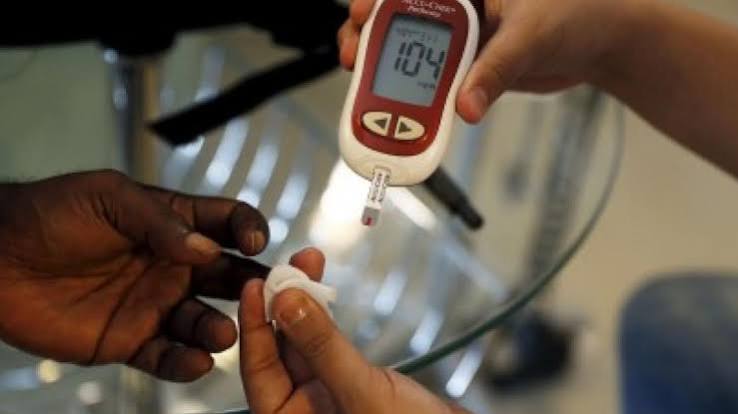
Metformin is comparatively cheap. Test strips are not, and they are the item people quietly stop buying first. Without readings, neither you nor your doctor knows whether the regimen works, so a dose that was never adequate can run for years.
If cost is forcing a choice, say so out loud rather than rationing silently. Testing less often but consistently, at agreed times, is far better than testing randomly until the strips run out and then not at all.
5. You ran out, and refilling slipped
The commonest failure and the least dramatic. The tablets finish, the pharmacy is out of stock, money is tight that week, and a month disappears. Every gap lets blood sugar climb back, and the damage of those gaps accumulates silently over years.
6. Nobody ever looked at your feet
Most people with diabetes in Nigeria have never been taught to check their feet, and most have never had a health worker examine them. That omission is what the next section is about.
The complication that takes limbs
A 2025 systematic review and meta-analysis of 18 Nigerian studies covering 2,616 patients found the following among people who developed a diabetic foot ulcer.
Outcome
Pooled figure
Foot ulcer prevalence among Nigerian diabetes patients
16.69 percent
Amputation
33.27 percent
Death in hospital
17.75 percent
Average time before presenting
46.65 days
One in three loses part of a limb. Nearly one in five dies. And the average person waited more than six weeks before coming in.
That delay is the whole tragedy of diabetes in Nigeria, because it is the one part that costs nothing to fix. Nerve damage removes pain, so a wound that would have anyone else limping to a hospital goes unnoticed inside a shoe. By the time it smells or spreads, the decision has narrowed to surgery.
So do this tonight, and every night. Look at both feet, including between the toes and the soles, using a mirror or asking someone if you cannot see them. You are looking for any sore, blister, crack, colour change or hot swollen area. Anything new goes to a health worker the same day, not after salt water, hot water or a local remedy. Never walk barefoot, and check inside your shoes before putting them on.
What actually works for diabetes in Nigeria
Attach the dose to something you already do
Habit beats willpower and beats phone reminders. Tie metformin to a meal you never skip, since it should be taken with food anyway.
Buy for three months, not for a week
Weekly buying is how gaps happen, and buying in small quantities usually costs more per tablet. A three month supply removes the commonest cause of treatment failure and protects you from the week when money is short.
Know your HbA1c, not just your meter
A finger prick tells you about this moment. HbA1c tells you about the last three months, and it is the number your treatment is actually judged on. Ask for it, write it down, and ask what your personal target is.
Check your feet daily and your blood pressure regularly
Diabetes and high blood pressure travel together, and the combination drives kidney disease, heart attack and stroke far harder than either alone. If you have one, you should know your numbers for the other.
Tell your pharmacist everything you take
Herbal preparations, supplements, painkillers, anything a relative recommended. This is the single most useful sentence you can say in a pharmacy, and two thirds of Nigerian patients never say it.
What good control actually looks like
Your doctor sets your target, and it is individualised. For many non-pregnant adults it sits around HbA1c below 7 percent, with fasting glucose roughly 4.4 to 7.0 mmol/L and readings under about 10 mmol/L two hours after eating.
Older adults, people who live alone, and anyone prone to hypoglycaemia are often given a slightly higher, safer target deliberately. Tighter is not automatically better, particularly on glibenclamide, which causes more low blood sugar than newer agents and needs real care during Ramadan or any period of fasting.
Judge yourself on a pattern over weeks rather than any single reading.
When to seek help immediately
Go to a hospital straight away for any of these.
Vomiting with very high sugar, deep rapid breathing, a fruity smell on the breath, or drowsiness and confusion
A new sore, blister, black area or hot swollen foot, especially with fever
Severe low blood sugar, meaning confusion, fitting, or someone unable to swallow safely
Chest pain, sudden weakness on one side, slurred speech or sudden vision change
For a mild low, meaning shakiness, sweating and hunger while still able to swallow, take about 15 grams of fast sugar such as three teaspoons of sugar or half a bottle of a soft drink, wait 15 minutes and recheck, then eat something more substantial.
Common questions
Can diabetes in Nigeria be cured?
Type 2 diabetes can go into remission in some people after substantial weight loss, meaning normal readings without medication, and that is worth pursuing with your doctor. It is not the same as a cure, because the tendency remains and readings can rise again. No herbal preparation cures diabetes, and anyone selling one is selling something.
How common is undiagnosed diabetes in Nigeria?
Commoner than most people assume. Prevalence has roughly doubled since 2019 and type 2 diabetes produces no symptoms for years, so a large share of the 8 million have never been tested. If you have a family history, carry extra weight around the middle, or are over 40 and inactive, get a fasting glucose or HbA1c.
Is bitter leaf or moringa useful?
Some plants have modest evidence of a blood sugar lowering effect, and none approaches what metformin or insulin does. The danger is substitution rather than the plant. Use them if you wish, keep taking your medicine, and tell your pharmacist, because some interact with prescribed drugs.
Do I have to take metformin forever?
Often yes, though doses change and some people reduce or stop under supervision after sustained weight loss. That decision belongs to your doctor, and normal readings on treatment are evidence the treatment is working rather than evidence you no longer need it.
How often should I check my blood sugar?
It depends on your regimen. People on insulin or sulfonylureas need to check more often than people on metformin alone. Agree a schedule with your pharmacist or doctor that fits what you can afford, then keep to it consistently.
Can I fast during Ramadan?
Many people with diabetes can, with planning. Doses and timings usually need adjusting, particularly on sulfonylureas or insulin, and some people are advised not to fast at all. Have that conversation several weeks beforehand rather than the night before.
I feel completely fine. Do I really need treatment?
Yes. Feeling well is the normal experience of high blood sugar for years, which is exactly why the damage accumulates unnoticed. The absence of symptoms is not evidence of control.
Diabetes in Nigeria is lost between appointments, not in them
The evidence points somewhere specific and slightly hopeful. People who get diagnosed, reach care and stay in it do reasonably well. What breaks is everything around that: the test never taken, the metformin stopped in silence, the herbal mixture nobody mentioned, the month without tablets, the foot nobody looked at.
Every one of those is a supply and follow-through problem, and that is exactly the work HubPharm Africa does. We source verified medicines, deliver them across Nigeria, coordinate refills so treatment never lapses, and put a pharmacist on the phone when a side effect appears or you want to check whether something is safe to take alongside your tablets. Across our programmes we have seen a 42 percent improvement in medication adherence and 95 percent patient satisfaction.
Managing diabetes in Nigeria is mostly a logistics problem wearing a clinical costume. Start with the free Diabetes Risk Test if you have not been checked. If you are already on treatment and keep running out, talk to our care team about a supply plan.
Written by Fawzi Rufai, Medically reviewed by Pharm. Sesan Kareem, B.Pharm, MPA, MBA.
This article is for general information and does not replace advice from your own doctor or pharmacist. Never start, change or stop diabetes medication without speaking to them first.
References
A systematic review and meta-analysis of the prevalence and risk factors of type 2 diabetes mellitus in Nigeria. Clinical Diabetes and Endocrinology, 2024.
Sociodemographic predictors of glycaemic control among adults with type 2 diabetes mellitus in a Nigerian population. BMC Public Health.
Epidemiology and Outcome of Diabetic Foot Ulcers in Nigeria: A Systematic Review and Meta-analysis of 2 Decades, 2005 to 2024. Journal of Epidemiology and Global Health, 2025.
Herbal medicine use among Type 2 diabetes mellitus patients in Nigeria: understanding the magnitude and predictors of use. International Journal of Clinical Pharmacy, 2018.
Prevalence and predictors of traditional medicine use among persons with diabetes in Africa: a systematic review. International Health, 2024.
International Diabetes Federation, Diabetes Atlas.
World Health Organization, HEARTS-D module for diagnosis and management of type 2 diabetes.
Please follow and like us:
Views:173
Related Posts:
Metformin Side Effects: What Is Normal and What Is Not Most people meet metformin side effects in the first fortnight, decide the drug does not agree with them, and stop it without telling anyone. That decision is usually wrong, and it is almost always avoidable,…
Nigerian Diet for Diabetes: A Practical Guide to Eating Well A diagnosis of diabetes often comes with a long list of foods you are told to stop eating. Many people believe they must give up eba, rice, yam and plantain for ever. That is not…
Living With Heart Failure: A Daily Guide for… Heart failure does not mean that the heart has stopped or is about to stop. It means that the heart is not pumping blood around the body as well as it should. It is a…
High Blood Pressure in Nigeria: Why Treatment Stops Working Most people who lose control of high blood pressure in Nigeria were never lost to the health system. They were diagnosed. They collected a prescription. Many even took the tablets for a while. Then something…