Most people meet metformin side effects in the first fortnight, decide the drug does not agree with them, and stop it without telling anyone. That decision is usually wrong, and it is almost always avoidable, because the effect that drives it settles or responds to a simple change.
There is also a second problem, quieter and far more serious, which almost nobody in Nigeria is warned about. This guide covers both: the stomach upset that passes, the vitamin deficiency that can be mistaken for nerve damage, and the rare complication worth understanding rather than fearing.
What metformin side effects look like in the first weeks
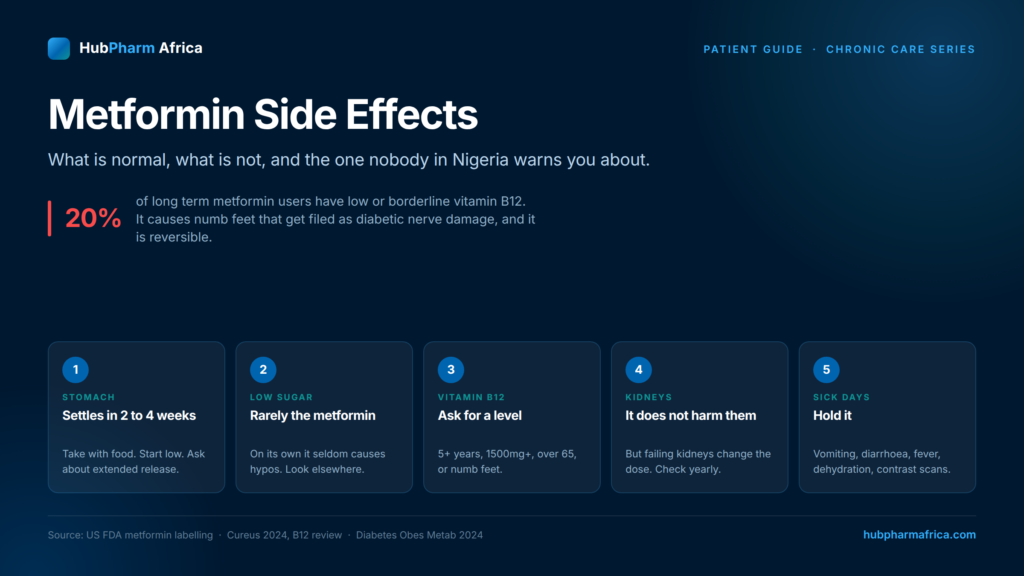
Nausea, diarrhoea, a metallic taste, loss of appetite and abdominal discomfort are the common ones. They usually appear within days of starting or of a dose increase, and in most people they settle within two to four weeks.
These metformin side effects happen because the drug acts largely in the gut, changing how the intestine handles glucose and bile acids. It is a local irritation rather than a sign the drug is damaging anything.
Five things that fix it, in order of what to try first
Take it with food, or immediately after. Never on an empty stomach. This alone resolves most cases.
Start low and climb slowly. Beginning at 500mg once daily and increasing every one to two weeks is far better tolerated than starting at a full dose.
Switch to the extended release form. Metformin XR or MR releases the drug gradually and is considerably gentler on the gut. Where cost allows, this is the single most effective fix for persistent diarrhoea.
Split the dose. Two smaller doses with meals often beat one large one.
Give it time. If it is improving week on week, it will usually finish improving.
Almost nobody needs to abandon metformin over stomach upset. If you have tried the first four and it has not settled after a month, that is a conversation about switching, not a reason to stop quietly.
The metformin side effects people expect but do not get
Metformin alone rarely causes low blood sugar
This surprises people. Metformin does not push insulin out of the pancreas, so on its own it very seldom causes hypoglycaemia. If you are having lows, the usual culprits are glibenclamide, gliclazide or insulin, taken alongside it.
That matters practically. If you are on metformin only and you feel shaky and sweaty, do not assume it is your sugar. Check if you can, and mention it, because something else may be going on.
It does not cause weight gain
Metformin is weight neutral and often causes modest weight loss. It is one of the reasons it remains first line.
It does not damage the kidneys
This is the most persistent myth in Nigerian practice and it is worth stating plainly. Metformin does not cause kidney disease. What is true is that failing kidneys clear metformin poorly, so the dose has to change when kidney function falls. The direction of cause runs the opposite way to the way people assume.
The metformin side effect nobody in Nigeria warns you about
This is the section to read twice.
Long term metformin use lowers vitamin B12. Large trials in the United States found deficiency or borderline levels in 19 to 20 percent of metformin users after five to thirteen years, against 9 to 16 percent of people not taking it. Across all published studies the range runs from about 4 percent to 41 percent depending on the population.
Metformin appears to interfere with calcium-dependent absorption of B12 in the last part of the small intestine, and may also reduce intrinsic factor and alter gut bacteria.
Here is why it matters far more in Nigeria than the international pages suggest.
B12 deficiency causes peripheral neuropathy. Numbness, tingling, burning and pins and needles in the feet. Those are exactly the symptoms of diabetic neuropathy, so they get attributed to diabetes, written off as inevitable, and never investigated.
But B12 deficiency is reversible and diabetic nerve damage largely is not. And numb feet are precisely how a foot ulcer goes unnoticed for the 47 days that Nigerian data says people wait before presenting, in a country where a third of those ulcers end in amputation.
So a treatable vitamin deficiency can be quietly filed as untreatable nerve damage, and the feet pay for it.
Who should ask for a B12 level
Ask your doctor to check it if any of these apply:
You have taken metformin for five years or more
Your daily dose is 1,500mg or above
You are 65 or older
You have been on an acid reducing medicine such as omeprazole for a year or more
You already have numbness, tingling or burning in your feet or hands
You have unexplained tiredness or anaemia
Do not stop metformin over this. The correct response is to check the level and supplement if it is low, while continuing the medicine, because metformin’s benefits are substantial and B12 is easy to replace.
Metformin lactic acidosis, the rare one worth understanding
Lactic acidosis is the serious complication attached to metformin, and it is genuinely rare. The FDA puts it at roughly 0.03 cases per 1,000 patient years, meaning about three cases per 100,000 people treated for a year. In clinical trials covering more than 20,000 patient years, there were none at all.
Of all metformin side effects this is the one people have heard of, and it matters not because it is common but because it is largely avoidable, and avoiding it is about knowing when to pause the drug.
When to hold metformin temporarily
Stop taking it and contact your doctor or pharmacist if any of these happen.
Vomiting or diarrhoea severe enough to leave you dehydrated, from any cause
A serious illness with fever, particularly with poor fluid intake
Before a scan using contrast dye, and before most surgery
Any condition causing very low oxygen or severe infection
These are sometimes called sick day rules, and they exist because dehydration and illness reduce kidney clearance, which is what allows metformin to accumulate.
Kidney function decides the dose
Metformin is cleared by the kidneys, so your dose depends on your eGFR. Broadly, it is used normally above 45, reviewed and often reduced between 30 and 45, and stopped below 30. Your doctor should check kidney function at least yearly, and more often if it is borderline.
Go to a hospital urgently if you develop deep rapid breathing, severe weakness, muscle pain, unusual drowsiness or vomiting with abdominal pain, especially during an illness.
Which metformin side effects mean carry on, and which mean act
Effect
What it usually means
What to do
Nausea or diarrhoea in the first weeks
Expected, usually settles
Take with food, carry on, mention at next visit
Metallic taste
Common, harmless
Carry on
Diarrhoea persisting past a month
Formulation problem
Ask about extended release
Numbness or tingling in the feet
Could be B12, not just diabetes
Ask for a B12 level
Unexplained tiredness or anaemia
Could be B12
Ask for a B12 level
Shakiness and sweating on metformin alone
Rarely the metformin
Report it, look for another cause
Vomiting or diarrhoea with dehydration
Hold the drug
Stop, rehydrate, contact your pharmacist
Deep rapid breathing, severe weakness, muscle pain
Possible lactic acidosis
Emergency, go to hospital now
Common questions
Do metformin side effects mean the drug is working?
No. There is no relationship between how rough the first fortnight feels and how well your blood sugar comes down. People with no symptoms at all are getting the full benefit.
How long do metformin side effects last?
Stomach effects usually settle within two to four weeks of starting or of a dose increase. If they are still there after a month, the answer is a change of formulation or dose rather than more patience.
Is extended release metformin worth the extra cost?
For someone who cannot tolerate the standard form, yes. It is markedly gentler on the gut and it is the difference between staying on treatment and stopping. For someone with no symptoms, the standard form is fine.
Can I take metformin at night instead?
Many people do, particularly with the extended release form, which is often taken with the evening meal. Consistency matters more than timing.
Does metformin damage the liver or kidneys?
No. It does not cause kidney or liver disease. It is cleared by the kidneys, so the dose changes if kidney function declines, and it is avoided in significant liver disease. Those are precautions, not evidence of harm.
Should everyone on metformin take a B12 supplement?
Not automatically. The sensible approach is to check the level in people at higher risk, meaning long duration, higher dose, older age, acid reducing medicines or existing nerve symptoms, then supplement if it is low. Ask rather than self-prescribe.
I stopped metformin months ago because of my stomach. What now?
Go back and say exactly that. Untreated diabetes is doing quiet damage in the meantime, and the fix for what happened to you is usually a smaller starting dose or the extended release form. Nobody will scold you.
Nobody should lose treatment, or a foot, over a fixable problem
Almost every one of the metformin side effects on this page has an answer that keeps you treated, and none of them is a good reason to face diabetes untreated. The stomach upset settles or responds to a change of formulation. The B12 problem is found with one blood test and fixed with a supplement. Lactic acidosis is rare and largely prevented by knowing when to pause.
What is not fixable is the silence. A person who stops metformin without telling anyone leaves the diabetes untreated, and a person whose numb feet are filed as inevitable stops looking at them.
At HubPharm Africa our pharmacists are reachable exactly at those moments. We source verified medicines, deliver them across Nigeria, coordinate refills so treatment does not lapse, and talk through side effects before they become a reason to quit. Across our programmes we have seen a 42 percent improvement in medication adherence and 95 percent patient satisfaction.
If metformin is not sitting right with you, speak to us before you stop it.
Written by Fawzi Rufai, Medically reviewed by Pharm. Sesan Kareem, B.Pharm, MPA, MBA.
This article is for general information and does not replace advice from your own doctor or pharmacist. Never start, change or stop metformin without speaking to them first.
References
Vitamin B12 Deficiency in Patients Taking Metformin: Pathogenesis and Recommendations. Cureus, 2024.
United States Food and Drug Administration, metformin labelling and safety communications, including revised renal function recommendations.
Optimizing metformin therapy in practice: tailoring therapy in specific patient groups to improve tolerability, efficacy and outcomes. Diabetes, Obesity and Metabolism, 2024.
Epidemiology and Outcome of Diabetic Foot Ulcers in Nigeria: A Systematic Review and Meta-analysis of 2 Decades, 2005 to 2024. Journal of Epidemiology and Global Health, 2025.
World Health Organization, HEARTS-D module for diagnosis and management of type 2 diabetes.
Please follow and like us:
Views:116
Related Posts:
Diabetes in Nigeria: Why Blood Sugar Control Fails Diabetes in Nigeria does not usually fail in the clinic. Among people who reach a specialist and stay in care, control is often reasonable. It fails in the years before anyone tests you, and it…
Blood Pressure Medication Side Effects and What to Do Most people never tell anyone about their blood pressure medication side effects. They notice their ankles have swollen, or that a dry cough has not gone away since February, and they draw the obvious conclusion:…
High Blood Pressure in Nigeria: Why Treatment Stops Working Most people who lose control of high blood pressure in Nigeria were never lost to the health system. They were diagnosed. They collected a prescription. Many even took the tablets for a while. Then something…
Normal Blood Sugar Levels: What Your Numbers Mean Someone checks your sugar at a chemist, reads out a number, and either looks worried or does not. Nobody explains which test it was, which units it is in, or what the threshold actually is.…