Someone checks your sugar at a chemist, reads out a number, and either looks worried or does not. Nobody explains which test it was, which units it is in, or what the threshold actually is. So you go home with a figure and a feeling.
This guide fixes that. It sets out what normal blood sugar levels are across all four tests people casually call “blood sugar”, gives every threshold in both mmol/L and mg/dL, and explains what to do at each level. It also covers the reason two websites can look at the same result and disagree.
What counts as normal blood sugar levels
These are the internationally used diagnostic thresholds for normal blood sugar levels and everything above them. They apply to someone being tested, not to someone already on diabetes treatment, whose targets are different and appear further down.
Test
Normal
Prediabetes
Diabetes
Fasting glucose
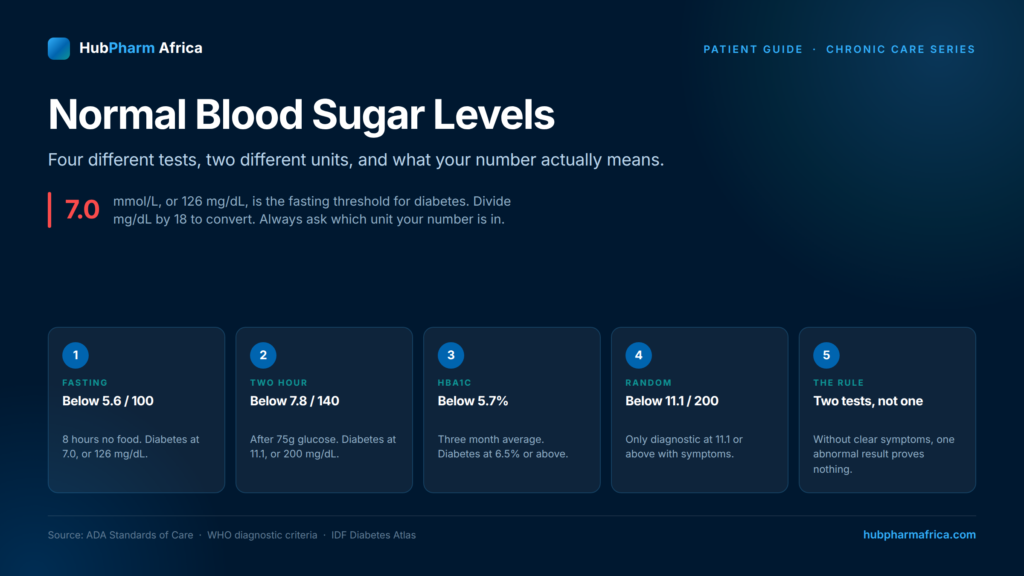
Below 5.6 mmol/L (100 mg/dL)
5.6 to 6.9 (100 to 125)
7.0 or above (126 or above)
Two hours after 75g glucose
Below 7.8 mmol/L (140 mg/dL)
7.8 to 11.0 (140 to 199)
11.1 or above (200 or above)
HbA1c
Below 5.7 percent
5.7 to 6.4 percent
6.5 percent or above
Random glucose
Below 11.1 mmol/L (200 mg/dL)
Not used
11.1 or above with symptoms
Two rules govern that table.
First, one abnormal result is not a diagnosis. Without clear symptoms of high blood sugar, two abnormal tests are required before anyone says you have diabetes. A single high reading after a bowl of jollof is not a diagnosis.
Second, the test has to match the threshold. Comparing a random reading against a fasting cut-off is the commonest mistake made in Nigerian pharmacies and it manufactures panic in people who are perfectly well.
Why normal blood sugar levels differ depending on who you ask
Here is the part that explains the contradictory advice online.
The American Diabetes Association puts the bottom of the prediabetes range at a fasting glucose of 5.6 mmol/L, or 100 mg/dL. The World Health Organization sets it higher, at 6.1 mmol/L, or 110 mg/dL, and calls the band impaired fasting glucose.
So a fasting result of 5.8 mmol/L is prediabetes by American criteria and entirely normal by WHO criteria. Your arteries did not change. The label did.
WHO has also been more cautious about using HbA1c to define prediabetes at all, while the American band of 5.7 to 6.4 percent is widely quoted online.
What to do with that. Ask which criteria your laboratory reports against, and take your doctor’s interpretation over any website, this one included. The practical advice at the borderline is identical under both systems: change what you can change, and retest.
The four tests people all call “blood sugar”
Fasting glucose
Taken after at least eight hours with no food and no caloric drinks. Water is fine. It is the commonest test in Nigeria and the one most often done wrongly, because people have tea with sugar, or chew something on the way, and then wonder why the result is odd.
Random glucose
Taken at any time, regardless of food. Useful for spotting very high readings quickly, and useless for fine distinctions. Only a random result of 11.1 mmol/L or above, together with symptoms such as thirst, weight loss and passing urine frequently, points to diabetes on its own.
The two hour test
A measured 75g glucose drink, then a blood sample two hours later. It is the most sensitive of the tests and the most inconvenient, which is why it is used less often than it should be. It is standard in pregnancy.
HbA1c
A blood test reflecting your average glucose over roughly the last three months, so it needs no fasting and is not thrown off by what you ate yesterday. It is the best single measure of control, and the one your treatment should be judged on.
It has limitations worth knowing in Nigeria. Anaemia, sickle cell trait and disease, other haemoglobin variants, recent blood loss and recent transfusion can all distort an HbA1c result. Given how common haemoglobin variants are here, this matters more locally than the international pages suggest. If your HbA1c and your meter readings disagree consistently, say so, because the HbA1c may be the unreliable one.
Two units, and why the mix-up causes panic
Nigerian meters and laboratories use both mmol/L and mg/dL, and results get quoted between people without the units attached.
That single ambiguity turns normal blood sugar levels into a crisis and back again, so the conversion is worth memorising. Divide mg/dL by 18 to get mmol/L. Multiply mmol/L by 18 to get mg/dL.
So 126 mg/dL is 7.0 mmol/L. Someone told “your sugar is 7” is being told something entirely normal-sounding if they are thinking in mg/dL, and something at the diagnostic threshold if the reading is in mmol/L. Always ask which unit, and write it down with the number.
Prediabetes, the group Nigeria should care most about
Prediabetes means glucose above normal blood sugar levels but below the diabetes threshold. It causes no symptoms whatsoever, so nobody finds it without looking.
It matters here for two reasons. Nigerian prevalence of diabetes has roughly doubled since 2019, which means a very large group is somewhere on the way. And prediabetes is the one stage where lifestyle change reliably works, because losing modest weight, moving more and cutting refined carbohydrate can return many people to normal readings without any medicine at all.
That window closes. Once diabetes is established, diet helps but rarely reverses it.
If your result sits in the prediabetes band, the useful next steps are a repeat test in three to six months, a serious attempt at weight and activity, and a check of your blood pressure and cholesterol at the same time, since they travel together.
Normal blood sugar levels are not the same as your treatment targets
This trips people up constantly. The thresholds above are for diagnosing someone. If you already have diabetes, your doctor sets targets, and they are deliberately less strict than the normal range.
For many non-pregnant adults, typical targets are an HbA1c below 7 percent, fasting glucose around 4.4 to 7.0 mmol/L (80 to 130 mg/dL), and readings below about 10 mmol/L (180 mg/dL) two hours after eating.
Older adults, people who live alone, anyone with a history of severe lows, and anyone on glibenclamide or insulin are often given a deliberately higher and safer target. Tighter is not automatically better. Chasing a normal number with a drug that causes hypoglycaemia can be more dangerous than the slightly raised number was.
When a reading is an emergency
Go to a hospital straight away for either of these.
Very high, with symptoms. A reading above roughly 16.7 mmol/L (300 mg/dL) together with vomiting, deep rapid breathing, a fruity smell on the breath, abdominal pain, drowsiness or confusion. That combination suggests diabetic ketoacidosis or a hyperosmolar state, both of which are emergencies.
Severe low. Below 3.0 mmol/L (54 mg/dL), or any low with confusion, fitting or inability to swallow safely.
For a mild low, meaning below 3.9 mmol/L (70 mg/dL) while still able to swallow, take about 15 grams of fast sugar, wait 15 minutes, recheck, then eat something more substantial.
Common questions
What are normal blood sugar levels for someone without diabetes?
Fasting below 5.6 mmol/L (100 mg/dL), and below 7.8 mmol/L (140 mg/dL) two hours after eating. HbA1c below 5.7 percent.
What are normal blood sugar levels after eating?
Below 7.8 mmol/L, or 140 mg/dL, two hours after a meal in someone without diabetes. People already on treatment are usually aiming below 10 mmol/L, or 180 mg/dL, at the same point.
Is 6.5 fasting bad?
It sits in the prediabetes band under American criteria and just inside the impaired fasting glucose band under WHO criteria. It is not diabetes. It is a clear signal to change something and retest, not a reason to panic.
Can I diagnose myself with a glucometer?
No. Home meters are for monitoring, not diagnosis. Diagnosis needs a laboratory sample, and usually two abnormal results. Use a high home reading as a reason to get a proper test.
Why is my HbA1c high when my meter readings look fine?
Common reasons include testing only at times of day when your sugar is naturally lower, missing overnight or post-meal peaks, or a haemoglobin variant affecting the HbA1c. Bring both sets of numbers to your doctor rather than assuming one is wrong.
Does stress or illness raise blood sugar?
Yes, sometimes considerably, and so do steroids. A single high reading during a fever or a difficult week should be repeated once you are well before anyone draws conclusions.
How often should I be tested if I am well?
Discuss it with your doctor. Testing earlier and more often is sensible if you have a family history of diabetes, carry weight around the middle, have high blood pressure, or had diabetes in pregnancy. The free Diabetes Risk Test is a reasonable two minute starting point.
Normal blood sugar levels are a starting point, not a verdict
Normal blood sugar levels are worth knowing precisely because the alternative is guessing, and guessing in either direction is expensive. People panic over a random reading that meant nothing, and people ignore a fasting result that meant a great deal.
So write down the number, the units and which test it was. Repeat it before drawing conclusions. And if it comes back high, the thing that decides your outcome is not the reading itself but whether treatment then stays steady month after month.
That second part is HubPharm Africa’s work. We source verified medicines, deliver them across Nigeria, coordinate refills so treatment never lapses, and put a pharmacist on the phone when a number worries you. Across our programmes we have seen a 42 percent improvement in medication adherence and 95 percent patient satisfaction.
Know your numbers, then talk to us about keeping the supply behind them steady.
Written by Fawzi Rufai, Medically reviewed by Pharm. Sesan Kareem, B.Pharm, MPA, MBA.
This article is for general information and does not replace advice from your own doctor or pharmacist. Never start, change or stop medication based on a reading you took at home.
References
American Diabetes Association, Standards of Care in Diabetes, diagnosis and classification.
World Health Organization, Definition and Diagnosis of Diabetes Mellitus and Intermediate Hyperglycaemia.
International Diabetes Federation, Diabetes Atlas, diagnostic criteria.
A systematic review and meta-analysis of the prevalence and risk factors of type 2 diabetes mellitus in Nigeria. Clinical Diabetes and Endocrinology, 2024.
World Health Organization, HEARTS-D module for diagnosis and management of type 2 diabetes.
Please follow and like us:
Post Views:2
Related Posts:
Normal Blood Pressure Reading: What Your Numbers Mean You have two numbers and no idea what they mean. Worse, you searched them and found an American page telling you that 134 over 86 is Stage 1 hypertension, while your doctor in Lagos looked…
Diabetes in Nigeria: Why Blood Sugar Control Fails Diabetes in Nigeria does not usually fail in the clinic. Among people who reach a specialist and stay in care, control is often reasonable. It fails in the years before anyone tests you, and it…
Breast Cancer Screening in Nigeria: Where to Go and Costs Breast cancer screening in Nigeria confuses people for a simple reason: nobody tells you which test you need. A woman of 32 asks for a mammogram and is told she does not need one. A…
Metformin Side Effects: What Is Normal and What Is Not Most people meet metformin side effects in the first fortnight, decide the drug does not agree with them, and stop it without telling anyone. That decision is usually wrong, and it is almost always avoidable,…