Most people who lose control of high blood pressure in Nigeria were never lost to the health system. They were diagnosed. They collected a prescription. Many even took the tablets for a while. Then something happened, and the treatment quietly stopped working.
Treating high blood pressure in Nigeria fails at that point far more often than it fails at diagnosis. That pattern is not a personal failing. It is a set of six specific, repeated, fixable problems, and this guide names each one. It also explains what a Nigerian programme did to push control rates above 50 percent, which tells us the problem is solvable here rather than only in Europe.
What the numbers say about high blood pressure in Nigeria
Nigeria’s national survey, published in Global Heart, followed patients through four stages. The drop-off is the whole story.
Stage
Share of Nigerian adults with hypertension
Have hypertension
38.1 percent of adults
Know they have it
about 60 percent
Are on treatment
33.6 percent
Have it controlled
12.4 percent
So roughly one in three adults has it, most of them know, a third are treated, and only about one in eight has it under control. Prevalence also varies enormously by zone, from 20.9 percent in the North Central to 52.8 percent in the South East.
The gap between treated and controlled is where the damage happens. Uncontrolled blood pressure is a leading cause of stroke, heart failure and kidney failure, and it produces no symptoms at all until it does.
Why treatment for high blood pressure in Nigeria stops working
1. You felt fine, so you stopped
Hypertension has no symptoms in most people, so the tablets do not make you feel better. They make you feel exactly the same, which the mind reads as evidence that they are unnecessary.
Many people therefore take their medication until they feel well, then stop, the way you would stop an antibiotic. But blood pressure is not an infection to be cleared. Treatment is what holds the number down, so stopping returns you to where you started, usually within weeks.
2. The brand keeps changing
You buy amlodipine from one pharmacy this month and a different brand next month. The box looks different, the tablet is a different colour, and it is easy to conclude that you have been given the wrong thing, or to take both.
Generic substitution is normally fine and often sensible. However, changing brand without knowing you have changed brand causes confusion, doubled doses and missed doses. Ask your pharmacist to write the generic name on the box.
3. You ran out, and refilling slipped
This is the commonest failure and the least dramatic. The tablets finish on a Thursday. The pharmacy is out of stock. Money is tight that week. You intend to sort it on Saturday, then the following week, and a month disappears.
Every gap allows your pressure to climb back, and the damage of those gaps accumulates silently over years.
4. One tablet was never going to be enough
Most people with hypertension need more than one medicine to reach target. That is not a sign that your case is severe or that the first drug failed. It is simply how blood pressure control usually works.
If your reading is still high after several months on a single tablet, the answer is often a second agent or a combination, not a stronger dose of the same thing. Ask.
5. Herbal preparations replaced the tablets instead of sitting alongside them
Hibiscus, garlic, bitter leaf, moringa and various packaged herbal mixtures are widely promoted for blood pressure here. Some have modest evidence behind them, and none of them replace an antihypertensive.
The harm comes from substitution rather than from the plants themselves. People stop the medicine that was working, feel no different for months because hypertension is silent, and present later with a stroke. Tell your pharmacist what you are taking, because some preparations also interact with prescribed medicines.
6. Nobody checked whether it was working
A prescription is not a treatment plan. Without regular readings, neither you nor your doctor knows whether the dose is right, and years pass on a regimen that was never adequate.
What actually works for high blood pressure in Nigeria
High blood pressure in Nigeria is fixable here specifically, not just in theory. The Hypertension Treatment in Nigeria programme ran across 60 primary healthcare centres in the Federal Capital Territory using the WHO HEARTS model. By December 2023, across more than 21,000 registered patients, it had pushed treatment rates above 90 percent and control rates above 50 percent.
What made the difference is worth reading closely, because none of it was a new drug. It was standard protocols, a drug revolving fund that allowed bulk purchasing and prevented stock-outs, fixed-dose combination tablets, home blood pressure monitoring, and telephone follow-up from community health workers.
In other words, reliable supply and consistent follow-up did most of the work. Here is how to apply that individually.
Take it at the same time every day
Attach the dose to something you already do without fail, for example morning prayer or brushing your teeth. Habit stacking beats willpower and beats reminders on a phone you sometimes ignore.
Buy for three months, not for a week
Weekly buying is how gaps happen, and because you buy in small quantities it usually costs more per tablet. A three-month supply removes the most common cause of treatment failure at a stroke, and it protects you from the week when money is short.
Ask about single-pill combinations
Fixed-dose combinations put two or three medicines in one tablet. Nigeria added them to the national essential medicines list in 2023, and they are central to the programme above. Fewer tablets means fewer missed doses, and combinations are often cheaper than buying the components separately. Ask your doctor whether one suits your regimen.
Check at home and write it down
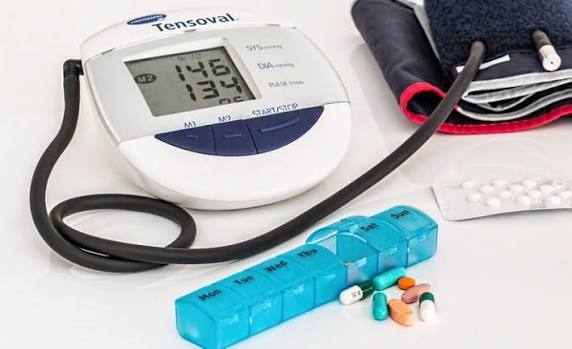
A single reading in a clinic tells you very little. A pattern over weeks tells you and your doctor almost everything. So buy an upper-arm digital monitor rather than a wrist one, and record every reading with the date.
Never stop anything without telling your doctor
If a medicine gives you a side effect, say so rather than stopping quietly. Ankle swelling on amlodipine and a persistent dry cough on lisinopril are both common, both well recognised, and both usually solved by switching within the same family. Stopping without telling anyone is what turns a manageable side effect into an uncontrolled disease.
What good control actually looks like
Anyone treating high blood pressure in Nigeria should know their own target. Your doctor sets it, and for most adults it sits below 140/90, with a lower target of around 130/80 for many patients, particularly those with diabetes or kidney disease.
Do not judge yourself on one reading. Judge on the average of several taken over days, when you are seated, rested for five minutes, with your back supported, your arm at heart level and the cuff on bare skin rather than over clothing.
When to seek help immediately
Most of the time high blood pressure in Nigeria is silent and managed calmly over years. Some situations are not routine. Get to a hospital straight away if a very high reading comes with any of the following:
Chest pain or tightness
Sudden severe headache, or a change in vision
Difficulty breathing
Weakness or numbness in the face, arm or leg, especially on one side
Slurred speech or sudden confusion
The last two are signs of stroke, where every minute counts.
Common questions
Can I ever stop blood pressure medication?
Rarely, and never on your own. Some people who lose significant weight, cut salt substantially and become more active can reduce their dose under supervision. For most people, though, treatment is long term, and the fact that your reading is now normal is evidence the medicine is working rather than evidence you no longer need it.
Why is my blood pressure still high on medication?
Common reasons include needing a second medicine, missed doses, salt intake, alcohol, untreated sleep apnoea, pain medicines such as ibuprofen and diclofenac, and readings taken incorrectly. Bring a fortnight of home readings to your next appointment, because that usually identifies the problem quickly.
Is high blood pressure in Nigeria more common than elsewhere?
Prevalence here is high at roughly 38 percent of adults, and it varies widely by zone. However, the bigger difference is not how many people have high blood pressure in Nigeria but how few have it controlled, which is where the gap with other countries is widest.
Can hibiscus tea replace my medication?
No. Some studies suggest a modest blood pressure lowering effect from hibiscus, but the effect is small and it does not substitute for an antihypertensive. Drink it if you enjoy it, keep taking your tablets, and tell your pharmacist about any herbal preparation you use.
How often should I check my blood pressure at home?
While your dose is being adjusted, twice daily for a week gives a useful picture. Once stable, two or three mornings a week is plenty. Write every reading down.
The problem is supply and follow-through, and that is solvable
The evidence on high blood pressure in Nigeria is encouraging in a specific way. Control rates above 50 percent were reached not with new drugs but with dependable medicine supply, simpler regimens and someone following up.
That is exactly the work HubPharm Africa does. We source verified medicines, deliver them across Nigeria, coordinate refills so you never reach the Thursday when the tablets finish, and put a pharmacist on the other end of a phone when a side effect appears or a brand changes. Across our programmes we have seen a 42 percent improvement in medication adherence.
If your blood pressure is not where it should be, or you keep running out, talk to our care team about a supply plan.
Written by Fawzi Rufai, Medically reviewed by Pharm. Sesan Kareem, B.Pharm, MPA, MBA.
This article is for general information and does not replace advice from your own doctor or pharmacist. Never change or stop prescribed medication without speaking to them first.
References
Prevalence, Awareness, Treatment and Control of Hypertension in Nigeria: Data from a Nationwide Survey 2017. Global Heart.
Improving hypertension control in Nigeria: early policy implications from the Hypertension Treatment in Nigeria program. Global Health Research and Policy, 2024.
World Health Organization, HEARTS technical package for cardiovascular disease management in primary health care.
Federal Ministry of Health, Nigeria, National Essential Medicines List, fixed-dose combination antihypertensives, 2023.
Please follow and like us:
Views:240
Related Posts:
Diabetes in Nigeria: Why Blood Sugar Control Fails Diabetes in Nigeria does not usually fail in the clinic. Among people who reach a specialist and stay in care, control is often reasonable. It fails in the years before anyone tests you, and it…
Newly Diagnosed With Breast Cancer? Your First 30 Days Guide If you have just been newly diagnosed with breast cancer, start here. You do not need to understand everything today. You need to know what to do next, and in what order. This guide breaks…
Metformin Side Effects: What Is Normal and What Is Not Most people meet metformin side effects in the first fortnight, decide the drug does not agree with them, and stop it without telling anyone. That decision is usually wrong, and it is almost always avoidable,…
Normal Blood Sugar Levels: What Your Numbers Mean Someone checks your sugar at a chemist, reads out a number, and either looks worried or does not. Nobody explains which test it was, which units it is in, or what the threshold actually is.…