If you have just been newly diagnosed with breast cancer, start here. You do not need to understand everything today. You need to know what to do next, and in what order.
This guide breaks your first 30 days into four weeks, with a small number of tasks for each. It is written for the realities of breast cancer in Nigeria: our hospitals, our costs, our insurance schemes, our drug supply. Read it once now, then come back week by week.
Newly diagnosed with breast cancer? Why the first 30 days matter
Breast cancer is the most common cancer in Nigerian women. The International Agency for Research on Cancer estimates roughly 44,196 new cases and 21,309 deaths in Nigeria for 2024.
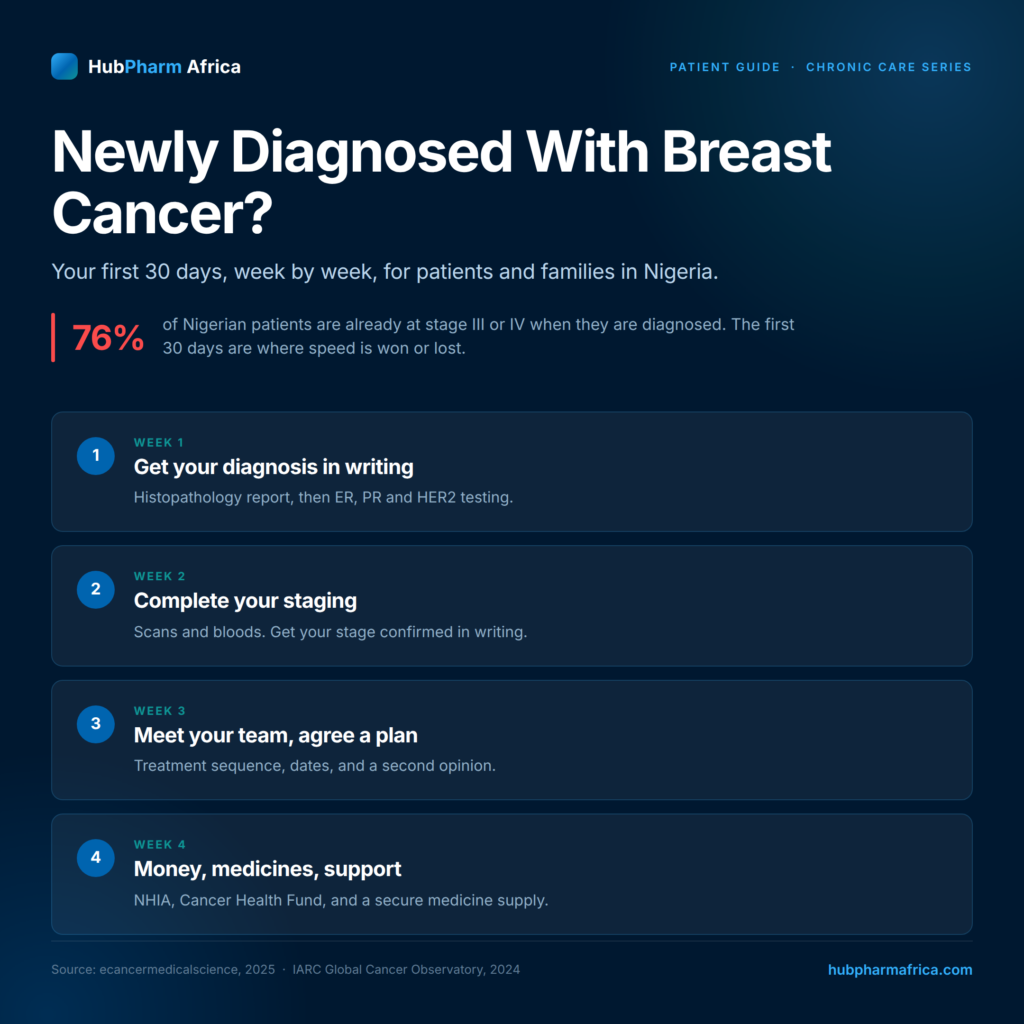
The gap between those two numbers is the point. Breast cancer is one of the most treatable cancers in the world, and where women are diagnosed early and treated fully, more than nine in ten are alive five years later. Our outcomes are poor mainly because we find it late. A 2025 review of 11 Nigerian studies found that about 76 percent of patients were already at stage III or IV at diagnosis, and only 6 percent at stage I.
If you were diagnosed at a later stage, treatment becomes harder, not pointless. Stage III is still treated with the intention to cure. What you still control is speed, and the next 30 days are where speed is won or lost.
Week 1: get your diagnosis in writing
Almost everyone newly diagnosed with breast cancer leaves the consulting room with a sentence and no paperwork. A verbal diagnosis is not something you can plan with, so collect the paper.
Get your histopathology report. Only a biopsy confirms breast cancer. Not an ultrasound, not a mammogram, not an examination. Note the histological type, the grade (1 to 3, which is not the same as stage) and the tumour size.
Insist on receptor testing. Immunohistochemistry, written as IHC, tells you whether your cancer carries the oestrogen receptor (ER), the progesterone receptor (PR) and HER2. These three results decide your treatment. ER or PR positive means hormone therapy such as tamoxifen will work, and it is the cheapest and most available of all breast cancer medicines. HER2 positive opens up targeted therapy such as trastuzumab. Triple negative means none of the three is present and chemotherapy carries the load.
This matters especially here. A genomic study published in Nature Communications found 43 percent of Nigerian breast cancers were triple negative, against 13 percent in a White American cohort. Our disease is more aggressive and appears younger, so a plan copied from an American website may not fit you. If your hospital cannot run IHC, ask for the paraffin block, not just the slides, and send it to a laboratory that can.
Start a file and photograph every page. You will be asked for these documents repeatedly, often by a different doctor in a different hospital.
Week 2: complete your staging
Staging answers one question: has the cancer stayed in the breast and nearby lymph nodes, or has it travelled? Expect chest imaging, an abdominal and pelvic scan, blood tests including liver and kidney function, a bilateral mammogram, and a bone scan if bone spread is suspected.
Two practical notes. Book everything in one facility on one day where you can, because moving between three centres for three scans turns a one-week step into a month. And if PET-CT is suggested, ask directly whether it will change your treatment. For early-stage disease it usually will not, and that money is better spent elsewhere.
Write your stage down and say it out loud. Vagueness about your own stage is a common reason people treated for breast cancer in Nigeria end up with the wrong sequence of treatment.
Week 3: meet your team and agree a plan
Anyone newly diagnosed with breast cancer is best served by a team rather than a single doctor. You want a surgeon, an oncologist and a pathologist involved, with a radiation oncologist added where radiotherapy is planned. Breast cancer treatment in Nigeria works best this way.
Where to go. In June 2026 the federal government approved a roughly N37.4 billion upgrade of six cancer centres with the Nigeria Sovereign Investment Authority: LUTH Lagos, UBTH Benin, ABUTH Zaria, UNTH Enugu, JUTH Jos and Federal Teaching Hospital Katsina. The NSIA-LUTH Cancer Centre, National Hospital Abuja and UCH Ibadan also offer full services. Radiotherapy is the tightest bottleneck, with the Nigerian Cancer Society putting functional machines nationwide at around ten as of early 2026. If radiotherapy is in your plan, join the queue the day it is recommended.
Understand the order. Surgery does not always come first. Chemotherapy or hormone therapy given before surgery to shrink the tumour is standard for larger tumours and for triple negative and HER2 positive disease, which is a very common recommendation in Nigeria given how many women present at stage III. Ask your oncologist to write the full sequence down with rough dates.
Get a second opinion in week three, not month four. Take copies of your report, receptor results and scans. Do not start over with a fresh biopsy at every hospital you visit.
Week 4: money, medicines and support
This is the week that decides whether the plan actually happens.
Understand the cost of breast cancer treatment in Nigeria. A study at Obafemi Awolowo University Teaching Hospital recorded mean out-of-pocket costs of about 2,049 US dollars per patient, with 95 percent of households crossing the threshold for catastrophic health expenditure. That figure predates recent exchange rate movements, so treat it as a floor. Price the next three months, not the whole journey.
Apply for support in the same week, because none of it is guaranteed. NHIA enrollees pay 20 percent of the cost of cancer medications, with coverage extending to surgery, chemotherapy and radiotherapy. In August 2026 NHIA announced a radiotherapy cost-sharing scheme that halves the patient’s radiotherapy bill, capped at N400,000. The Cancer Health Fund, run by NICRAT, supports indigent breast, cervical and prostate cancer patients through designated public hospitals including ABUTH Zaria, National Hospital Abuja, UBTH Benin, Federal Teaching Hospital Gombe, UNTH Enugu and UCH Ibadan. Patients have reported long delays, so apply early and keep following up. Foundations including Medicaid Cancer Foundation, Sebeccly Cancer Care and Project PINK BLUE also run support programmes.
Secure your medicine supply before you need it. Treatment plans in Nigeria collapse less often because the plan was wrong and more often because a drug was out of stock or the price moved between cycles. Confirm where each medicine will be sourced, ask what happens if it is unavailable on the day, and set a reminder system for the daily medicines you will take for years. Missing doses of tamoxifen quietly undoes the benefit of everything else you have been through.
Raise fertility before chemotherapy starts, not after, if you may want children later. Ask your centre about counselling too. Anxiety after a diagnosis is expected, not weakness.
What not to do in your first 30 days
These four mistakes cost patients more than any single treatment decision.
Do not delay hospital treatment for herbal remedies. None has been shown to cure breast cancer, some interfere with chemotherapy and hormone therapy, and some damage the liver and kidneys your treatment depends on. Tell your pharmacist what you are already taking.
Do not treat faith and medicine as a choice. Pray, and take the treatment.
Do not restart the process at every new hospital. Carry your file.
Do not go quiet when money runs short. Tell your team. Regimens can be resequenced and biosimilars substituted. Disappearing from care is the most expensive decision available to you.
Your 30-day checklist
Week
What must be done
Week 1
Histopathology report collected · ER, PR and HER2 requested · file started
Week 2
Staging scans and blood tests done · stage confirmed in writing
Week 3
Oncologist seen · treatment sequence written down · second opinion · radiotherapy queue joined
Week 4
NHIA confirmed · Cancer Health Fund and NGO applications in · medicine supply arranged
Frequently asked questions
What should I do first after being newly diagnosed with breast cancer?
Collect your histopathology report and request ER, PR and HER2 testing. Nothing useful can be planned without them. Then complete staging in week two, agree a written treatment sequence in week three, and sort out funding and medicine supply in week four.
Is breast cancer curable in Nigeria?
Yes, breast cancer in Nigeria is curable, particularly when found early and treated completely. Stages I to III are treated with the intention to cure, and Nigerian centres deliver the same core treatments used elsewhere. The threats to cure here are late diagnosis and interrupted treatment, not the absence of effective treatment.
How much does breast cancer treatment cost in Nigeria?
It depends on stage, receptor status and whether you use public or private facilities. Nigerian research has recorded mean out-of-pocket costs of roughly 2,049 US dollars per patient, with HER2 targeted therapy costing considerably more. Ask for a written estimate covering three months and apply to NHIA and the Cancer Health Fund in parallel.
Does NHIA cover cancer treatment in Nigeria?
Partially. Enrollees pay 20 percent of the cost of cancer medications, with coverage extending to surgery, chemotherapy and radiotherapy. A scheme announced in August 2026 halves radiotherapy costs with the authority contributing up to N400,000 per patient.
How long can I wait before starting treatment?
As short a time as possible once you are newly diagnosed with breast cancer. Use the first 30 days for diagnosis, staging and planning, then begin. Delays measured in months can move you from a curable stage to a harder one.
You do not have to organise this alone
The medical part is difficult. The logistics around it, finding the medicines, affording them and keeping to schedule for years, are what quietly defeat most families, and that part is fixable.
HubPharm Africa exists for that second problem. We source verified medicines, deliver them across Nigeria, coordinate refills so no cycle is missed for a supply reason, and put a pharmacist on the other end of a phone. If you or someone you love has been newly diagnosed with breast cancer, talk to our care team.
Written by Fawzi Rufai,Medically reviewed by Pharm. Sesan Kareem, B.Pharm, MPA, MBA.
This article is for general information and does not replace advice from your own oncologist, surgeon or pharmacist.
References
International Agency for Research on Cancer, Nigeria fact sheet, Global Cancer Observatory, 2024 estimates.
Nigeria’s 6-year (2018–2023) stage distribution of breast cancer at diagnosis. ecancermedicalscience, 2025.
Characterization of Nigerian breast cancer reveals prevalent homologous recombination deficiency. Nature Communications, 2018.
The out-of-pocket cost of breast cancer care at a public tertiary hospital in Nigeria. Pan African Medical Journal, 2022.
National Health Insurance Authority radiotherapy cost-sharing announcement, August 2026.
NICRAT, Cancer Health Fund. Federal Ministry of Health and NSIA six-centre oncology upgrade, June 2026.
Please follow and like us:
Views:187
Related Posts:
Lower Back Pain Relief: What Works and When to Worry Low back pain is the leading cause of disability worldwide. The World Health Organization estimates that it affected 619 million people in 2020, and almost everyone experiences it at least once. Market traders, drivers, office…
Breast Cancer Screening in Nigeria: Where to Go and Costs Breast cancer screening in Nigeria confuses people for a simple reason: nobody tells you which test you need. A woman of 32 asks for a mammogram and is told she does not need one. A…
How to Check for Breast Cancer at Home: 5 Simple, Safe Steps Most Nigerian women who find breast cancer find it themselves. Not at a screening centre, and not during a routine check-up, but in the shower or while dressing. So learning how to check for breast…
Diabetes in Nigeria: Why Blood Sugar Control Fails Diabetes in Nigeria does not usually fail in the clinic. Among people who reach a specialist and stay in care, control is often reasonable. It fails in the years before anyone tests you, and it…