Low back pain is the leading cause of disability worldwide. The World Health Organization estimates that it affected 619 million people in 2020, and almost everyone experiences it at least once. Market traders, drivers, office workers and farmers are all affected. The good news is that most episodes improve within a few weeks. Lower back pain relief rarely requires scans, injections or surgery. The key is knowing what helps and what makes it worse.
Why your back hurts
In about nine out of ten cases, no single damaged structure can be identified. Doctors call this non-specific back pain. It usually comes from strained muscles, ligaments or joints. Common triggers include:
Heavy lifting or awkward bending
Long hours of sitting in traffic or at a desk
Weak core muscles and excess weight
Poor sleep and stress
Less often, the cause is a slipped disc pressing on a nerve, which sends pain shooting down the leg. Arthritis, a fracture from thin bones or an infection can also be responsible.
Types of back pain
Doctors group back pain by how long it lasts and what it feels like, because this guides treatment.
By duration:
Acute pain lasts less than six weeks
Subacute pain lasts six to twelve weeks
Chronic pain lasts longer than twelve weeks
By pattern:
Mechanical pain is the most common. It changes with movement and position, and it eases with rest.
Nerve pain travels down the leg, often below the knee. It may come with numbness or pins and needles.
Inflammatory pain causes stiffness for more than half an hour each morning and improves with activity. It often begins before the age of 40 and needs a specialist.
Knowing your pattern helps you to describe it clearly, and it shows which kind of lower back pain relief is most likely to work.
Lower back pain relief that works
Keep moving. Bed rest slows recovery. Instead, continue gentle daily activities and take short walks.
Use heat. A warm towel or hot water bottle for 15 to 20 minutes eases muscle spasm.
Take painkillers for a short time. An anti-inflammatory such as ibuprofen, taken with food for a few days, often helps most. However, it is not suitable if you have ulcers, kidney disease or uncontrolled blood pressure, or if you are pregnant. Paracetamol is a gentler alternative.
Stretch and strengthen. Once the sharp pain eases, gentle stretches, walking, swimming and core exercises reduce the chance of another episode. A physiotherapist can design a plan for you.
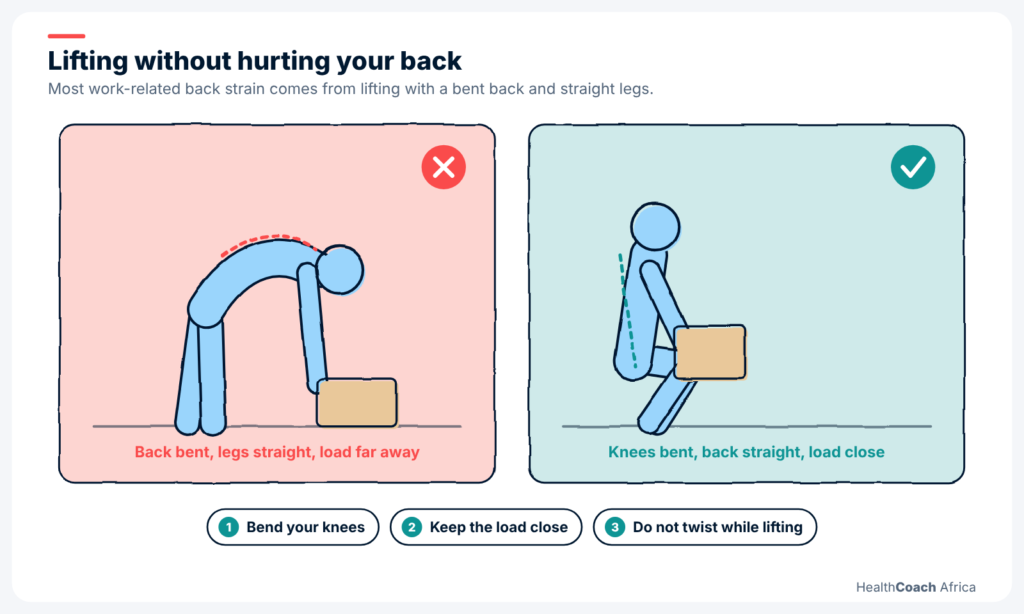
Fix daily habits. Change position every 30 minutes. When lifting, bend your knees and keep the load close to your body.
Protect sleep and manage stress. Both of them amplify pain.
Five simple exercises to start with
Once the worst pain has settled, gentle movement speeds recovery. Try these once or twice a day on a mat or a firm bed:
Knee to chest. Lie on your back and pull one knee gently towards your chest. Hold for 20 seconds, then change legs. Repeat three times.
Pelvic tilt. Lie on your back with your knees bent. Tighten your stomach and flatten your lower back against the floor. Hold for five seconds and repeat ten times.
Cat and cow. On your hands and knees, slowly arch your back upwards, then let it sink down. Repeat ten times.
Bridge. Lie on your back with your knees bent and lift your hips until your body forms a straight line. Hold for five seconds and repeat ten times.
Walking. Start with ten minutes and add a few minutes each day.
Mild discomfort is acceptable. However, stop if pain shoots down your leg or becomes sharply worse, and seek advice.
What does not help
Some popular approaches to lower back pain relief do more harm than good:
Prolonged bed rest. It weakens the muscles that support the spine.
Routine X-rays and MRI scans. In the first six weeks, they often show age-related changes that have nothing to do with the pain.
Long-term strong painkillers. Tramadol and similar medicines lead to dependence.
Unlabelled herbal pain mixtures. Some contain hidden steroids or painkillers that damage the stomach and kidneys.
Sciatica and slipped discs
Sciatica is pain that runs from the lower back or buttock down the leg. It happens when a nerve root is irritated, most often by a bulging disc. The leg pain is frequently worse than the back pain.
The outlook is better than many people fear. Most cases improve within six to twelve weeks without an operation, because the disc shrinks back over time. Staying gently active helps. A doctor may prescribe medicine for nerve pain or arrange physiotherapy.
Surgery is considered only when pain is severe and persistent, or when there is growing weakness in the leg. Therefore, a scan that shows a “slipped disc” is not, on its own, a reason for an operation.
Back pain at work, on the road and at home
Daily routines cause most back trouble, so small changes bring real lower back pain relief.
Drivers. Sit close enough to reach the pedals with your knees slightly bent. Place a small cushion behind your lower back, and stop to stretch on long trips.
Office workers. Raise your screen to eye level, keep your feet flat and stand up every half hour.
Traders and farmers. Bend your knees when lifting, split heavy loads into smaller ones and avoid twisting while carrying.
Parents. Lift children by squatting, and alternate the side on which you carry a baby.
At night. A medium-firm mattress suits most people. Try sleeping on your side with a pillow between your knees.
Red flags that need urgent care
Go to hospital immediately if back pain comes with:
Numbness around the genitals, buttocks or inner thighs
New difficulty passing urine or controlling your bowels
Weakness in one or both legs
These signs suggest pressure on the nerves at the base of the spine, which may need surgery within hours.
See a doctor promptly if you have:
Pain after a fall or accident
Fever or unexplained weight loss
A history of cancer
Pain that is worse at night or when resting
Pain that has lasted more than six weeks
Massage, bone setters and other therapies
Many people try hands-on treatments for lower back pain relief. Gentle massage can relax tight muscles and give short-term relief, and it is safe for most people. Yoga and stretching classes also help some people with long-lasting pain.
However, forceful manipulation by untrained practitioners is risky. Traditional bone setters may twist or pull the spine, tie tight splints or apply hot substances. These practices can injure nerves and skin, and they delay proper diagnosis. Back belts and corsets may be worn briefly for heavy tasks, but long-term use weakens the muscles.
When back pain becomes chronic
Pain that continues beyond three months is called chronic. At that stage, stronger medicine is rarely the answer. Instead, the best results come from a combination of supervised exercise, education about pain, weight management and psychological support. Progress is gradual, so measure it by what you can do, not only by how much it hurts.
Preventing the next episode
Stay active on most days, and build strength in your back and abdominal muscles. In addition, set up your workspace so that your screen is at eye level and your feet rest flat on the floor. Take breaks on long journeys. Finally, maintain a healthy weight and avoid smoking, which slows healing in the spine.
Frequently asked questions
Should I rest or keep moving?
Keep moving. A day or two of taking things easy is fine, but longer bed rest slows recovery.
Is heat or ice better?
Use whichever feels better. Heat relaxes tight muscles, while a cold pack may help in the first two days after a strain.
Do I need an X-ray or MRI?
Usually not. Scans are for red flag symptoms, pain lasting beyond six weeks or cases in which surgery is being considered.
Could my kidneys be causing the pain?
Kidney pain is usually felt higher up and to one side. It often comes with fever or changes in the urine, and it does not vary with movement.
Can stress really cause back pain?
Stress tightens muscles and makes the brain more sensitive to pain. Managing it is a real part of treatment.
The essentials
Lasting lower back pain relief rests on a few habits: stay active, strengthen your core, lift carefully and use medicines briefly and wisely. Know the red flags as well, so that you can tell ordinary pain from an emergency.
Low Blood Sugar Symptoms: Warning Signs and What to Do Fast Most conversations about diabetes focus on high blood sugar. Yet for people who use insulin or certain tablets, the more immediate danger is sugar that drops too low. Low blood sugar symptoms can progress from…
Tuberculosis Symptoms and Treatment: What You Need to Know Tuberculosis, or TB, is one of the oldest diseases known to humans, and it remains a major killer. Nigeria has one of the highest TB burdens in Africa, and many people with the disease have…
Diabetes in Nigeria: Why Blood Sugar Control Fails Diabetes in Nigeria does not usually fail in the clinic. Among people who reach a specialist and stay in care, control is often reasonable. It fails in the years before anyone tests you, and it…
Blood Pressure Medication Side Effects and What to Do Most people never tell anyone about their blood pressure medication side effects. They notice their ankles have swollen, or that a dry cough has not gone away since February, and they draw the obvious conclusion:…