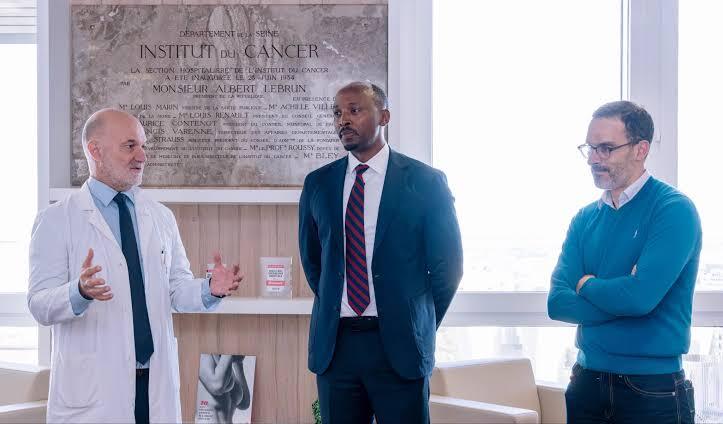
KIGALI, RWANDA — Transforming the landscape of cancer care in rwanda, the Ministry of Health has signed a historic memorandum of understanding with Gustave Roussy, Europe’s top-ranked oncology center. Signed in Villejuif, France, by Health Minister Dr. Sabin Nsanzimana and Director General Prof. Fabrice Barlesi, the bilateral pact focuses on expanding specialized oncology, clinical research, medical training, and interventional radiology services across Rwandan health facilities.
The agreement comes as Rwanda seeks to build domestic tertiary capacity, reducing dependence on costly medical transfers abroad for complex oncological care.
Expanding Specialized Care for Cancer in Rwanda
The partnership targets critical gaps in specialized oncology, focusing on early diagnostic imaging and advanced treatment options:
Partnership Milestone
Strategic Focus & Impact
Partner Institution
Gustave Roussy (Treats 54,000+ patients annually; ranked #1 in Europe)
Key Clinical Focus
Specialized Radiology (CT, MRI, mammography, and interventional procedures)
National Cancer Burden
10,000+ new cases diagnosed annually (7,000+ deaths per year)
Local Capacity Expansion
Defense College of Health Sciences opened at Gako to train specialists
Addressing Late Diagnosis for Cancer Care in Rwanda
A major hurdle facing cancer care in rwanda is late presentation, where patients are diagnosed at advanced disease stages when treatment options are limited. Boosting diagnostic radiology capacity—such as computed tomography (CT), magnetic resonance imaging (MRI), and image-guided biopsies—allows clinicians to catch tumors early and guide precision therapies.
To complement tertiary partnerships, local screening initiatives are expanding nationwide:
Community Screening: On October 1, Labscroll Medicals launched the Pink Ribbon Project in Kicukiro District, delivering free diagnostic screening to 400 citizens.
Workforce Retention: The long-term impact of cancer care in rwanda relies on clinical fellowships, remote multi-disciplinary team (MDT) case reviews, and retaining trained radiologists within local public hospitals.
Institutional Models for Cancer Care in Rwanda
Rwanda’s dual strategy offers a blueprint for other African nations seeking to reduce outbound medical tourism. By establishing partnerships with world-class centers while expanding domestic training institutions, the nation is laying the groundwork for sustainable, self-reliant oncology infrastructure.
Why It Matters: Training radiologists and oncologists at home allows more Rwandans to access early diagnosis and lifesaving treatment without traveling abroad.
Rwanda Takes Handover of 837-Bed Masaka Hospital in Kigali Rwanda has taken handover of the renovated and expanded Masaka Hospital in Kicukiro District, a 837-bed facility that becomes the country's largest hospital complex, with the University Teaching Hospital of Kigali due to relocate services…
Shortage of Oncology Nurses Threatens Cancer Care in… ABUJA, NIGERIA — Highlighting severe human resource deficits across tertiary health centers, the shortage of oncology nurses in Nigeria poses a critical threat to national cancer treatment delivery. According to estimates provided by nursing education…
Kenya Italy Referral Hospital Partnership Expands… NAIROBI, KENYA — President William Ruto announced a bilateral agreement on 9 September 2026 to construct 15 modern medical facilities across 15 counties. The Kenya Italy referral hospital partnership operates under Italy’s Mattei Plan for…
Rwanda Reports 80 Percent Drop in Alcohol-Linked… KIGALI, RWANDA — Emergency room admissions for violence and trauma linked to illicit high-strength drinks have dropped by 80 percent across national health facilities following a government enforcement drive against unlicenced distilleries. Presenting findings to…