Infertility affects many Nigerian couples and often brings stress, stigma and family pressure. In vitro fertilisation, or IVF, has helped many of these couples to have children. The number of fertility clinics in Nigeria has grown in recent years, but costs are high and quality varies. This guide explains IVF treatment in Nigeria step by step, who it is for and how to make informed choices.
What IVF is
In vitro fertilisation means “fertilisation in glass”. Eggs are collected from a woman’s ovaries and fertilised with sperm in a laboratory. The resulting embryos grow for a few days before one is placed into the womb. If the embryo implants, a pregnancy begins.
IVF bypasses several common causes of infertility, such as blocked fallopian tubes and low sperm counts. However, it is not a guaranteed solution, and success depends on several factors.
Who may need IVF?
Doctors may recommend IVF for couples with:
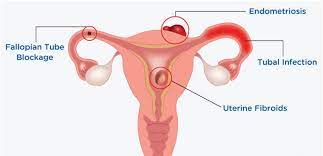
Blocked or damaged fallopian tubes, often after pelvic infection
Severe male factor infertility, such as a very low sperm count or poor sperm movement
Endometriosis that has affected fertility
Ovulation problems that have not responded to tablets or injections
Unexplained infertility after other treatments have failed
Reduced egg numbers because of age
Before IVF, both partners should have a full assessment. This often includes a semen analysis, an ultrasound scan, blood tests for ovarian reserve such as AMH, a test of the fallopian tubes and screening for infections such as HIV and hepatitis.
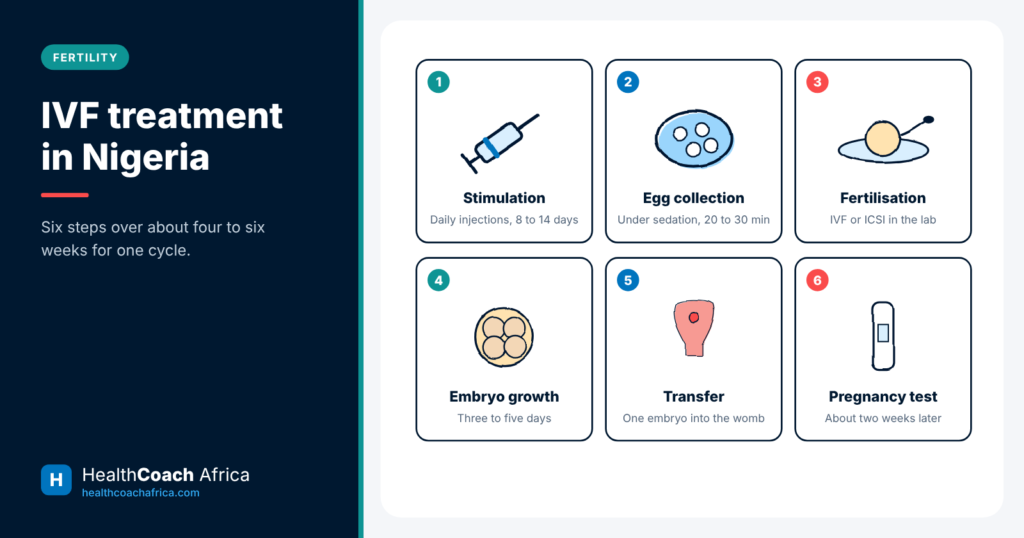
Step 1: stimulating the ovaries
Normally, one egg matures each month. In IVF, fertility injections 1 are used to encourage several eggs to mature at the same time. These injections are usually given daily for about 8 to 14 days. Many women learn to give them at home.
During this time, you will have regular ultrasound scans and sometimes blood tests to monitor how the follicles are growing. Other medicines are used to stop the eggs from being released too early.
HUBPHARM PHARMACIST’S NOTE Many IVF injections must be kept between 2 and 8°C and given at an exact time, so a power cut or a missed alarm can affect a cycle. Talk to a HubPharm pharmacist about cold-chain delivery, cool bags and a written injection timetable for your cycle.
Step 2: the trigger injection and egg collection
When the follicles are ready, a final “trigger” injection 2 is given to complete egg maturation. About 34 to 36 hours later, the eggs are collected. This is done with a thin needle guided by ultrasound through the vaginal wall, usually under sedation. It takes about 20 to 30 minutes, and most women go home the same day.
Step 3: fertilisation
On the same day, the male partner provides a semen sample, or previously frozen sperm is used. In standard IVF, the eggs and sperm are placed together in a dish. In ICSI, a single sperm is injected directly into each egg. ICSI is used when sperm quality is poor.
Step 4: embryo development
Fertilised eggs are watched in the laboratory as they develop into embryos. They are usually grown for three to five days. Embryologists assess them and choose the best one for transfer. Good-quality extra embryos can often be frozen for later use.
Step 5: embryo transfer
The chosen embryo is placed into the womb using a thin, soft tube passed through the cervix. This is usually painless and does not need sedation. Afterwards, you will take progesterone 3 , often as pessaries or injections, to support the lining of the womb.
Step 6: the pregnancy test
A pregnancy blood test is done about two weeks after the transfer. This wait is often the hardest part emotionally. If the test is positive, an early scan confirms the pregnancy a few weeks later.
What affects success rates?
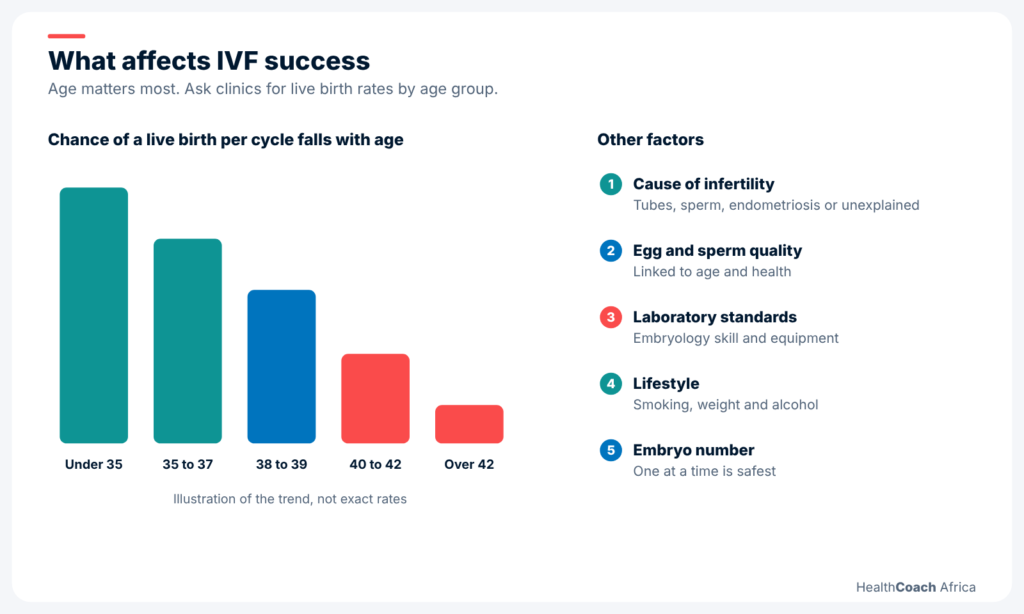
Success with IVF treatment in Nigeria, as elsewhere, depends most on the woman’s age. Younger women have a much higher chance of a live birth per cycle than women over 40. Other factors include the cause of infertility, egg and sperm quality, the clinic’s laboratory standards and lifestyle factors such as smoking and weight.
Many couples need more than one cycle. Ask clinics for their success rates by age group, measured as live births rather than positive pregnancy tests.
Chart of the main factors behind success rates for IVF treatment in Nigeria, led by the woman’s age
Many couples need more than one cycle, so plan your budget and emotional support with that in mind.
Risks and side effects
IVF is generally safe, but there are risks:
Ovarian hyperstimulation syndrome, where the ovaries over-respond to fertility drugs, causing bloating, pain and, rarely, serious illness
Multiple pregnancy, which carries higher risks for mother and babies. Transferring one embryo at a time reduces this risk.
Ectopic pregnancy, where the pregnancy implants outside the womb
Emotional stress for both partners
IVF treatment in Nigeria: preparing your body
Good health before IVF can improve your chances. Both partners should stop smoking, limit alcohol and aim for a healthy weight. Women should take folic acid 400 micrograms daily for at least a few months before treatment. Conditions such as high blood pressure, diabetes and thyroid disease should be well controlled. Men should avoid hot baths, tight underwear and anabolic steroids, which can lower sperm quality.
It also helps to plan your work schedule, because the stimulation phase involves frequent clinic visits at short notice.
Choosing a clinic
Choosing a clinic is one of the most important decisions in IVF treatment in Nigeria. Look for:
Clear, honest information about success rates by age
Qualified fertility specialists and embryologists
Transparent pricing, with a written list of all costs, including medicines, scans and embryo freezing
Counselling support
Willingness to transfer a single embryo when appropriate
Be cautious of clinics that promise guaranteed success or pressure you to decide quickly.
Costs and planning
Costs for IVF treatment in Nigeria vary widely between clinics and cities. Fertility medicines can be a large part of the total. Ask whether medicines are included in the quoted price. Some clinics offer payment plans, and a few employers and health insurers provide partial cover. Plan for the possibility of more than one cycle.
Frozen embryo transfer
Many clinics now freeze good-quality embryos and transfer them in a later cycle. Frozen embryo transfer can lower the risk of ovarian hyperstimulation and allows the womb lining to recover after stimulation. Success rates with frozen embryos are often similar to those with fresh embryos. Ask your clinic about storage costs and how long embryos can be stored.
Donor eggs, donor sperm and surrogacy
Some couples need donor eggs or sperm, for example because of early menopause or very poor sperm quality. Others consider surrogacy. These options raise medical, legal, cultural and emotional questions. Before starting IVF treatment in Nigeria with donors or a surrogate, seek independent legal advice and counselling, and make sure all agreements are in writing.
Questions to ask before you start
What is the cause of our infertility, and is IVF the best option?
What is your live birth rate for women of my age?
How many embryos do you usually transfer, and why?
What exactly is included in the price?
What happens if the cycle is cancelled or no embryos develop?
Clear answers help you compare clinics and plan your budget.
Looking after your emotional health
Infertility and IVF can strain relationships and mental health. Couples often face questions and pressure from family. Talking openly with your partner, joining a support group and seeing a counsellor can help. Remember that infertility is a medical condition, not a personal failure, and that men and women contribute equally to it.
Getting help
IVF treatment in Nigeria is a significant decision, and good information helps. Read our guide to understanding female fertility and the NHS guide to IVF.Many IVF medicines need careful storage and timing.For help sourcing fertility medicines, keeping injections cold or setting up a dosing schedule, message a HubPharm pharmacist or chat with Afiya on WhatsApp.
Medicines and products in this article
#
Medicine or product
What to know
1
Fertility injections (gonadotrophins)
Prescription only, keep refrigerated
Stimulate several eggs to mature. Given daily for about 8 to 14 days.
2
Trigger injection
Prescription only
Completes egg maturation. It must be given at the exact time the clinic specifies.
3
Progesterone
Prescription only
Pessaries or injections that support the womb lining after embryo transfer.
To order any of these, or to ask a pharmacist a question first, message HubPharm on WhatsApp or visit hubpharmafrica.com. Prescription medicines are supplied against a valid prescription.
Understanding Male Fertility: Factors, Diagnosis,… Male fertility refers to a man's ability to impregnate a woman and father a child. It is an important aspect of reproductive health and plays a significant role in human reproduction. Male fertility depends on…
Understanding Female Fertility: Factors, Diagnosis,… Female fertility refers to a woman's ability to conceive and carry a pregnancy to term. It is a complex and dynamic process that is influenced by various factors, including hormonal balance, reproductive anatomy, and overall…
Male Infertility in Africa: Breaking the Silence When people hear the word “infertility” in Africa, the assumption is almost always that the problem lies with women. Yet research shows that male infertility contributes to about 40–50% of all infertility cases worldwide. In…
Endometriosis and Getting Pregnant: What Women Need to Know Endometriosis is a common condition that causes painful periods, pelvic pain and, for some women, difficulty conceiving. Many women in Nigeria live with symptoms for years before diagnosis, because severe period pain is often dismissed…