NAIROBI, KENYA — Kenya and the World Health Organization (WHO) have held a Kenya WHO Ebola review after the country recorded three consecutive weeks without a new confirmed case, and agreed to develop a joint action plan on health security, KBC reported on 9 November.
Health Cabinet Secretary Aden Duale met a WHO delegation led by Regional Director for Africa Prof. Mohamed Yakub Janabi. Kenya is “entering a critical phase of its response,” the report said.
What the Kenya WHO Ebola review covered
Kenya has recorded nine cases of the imported Bundibugyo Ebola virus disease, all linked to a single transmission cluster, with no evidence of community transmission. Six patients have recovered and been discharged, two have died and one remains in treatment, according to KBC.
More than 772,000 travellers have been screened at 28 points of entry, 736 samples have been tested across five designated laboratories, and more than 7,300 health workers have been trained, the report said.
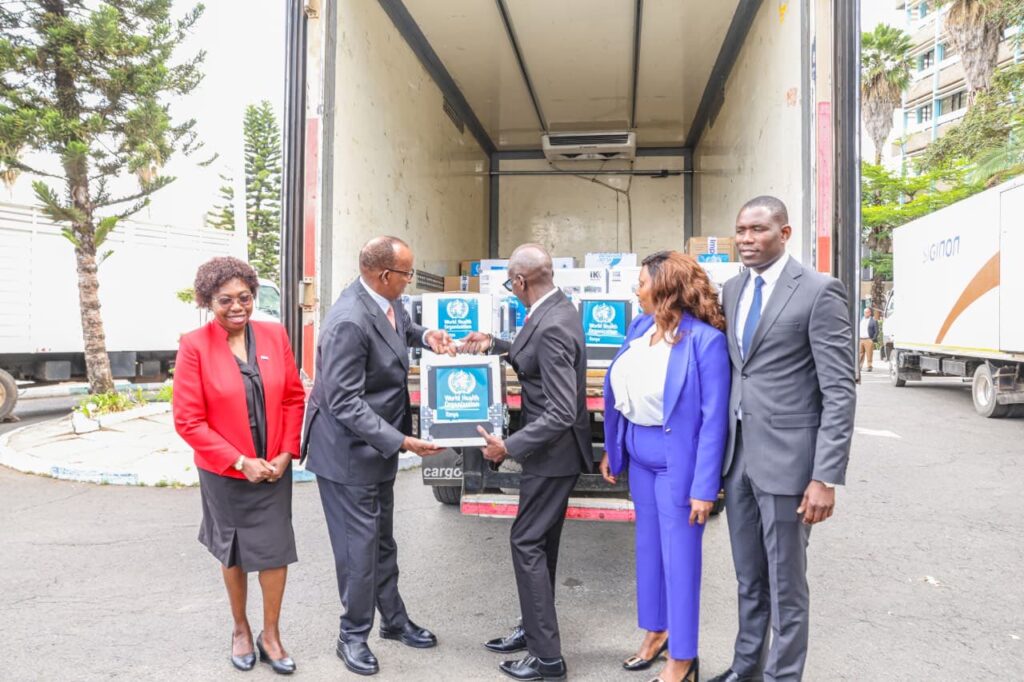
WHO has provided response supplies and personal protective equipment, validated Kenya’s Filovirus Surveillance Standard Operating Procedures, and donated 12 portable PCR systems and a 28-bed Ebola Treatment Unit.
Duale asked WHO for more support for diagnostic supplies, technical training, and isolation and treatment infrastructure in high-risk counties. The two sides discussed joint monitoring of the 42-day countdown, an After-Action Review and a coordinated declaration of the end of the outbreak once public health criteria are met.
The Kenya WHO Ebola review comes as the remaining contacts approach the end of their 21-day monitoring period, with the last group expected to finish quarantine by 11 November, according to earlier Ministry of Health updates.
Travel bans and solidarity
Duale raised concerns about blanket travel bans and visa restrictions imposed by some countries. He said “transparent reporting of health emergencies should be met with international solidarity rather than punitive restrictions.”
Kuwait and Saudi Arabia have barred more than 350 Kenyans from entering, according to earlier reports, and WHO advises against travel or trade restrictions with countries affected by Ebola. Health experts warn that bans can discourage countries from reporting outbreaks quickly.
Kenya’s experience will be closely watched by other countries in the region. The Kenya WHO Ebola review could provide lessons for Uganda, Rwanda, Nigeria, Ghana and others that are strengthening screening and preparedness as the DRC outbreak continues.
Beyond Ebola
The meeting also covered universal health coverage through the Social Health Authority, the Kenya National Public Health Institute, core capacities under the International Health Regulations, local manufacturing of health products, health financing and digital health, according to KBC.
Other officials present included Dr Neema Kimambo, WHO Kenya Country Representative, Mary Muthoni, Principal Secretary for Public Health and Professional Standards, Dr Ouma Oluga, Principal Secretary for Medical Services, and Dr Patrick Amoth, Director General for Health.
The broad agenda reflects WHO’s view that outbreak response should leave behind stronger health systems, not only end a single emergency.
Both sides agreed to keep surveillance active after the countdown ends.
Why the countdown matters
The 42-day countdown, twice the maximum incubation period, begins only after the last patient is discharged free of the virus. If no new case is confirmed during that period, WHO can declare the outbreak over.
An After-Action Review allows health authorities to identify what worked and what did not, including how quickly the first case was detected, how health workers were protected and how contacts were traced. WHO’s latest report noted that four health and care workers were among the secondary cases in Kenya’s cluster, which highlights the importance of infection prevention in health facilities.
Portable PCR systems allow faster testing closer to where patients are, reducing the time samples spend in transit. They can also be used for other outbreaks, which strengthens Kenya’s preparedness beyond Ebola.
The 28-bed treatment unit donated by WHO adds to the country’s capacity to isolate and treat patients safely, and can be kept ready for future outbreaks of Ebola, Marburg or other high-consequence infections.
The Kenya WHO Ebola review comes as the outbreak in the Democratic Republic of Congo, which WHO says is the largest in that country’s history, has passed 10,600 confirmed cases. Kenya’s position on major transport routes means it will need to maintain screening and surveillance even after its own outbreak ends.
The joint Kenya and WHO action plan is expected to set out priorities for health security, including laboratory capacity, emergency response and financing, as the country moves towards declaring the outbreak over.
Why it matters: Kenya’s contained cluster and WHO-backed testing capacity could end its outbreak soon, but travel bans are punishing transparency.
Duale Urges Faster Delivery of Ksh43.5 Billion World… NAIROBI, KENYA — Kenya’s Health Cabinet Secretary Aden Duale has called for faster implementation of two World Bank health projects worth about Ksh43.5 billion, to strengthen emergency response and the country’s Universal Health Coverage agenda,…
Kenya Discharges Five Ebola Patients, Africa CDC… NAIROBI, KENYA — Kenya Ebola patients discharged on Tuesday included five people who had recorded repeated negative tests, while 46 contacts completed their 21-day quarantine, the Africa Centres for Disease Control and Prevention (Africa…
DRC Ebola Outbreak Becomes Largest in Its History as… KINSHASA, DEMOCRATIC REPUBLIC OF CONGO The Bundibugyo virus outbreak in the Democratic Republic of Congo (DRC) is now the DRC largest Ebola outbreak ever recorded, regardless of virus species, the World Health Organization (WHO) said…
Pilot and Wife Test Negative in Adamawa Ebola Scare,… YOLA, NIGERIA — The Adamawa suspected Ebola cases, a 34-year-old pilot and his wife, a medical doctor, have tested negative for the virus after two rounds of testing, Nigeria’s disease control agency said, leaving the…