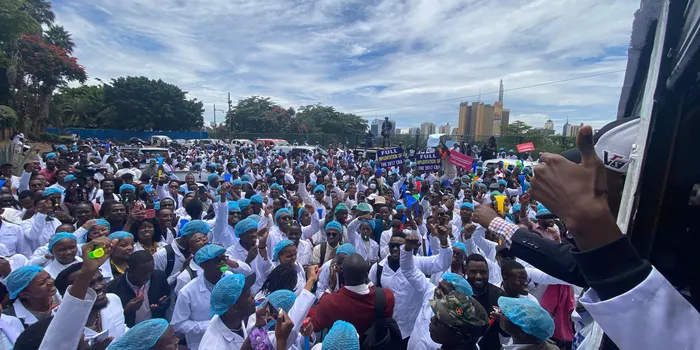
NAIROBI, KENYA — The Kenya Medical Practitioners, Pharmacists and Dentists Union (KMPDU) has issued a KMPDU doctors strike notice to 17 county governments, warning that doctors will stop work from 25 November 2026 unless agreed salary adjustments are paid, Kenyans.co.ke reported on 4 November.
KMPDU Secretary General Davji Atellah announced the 21-day notice. “Today, we issue a 21-day strike notice to these 17 counties,” he said.
Why the KMPDU doctors strike notice was issued
The dispute concerns basic salary adjustments for doctors that were due to take effect in July 2026. The adjustments come from a return-to-work formula agreed after the 2024 national doctors’ strike, which a court adopted as an order on 8 May 2024.
At a meeting with the Council of Governors on 22 July 2026, counties committed to implementing the adjustments, and the council confirmed that all 47 counties had received the allocated funds, according to the report. The money was released across the 2025/2026 and 2026/2027 financial years.
An audit by the National Advisory Council, presented at a meeting on 16 October, checked compliance in all 47 counties. It found that 17 had not implemented the adjustments despite receiving the money.
Atellah said the union had warned that “any county that would not have implemented the basic salary adjustment by the end of October would face necessary action.”
The counties named
The counties listed in the report are Murang’a, Nyandarua, Nyeri, Kirinyaga, Kiambu, Lamu, Taita Taveta, Tana River, Machakos, Makueni, Laikipia, Narok, Kajiado, Isiolo, Meru and Vihiga. The article refers to 17 counties but names 16.
The list includes densely populated counties near Nairobi, such as Kiambu, Machakos and Kajiado, as well as remote counties such as Lamu, Tana River and Isiolo, where public hospitals are often the only source of specialist care.
A history of disruption in devolved health
Health services in Kenya have been devolved to counties since 2013, which means each county employs and pays its own doctors, nurses and other health workers. Unions say this has led to delayed salaries, uneven promotions and repeated disputes across the country.
The 2024 doctors’ strike lasted nearly two months and disrupted services in public hospitals nationwide, before the return-to-work agreement was signed. Many patients turned to private and faith-based facilities, while others went without care.
Strikes in the public sector hit poorer patients hardest, because they rely on county hospitals and cannot easily pay for private care. People with chronic conditions such as diabetes, hypertension, HIV and cancer face risks when clinics close and prescriptions cannot be renewed, and pregnant women may lose access to safe delivery and emergency caesarean sections.
The KMPDU doctors strike notice also comes as Kenya is responding to Ebola. As of 3 November, the Ministry of Health reported nine confirmed cases in total, two deaths, five patients discharged, two still in care and no new cases since 19 October, according to The Star. Doctors in county hospitals are central to screening and referral during an outbreak.
Medical interns and junior doctors have also been at the centre of past disputes, including over posting and pay, and the union has warned in the past that delays in implementing agreements erode trust between doctors and county governments.
What happens next
Under Kenya’s labour laws, a strike notice gives employers time to resolve a dispute before industrial action begins. Counties that pay the adjustments before 25 November can avoid a strike, and talks involving the Council of Governors, the Ministry of Health and the Salaries and Remuneration Commission may follow.
The dispute also touches wider health financing questions. The Social Health Authority, which replaced the National Hospital Insurance Fund, depends on functioning public facilities to provide services to its members, and county budgets are under pressure from staffing costs and delayed reimbursements.
Health economists have argued that predictable payment of health workers is one of the simplest ways to improve service delivery, because strikes, absenteeism and staff departures are often linked to pay disputes.
Health Cabinet Secretary Aden Duale met union leaders in July, according to a photo caption in the report, but the article did not include a response from the ministry or the Council of Governors to the new notice.
If no settlement is reached, patients in the affected counties could face disruption in the run-up to the December holidays. The KMPDU doctors strike notice gives the counties three weeks to comply.
Why it matters: Strikes in county hospitals hit poorer patients and chronic care hardest, and the deadline falls during Kenya’s Ebola response.
Kenya Doctors Threaten Strike as Nurses' Walkout… NAIROBI, KENYA — Kenya’s healthcare crisis risks worsening as the Kenya Medical Practitioners, Pharmacists and Dentists Union (KMPDU) threatens to join an ongoing nurses' strike. The strike, which has lasted for six weeks, has forced…
Kenya Discharges Five Ebola Patients, Africa CDC… NAIROBI, KENYA — Kenya Ebola patients discharged on Tuesday included five people who had recorded repeated negative tests, while 46 contacts completed their 21-day quarantine, the Africa Centres for Disease Control and Prevention (Africa…
Health Workers’ Warning Strike Disrupts Hospital… KATSINA, NIGERIA — Public healthcare delivery across Katsina State has been severely paralyzed following the commencement of a one-week warning strike declared by the Assembly of Health Professionals, forcing patients and caregivers to plead for…
Kenya Issues Ebola Safety Guidelines for Workplaces… NAIROBI, KENYA — Kenya’s Ministry of Health has issued Ebola workplace safety guidelines urging employers and employees to promote awareness, early reporting and hand hygiene, as the country continues to monitor contacts linked to its outbreak,…