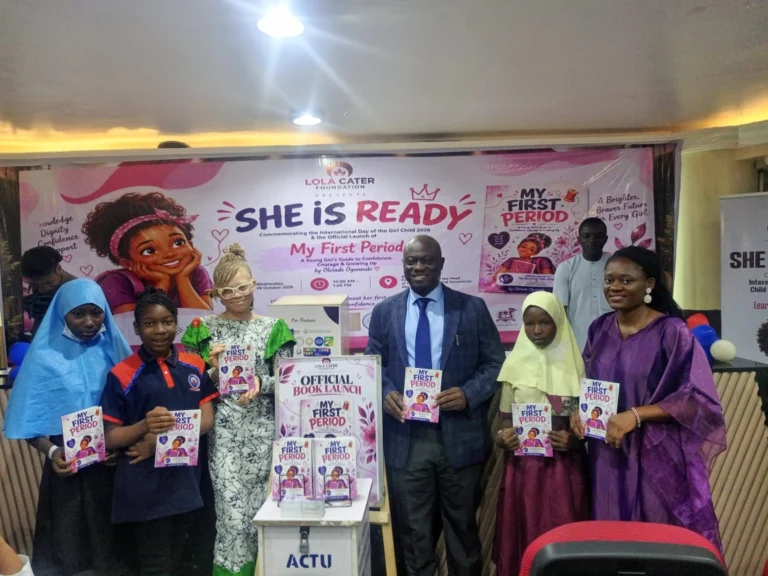
ABUJA, NIGERIA — A Nigerian foundation has launched a campaign to improve menstrual health for girls, aiming to reach 5,000 girls across the country with menstrual health education, books and hygiene support by 28 May 2027, the News Agency of Nigeria (NAN) reported on 29 October.
Ololade Ogunnubi, Chief Executive Officer of the Lola Cater Foundation, announced the initiative at “She Is Ready” 2026, an event held in Abuja on Wednesday to mark this year’s International Day of the Girl Child. The foundation also launched a book, My First Period: A Young Girl’s Guide to Confidence, Courage and Growing Up, intended for girls, parents, teachers and other trusted adults.
Why menstrual health for girls needs attention
Ogunnubi said many girls feel anxiety and shame during their first period because they lack reliable information, affordable products and trusted adults to talk to. She said communication between families and schools is often poor, with each expecting the other to lead. “Parents are not teaching, and schools are saying it is the parents’ responsibility,” she said.
Patricia Narai, wife of the Sakari of Karu, who spoke for the Association of Wives of FCT Traditional Rulers, said: “Menstruation is not a source of shame.”
Dr Maryam Keshinro, Permanent Secretary of the Federal Ministry of Youth Development, represented by Emmanuel Essien, Director of the ministry’s Youth Health, Mental and Psychosocial Affairs Department, linked menstrual stigma to lower school attendance and weaker confidence. “Girls are not merely beneficiaries of development. They are active contributors to national progress,” she said, urging investment in girls’ education, life skills and protection from gender-based violence and child marriage.
Joy Kalu, Head of the Adolescent and School Health Branch at the Federal Ministry of Health and Social Welfare, represented by Assistant Director Charity Okala, called for coordination. “We all have a role to play. We need to bring that together to ensure that our roles complement each other,” she said.
Health, school and cost
Menstrual health covers more than access to sanitary products. It includes accurate information about the body, the ability to manage periods with dignity at home and at school, access to clean water and private toilets, and care for menstrual disorders. When any of these is missing, girls may stay home during their periods, fall behind in class or drop out.
Cost is a major barrier in Nigeria, where the price of sanitary pads has risen with inflation. Some girls use cloth, tissue or other materials that may not be clean, which can increase the risk of discomfort, skin irritation and infection if they cannot be washed and dried properly.
Accurate information also helps girls and parents recognise warning signs that need medical attention, such as very heavy bleeding, severe pain that stops daily activities, or periods that stop for months. These can point to conditions such as anaemia, fibroids, endometriosis or polycystic ovary syndrome, which are often diagnosed late when symptoms are dismissed as normal.
Schools play a central role in improving menstrual health for girls. Separate toilets with doors, water, soap and safe disposal bins make it easier for girls to manage periods during the school day. Teachers who are trained to discuss puberty can fill the gap when parents are uncomfortable, and including boys in lessons can reduce teasing.
Programmes on menstrual health for girls are generally more effective when they also involve parents, teachers and boys, so that stigma is addressed at home and in class rather than only among girls. The Lola Cater Foundation’s book is aimed at girls and the trusted adults around them.
The International Day of the Girl Child is marked each year on 11 October. Keshinro tied girls’ wellbeing to protection from child marriage and gender-based violence, issues that affect whether girls stay in school through adolescence.
Ogunnubi said the campaign will combine education with books and hygiene support, so that girls receive both information and the products they need.
Health workers in primary care and school health services can also support girls by answering questions confidentially and checking for anaemia, which is common among adolescent girls in Nigeria.
The foundation’s target of 5,000 girls is modest compared with the number of adolescent girls in Nigeria, but programmes that combine education, supplies and engagement with parents and community leaders can serve as models for wider school health policy.
NAN’s report did not say which states the campaign will cover or how the foundation will fund the hygiene support.
Why it matters: Shame and cost keep girls out of class, so menstrual education and supplies protect both health and schooling.
Empowering Girls' Health and Well-being Through… In a world increasingly driven by technology, this article delves into the remarkable potential of digital platforms and mobile applications to uplift the health and well-being of girls. This exploration goes beyond the surface to…
Period Pain Relief Tips for Every Woman and Girl Most women and girls experience some pain during their periods. For many, it is a mild ache. For others, it is severe enough to cause vomiting, fainting or days off school and work. Too often,…
Raising Confident African Kids: Self-Esteem That Lasts Confidence is one of the greatest gifts parents can give their children. In Africa, where children face unique challenges such as limited educational resources, cultural expectations, and in some cases, social inequality, raising confident kids…
Adamawa State Aims to Safeguard 388,180 Girls from… The Adamawa State Primary Healthcare Development Agency has embarked on a vital mission to vaccinate 388,180 girls aged nine to 14 against the Human Papilloma Virus (HPV). The overarching goal of this initiative is to…