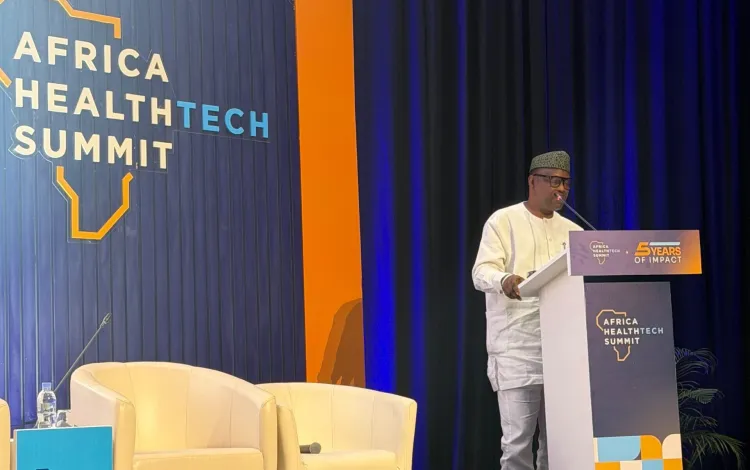
KIGALI, RWANDA — Unveiling a unified blueprint to connect fragmented medical databases nationwide, the Minister of State for Health and Social Welfare, Dr. Iziaq Salako, presented Nigeria’s new national digital health architecture at the 5th Africa HealthTech Summit. The policy framework is designed around the foundational principle of “one patient, one health record,” enabling seamless medical data sharing between public and private providers.
Developed under the Nigeria Digital in Health Initiative (NDHI) and approved by the National Council on Health, the framework addresses decades of disconnected health software across the country.
Core Pillars of the National Digital Health Architecture
The new national digital health architecture relies on a centralized digital structure to replace isolated databases:
Architectural Component
Core System Function
Strategic Health Objective
Health Information Exchange (HIE)
Interoperable communication layer
Enables real-time data sharing across facilities.
Shared Health Record (SHR)
Centralized longitudinal patient history
Eliminates repeated lab tests and lost records.
Master Client Registry
Unified patient identity mapping
Connects individual records across health networks.
Facility & Worker Registries
Verified health workforce tracking
Streamlines workforce allocation and licensing.
Moving Beyond Isolated Vertical Silos
Prior investments in Nigerian digital health created stovepiped, program-specific databases for vertical initiatives like HIV, immunization, malaria, and health insurance. While functional individually, these systems could not communicate.
Addressing delegates, Salako emphasized that artificial intelligence cannot fix weak underlying data standards. “Our ambition should not simply be to digitise healthcare but to build health systems that can learn, connect, anticipate and respond,” he stated.
Implementation is overseen by the newly established National Health Technology and Data Analytics Office within the Coordinating Ministry of Health, led by Dr. Obi Adigwe.
Infrastructure Bottlenecks and Continental Data Governance
Key challenges remain for rolling out the national digital health architecture across sub-national networks:
Sovereignty and Cloud Hosting: Judith Nguimfack, Head of Digital Health at the Africa CDC, warned that foreign cloud providers host most health AI models used across the continent, stressing that governments must remain primary data custodians.
Last-Mile Connectivity: Rural primary healthcare centers frequently lack reliable electricity, internet access, and funds for Electronic Medical Record (EMR) software.
Emerging Private Platforms: Local healthtech startups like Medinex are already deploying provider platforms, highlighting the need for enforced privacy and consent rules.
Why It Matters: A shared health record ends repeated diagnostic tests and lost patient histories, but full execution requires rural internet connectivity and strict data protection laws.
Kigali Health Tech Summit Urges Africa to Build Its Own AI KIGALI, RWANDA — Highlighting continental technological sovereignty, the kigali health tech summit urges africa build own ai capabilities tailored specifically for regional health systems. Opening on September 30, 2026, at the Kigali Convention Centre under…
Mental Health Challenges in Nigeria: Funding,… The World Health Organization (WHO) has consistently emphasized the critical importance of mental health, making it a global concern for the past three years through their World Mental Health Day themes. In 2021, the WHO…
Obasanjo, Abdulsalami, Others to Unveil Health Hub in Abuja Abuja, Nigeria – Former Nigerian presidents, including Olusegun Obasanjo and Abdulsalami Abubakar, alongside leading health experts, are set to unveil a state-of-the-art Health Hub in Abuja on September 2, 2025. The new facility, known as…
Nigerian Patients Left to Navigate Fragmented Care… ABUJA, NIGERIA — Public health stakeholders, government officials, and medical practitioners gathered at the 2026 Health Equity Conference in Abuja have warned that fragmented care in nigeria leaves vulnerable patients navigating disconnected hospitals, private laboratories,…