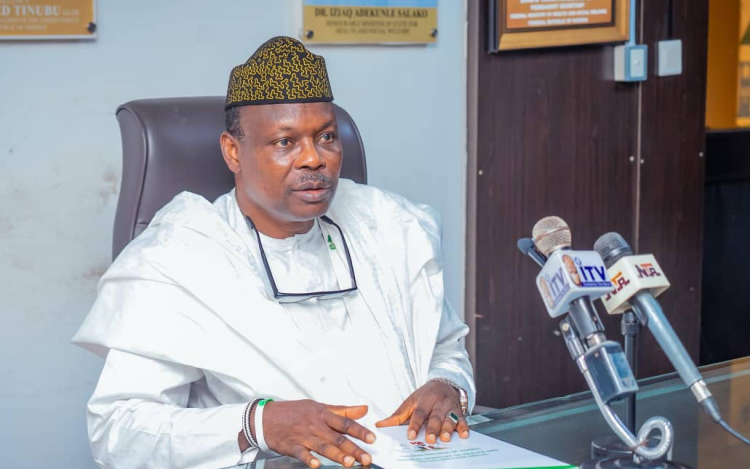
ABUJA, NIGERIA — Nigeria says it has disbursed ₦249.6 billion in primary health care funding through the Basic Health Care Provision Fund (BHCPF) over the past three years, and aims to extend direct financing to at least 17,600 health facilities, Minister of State for Health and Social Welfare Iziaq Salako said in Abuja on Wednesday.
The figure represents 77.1 per cent of the ₦323.6 billion disbursed since the fund began in 2019, Premium Times reported from the ministerial briefing. The BHCPF is governed by the National Health Act 2014 and is meant to improve access to essential care for poor and vulnerable Nigerians.
Where the primary health care funding went
Direct facility financing now supports 8,309 primary healthcare centres across the 36 states and the Federal Capital Territory, with a further 5,212 planned, bringing the projected total to 13,521. Facilities reaching Level 2 readiness rose from 1,748 in 2024 to 3,202 in the third quarter of 2026, and primary healthcare attendance rose from 34.55 million in 2023 to 43.06 million in the second quarter of 2026.
The Ministerial Oversight Committee approved a further ₦40.76 billion at its 14 October meeting, including ₦19.87 billion for the National Health Insurance Authority, ₦18.34 billion for the National Primary Health Care Development Agency, ₦2.04 billion for emergency medical treatment and ₦509.48 million for the Nigeria Centre for Disease Control and Prevention. That would raise cumulative disbursements to ₦364.3 billion.
National health insurance enrolment rose from about 16.2 million in 2023 to 23.06 million by the third quarter of 2026, and the fund supported coverage for 3,182,943 vulnerable Nigerians with National Identification Numbers. It also paid for free fistula surgeries, emergency caesarean sections and other emergency obstetric and newborn care for 96,068 women and babies.
The committee also approved insurance coverage for about 90,000 Nigerians in correctional facilities, and Salako commended Katsina State for releasing ₦240.79 million to its State Health Insurance Agency, a sign of the state contributions on which the insurance arrangements depend.
Medicines pooling, workers and accountability
The committee approved MEDIPOOL, a pooled procurement mechanism for essential medicines and health commodities, subject to quality assurance and accountability safeguards. It also approved phased salary support for 13,800 community-based health workers and skilled birth attendants, with the federal government paying 100 per cent in year one, 67 per cent in year two and 33 per cent in year three, before states take over.
Emergency transport is now in place in 171 of 172 local government areas under the Maternal and Newborn Mortality Reduction Innovation Initiative, and 168,571 ambulance episodes have been recorded since 2023. A total of 78,054 frontline health workers have been trained, towards a target of 120,000.
Emergency medical structures are now operational in all 36 states and the FCT, and the government plans to extend emergency transport to 200 local government areas by December 2026, according to the briefing.
The government is working with the National Assembly to raise the fund’s statutory allocation from 1 to 2 per cent of the Consolidated Revenue Fund, and is implementing updated BHCPF Guidelines 2.0 with the Independent Corrupt Practices and Other Related Offences Commission tracking spending.
The BHCPF is a central instrument of the Nigeria Health Sector Renewal Investment Initiative, launched in December 2023 to align federal, state and partner spending behind one plan. In the latest approval, the National Health Insurance Authority received about 48.7 per cent of the ₦40.76 billion and the National Primary Health Care Development Agency about 45 per cent, a calculation based on the figures announced.
MEDIPOOL’s design will be closely watched by suppliers and pharmacists. Pooled procurement combines orders across states to negotiate lower prices and set common quality standards, but it can also concentrate risk if a single supplier fails or payments are delayed. The committee approved it subject to quality assurance and accountability safeguards, but details of how it will operate were not published.
Higher primary health care funding matters most where clinics have long lacked basic drugs and staff. Pooled procurement could lower medicine prices and reduce stock-outs if it is managed transparently, while the shift of salary costs to states will test whether gains survive after federal support ends.
For patients with long-term conditions such as hypertension and diabetes, the value of primary health care funding is measured in whether the nearest clinic has a trained worker, working equipment and medicines in stock every month. Attendance figures show more Nigerians are using primary care, but the briefing did not report data on medicine availability, waiting times or patient outcomes, which would show whether the extra visits translate into better health.
Premium Times noted that one of its hyperlinked figures differed from the total releases cited, which should be checked against the ministry’s documents. The report did not cite independent audits of how facilities used their primary health care funding.
Why it matters: Direct financing and pooled medicine buying can keep clinics stocked and staffed, the backbone of chronic and maternal care in Nigeria.
Nigeria’s Health Insurance Coverage Hits 23.06… ABUJA, NIGERIA — Nigeria’s national health insurance coverage has reached 23.06 million people, up 42.35 per cent from 16.20 million in late 2023, the Director-General of the National Health Insurance Authority (NHIA), Dr Kelechi Ohiri,…
Kwara Penta-3 Vaccine Coverage Rises to 50.4 Per… ILORIN, NIGERIA — Child immunisation in Kwara has improved markedly, with coverage of the third dose of the pentavalent vaccine rising from 34.9 per cent in 2024 to 50.4 per cent in 2025 to 2026,…
Africa CDC Warns Continent Is Not Winning as Ebola… ADDIS ABABA, ETHIOPIA — The head of the Africa Centres for Disease Control and Prevention has issued a stark Africa CDC Ebola warning, telling more than 40 African health ministers that the continent is “not…
NCDC Says Allowance Followed Threats by Contacts to… Nigeria’s disease control agency began paying ₦100,000 a week to Ebola contacts in quarantine after some of them threatened to leave, and the payment was neither planned nor budgeted, the Director-General of the Nigeria Centre…