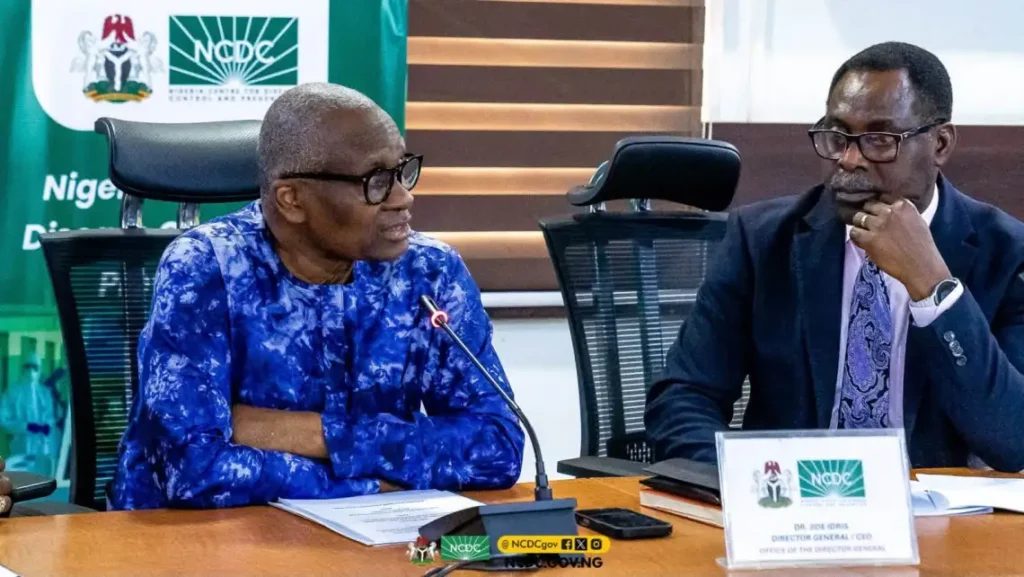
Nigeria’s disease control agency began paying ₦100,000 a week to Ebola contacts in quarantine after some of them threatened to leave, and the payment was neither planned nor budgeted, the Director-General of the Nigeria Centre for Disease Control and Prevention (NCDC), Jide Idris, said.
Idris told Channels Television’s Politics Today on Monday that the allowance was introduced on compassionate grounds after quarantined people complained that their absence was harming their families and businesses, Premium Times reported on 27 October. “It’s a temporary thing because it’s not something we’ve done,” he said.
Speaking at a briefing on 25 October, Idris had said: “We are providing N100,000 per person per week just to maintain their comfort and feeding, because they were complaining.” He also stressed then that being a contact does not mean a person has Ebola.
Why Ebola contacts in quarantine needed support
Idris said a contact leaving quarantine early would be a public health concern. “It’s a public health issue because you don’t know whether they will turn positive,” he said. The NCDC already provides feeding and accommodation for those in designated facilities.
He said the federal agency had to step in because support expected from state governments did not arrive, and that states are responsible for quarantine facilities and the resources needed for people under public health restrictions.
The number of identified contacts has risen to 54 after authorities traced an Uber driver who took the patient to the first hospital where she sought care, according to the report. Contacts include health workers, the patient’s husband, domestic staff and personnel who collected samples, and each is monitored for 21 days after their last possible exposure.
The contacts announced at the weekend included 44 people from the health facility where the patient was treated, three household members including her husband, driver and chef, three health workers who attended to her at a second clinic, and three members of the team that collected her samples. The Uber driver brought the total to 54. High-risk contacts are quarantined in a facility, while others are isolated and monitored, officials said last week.
Nigeria confirmed the imported case on 20 October, its first since the 2014 outbreak. The patient, a 42-year-old Ugandan-born woman living in Abuja, was evacuated to Switzerland with her husband on 26 October and is being treated in Geneva, while her husband is in isolation in Zurich. The World Health Organization has said Nigeria has no remaining confirmed cases, although monitoring of contacts continues.
Lessons for future outbreaks
Supporting Ebola contacts in quarantine is a recognised part of outbreak response. Quarantine asks healthy people to give up three weeks of income, and many Nigerians depend on daily earnings. Without food, cash or help for dependants, people may break quarantine or avoid tracing teams, which allows an undetected chain of transmission to continue.
The episode also points to a gap in planning between federal and state governments. States are expected to provide facilities and resources, but the NCDC had to fill the gap with money it had not budgeted. Clear agreements on who pays for quarantine support, set before an outbreak, would allow faster and more consistent help for Ebola contacts in quarantine and for those affected by future outbreaks of Lassa fever or other diseases.
Public health specialists generally recommend that quarantine support cover food, basic income, communication with family and psychological support, because three weeks of confinement while waiting to learn whether one is infected can be stressful. Clear information about why quarantine is needed, and exactly when it will end, also helps people comply.
Nigeria’s 2014 Ebola response, which contained the outbreak after 20 cases and eight deaths, relied heavily on tracing and monitoring contacts. That experience showed that public trust, and the willingness of Ebola contacts in quarantine to cooperate, can matter as much as laboratory capacity.
Health Minister Muhammad Pate has said Nigeria could declare its Ebola outbreak over on 7 December if no new confirmed or probable cases are detected.
The NCDC did not say how many people are currently in facility quarantine or the total cost of the allowance so far. Idris said at the weekend that the arrangement would be reviewed as the response continues.
The episode echoes wider concerns about funding gaps in the response. Idris acknowledged this week that some treatment isolation centres across the country, including one in Abuja, have broken down, and said the ₦10 billion emergency fund approved in June covers Lassa fever and other endemic diseases as well as Ebola, Premium Times reported.
Why it matters: Compensating quarantined people keeps them cooperating with tracing,
so funding this support should be planned before the next outbreak.
Healthy Monday Habits: Setting the Tone for the Entire Week Monday, the start of a new week, holds great potential for setting the tone for a successful and fulfilling week ahead. By incorporating healthy habits into our Mondays, we can create a positive and balanced…
Nigeria Tracks 53 Ebola Contacts, Approves Weekly… ABUJA, NIGERIA — As nigeria tracks 53 ebola primary contacts following expanded epidemiological tracing around its confirmed case, the Nigeria Centre for Disease Control and Prevention (NCDC) has approved a direct weekly allowance of ₦100,000…
WHO Says Ebola Survivors Can Spread Virus Through… BRAZZAVILLE, CONGO — People who survive Ebola can pass the virus on through sex if it persists in semen after recovery, but are not expected to spread it through sweat or saliva once discharged, the…
Newly Diagnosed With Breast Cancer? Your First 30 Days Guide If you have just been newly diagnosed with breast cancer, start here. You do not need to understand everything today. You need to know what to do next, and in what order. This guide breaks…