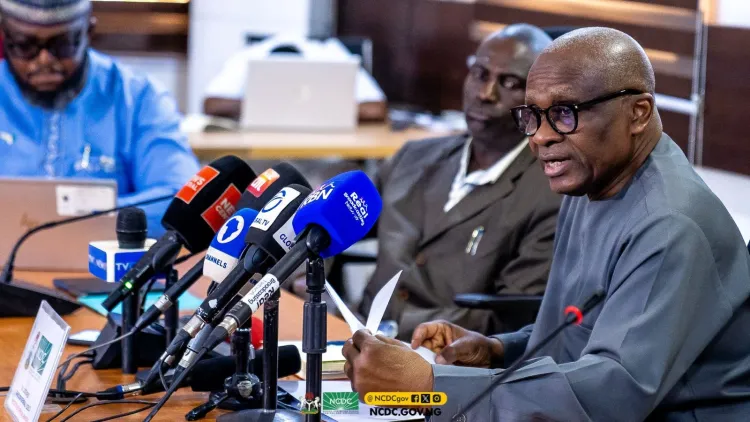
ABUJA, NIGERIA — As nigeria tracks 53 ebola primary contacts following expanded epidemiological tracing around its confirmed case, the Nigeria Centre for Disease Control and Prevention (NCDC) has approved a direct weekly allowance of ₦100,000 per person to cushion financial losses for individuals placed under mandatory quarantine. Announcing the emergency welfare intervention during a press briefing in Abuja, NCDC Director-General Dr. Jide Idris confirmed that while contact numbers rose from 44 to 53, all monitored individuals remain asymptomatic and have returned negative preliminary test results.
The cash support initiative was introduced after isolated individuals raised concerns over lost daily income, missed business commitments, and family upkeep challenges during the mandatory 21-day observation period.
Operational Benchmarks for Nigeria Tracks 53 Ebola
Data released by the NCDC and the Federal Ministry of Health outline the current contact surveillance and emergency resource parameters:
₦100,000 per person/week approved for loss of income
Primary Incubation Window
21-day active health monitoring from last known exposure point
National Testing Capacity
12 specialized laboratories designated for Bundibugyo molecular testing
Technical Mechanics: Nigeria Tracks 53 Ebola
Understanding the containment strategy behind why nigeria tracks 53 ebola contacts while establishing financial compensation highlights core epidemiological principles:
Incentivizing Compliance and Preventing Breach of Isolation: In informal and daily-wage economies, mandatory 21-day quarantine imposes severe socio-economic distress. Providing a weekly stipend of ₦100,000 alongside room and board mitigates the financial incentive for contacts to evade tracing teams, abscond from isolation, or hide symptom onset.
Expanded Contact Stratification and Mapping: The contact count expanded following secondary mapping across multiple clinical touchpoints: three household members (husband, driver, and chef), three clinical staff at Julius Berger Clinic, and three medical technicians from the initial sample collection team.
Subnational Preparedness and Diagnostic Network: The NCDC’s National Reference Laboratory in Abuja serves as the primary testing hub, supported by 12 regional laboratories equipped with Africa CDC-supplied reagents. State governments remain responsible for funding local isolation facilities, logistics, and field team deployment.
Financial Welfare, State Responsibilities, and Clinical Containment
Dr. Jide Idris clarified that while the ₦100,000 weekly stipend represents an unbudgeted emergency intervention, public health authorities will continuously review the financial package to ensure maximum compliance. Emphasizing that being listed as a primary contact does not equal infection, the NCDC chief urged full public cooperation while reminding state governors that subnational health security depends on localized funding and facility readiness.
Concurrently, infection prevention teams have decontaminated all private facilities and residential premises linked to the 42-year-old patient, while secondary suspect alerts—including a recent case in Rivers State—have been thoroughly investigated and ruled negative.
Economic Security in Outbreak Response and Sector Outlook
Public health experts praise the financial allowance as a vital structural innovation for African outbreak management. Historically, uncompensated quarantines have represented the weakest link in epidemic control, forcing low-income workers to prioritize immediate economic survival over public health isolation rules.
By pairing rigorous laboratory surveillance with direct economic cushions for affected households, Nigeria establishes a pragmatic operational model for maintaining quarantine integrity as nigeria tracks 53 ebola contacts across the Federal Capital Territory.
Why It Matters: Financially compensating quarantined contacts reduces economic pressure to evade isolation, closing one of the most common structural vulnerabilities in urban epidemic containment.
NCDC Says Allowance Followed Threats by Contacts to… Nigeria’s disease control agency began paying ₦100,000 a week to Ebola contacts in quarantine after some of them threatened to leave, and the payment was neither planned nor budgeted, the Director-General of the Nigeria Centre…
Nigeria Confirms Imported Ebola Case in Abuja,… ABUJA, NIGERIA — The Federal Ministry of Health and Social Welfare has confirmed an imported ebola case in abuja, placing 44 high-risk contacts in strict 21-day quarantine after an international traveler tested positive for the…
NCDC Explains Ebola Evacuation as Nigeria Eyes… ABUJA, NIGERIA — Clarifying diplomatic and biosecurity protocols behind recent aeromedical logistics, the NCDC explains ebola evacuation procedures for Nigeria's index patient to Switzerland while establishing a provisional December 7 target date to declare the…
NCDC Says ₦10 Billion Ebola Fund Also Covers Lassa Fever ABUJA, NIGERIA — Clarifying public expenditures following political debates over health emergency readiness, ncdc says 10 billion Naira approved by the Federal Government was designated for comprehensive epidemic response rather than isolated Ebola containment. Speaking…