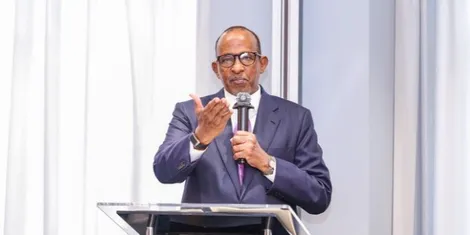
NAIROBI, KENYA — Kenya’s Health Cabinet Secretary Aden Duale has called for faster implementation of two World Bank health projects worth about Ksh43.5 billion, to strengthen emergency response and the country’s Universal Health Coverage agenda, Kenyans.co.ke reported on 30 October.
Duale met a World Bank delegation led by Manager Ronald Mutasa on Thursday, 29 October. Social Health Authority (SHA) Chief Executive Mercy Mwangangi, Director-General for Health Dr Patrick Amoth and Principal Secretary Ouma Oluga also attended.
The two World Bank health projects
The Building Resilient and Responsive Health Systems (BREHS) programme, launched in March 2024, carries Ksh27.9 billion ($215 million) in World Bank financing. It aims to strengthen primary health care, improve the supply of medical commodities through the Kenya Medical Supplies Authority (KEMSA) and support reforms, including the transition to the SHA.
The Kenya Health Emergency Preparedness, Response and Resilience (KHEPRR) programme is worth Ksh15.6 billion ($120 million) and runs for six years, from 2024 to 2030. It targets disease surveillance, laboratory services, medical supplies, health worker training and vaccine manufacturing.
Duale urged partners to align with the government’s approach of “One Plan, One Budget, One Monitoring and Evaluation Framework”, and stressed translating investments into measurable improvements in service delivery, according to the report.
The push comes as Kenya responds to an Ebola outbreak with nine confirmed cases and two deaths as of 26 October. Earlier in October, Kenya secured Ksh51.96 billion in emergency World Bank funding covering health emergencies, medicines, agricultural inputs, water and sanitation and support for vulnerable households, and the UN Office for the Coordination of Humanitarian Affairs allocated more than Ksh259 million for the Ebola response.
Partners equip Kenyatta National Hospital
On the same day, Duale handed over refurbished wards at Kenyatta National Hospital (KNH) under the Adopt-a-Ward Initiative, after private sector partners invested Sh130 million in specialised care, The Star reported. Co-operative Bank of Kenya contributed Sh100 million, including 96 orthopaedic beds, and the Nakumatt Molo Fire Victims Fund invested Sh30 million, including 40 three-crank electric beds.
“Their investments demonstrate how collective action can expand access to quality specialised care,” Duale said. He urged more companies, foundations and development partners to support the health sector in line with Ministry of Health standards, and stressed accountability and proper maintenance of donated equipment.
The Star reported that other investments at KNH include the Nest 360 newborn unit project, 136 modern beds and 3D printing technology, and that the government is renovating Levels Seven and Eight of the hospital, which it aims to make a centre of specialised treatment, research and training. Duale also cited the expansion of Primary Care Networks across all 47 counties, the National Ambulance Dispatch Centre and the SHA’s 922 Lifeline as parts of the emergency response system.
Development finance projects often move more slowly than planned because of procurement rules, delays in releasing counterpart funds and the need to coordinate national and county governments. Kenya’s devolved system, in which counties run most health facilities, adds another layer, because many investments must be delivered through 47 county health departments.
For patients, the value of World Bank health projects will show in whether clinics have medicines, laboratories can test quickly and health workers are trained and in post. Strengthening KEMSA’s supply chain is particularly important for chronic conditions such as HIV, diabetes and hypertension, where interruptions in supply force patients to buy medicines privately or go without.
Donated equipment brings its own challenges. Beds and machines need maintenance budgets and trained technicians, which is why Duale emphasised upkeep.
KHEPRR’s focus on vaccine manufacturing reflects a continental push for African production. Africa imports nearly all its vaccines, according to reporting from the African Medicines Agency’s inaugural week in Kigali this week.
World Bank health projects in Kenya are generally implemented through government agencies and counties, so delays in procurement, reporting or counterpart funding can hold back progress. That is one reason ministers press for faster implementation, particularly when an outbreak exposes gaps in surveillance and supplies.
The meeting included SHA chief executive Mercy Mwangangi, whose authority resumed verification of legacy NHIF claims this week.
Kenya’s health reforms, including the shift to the SHA and the expansion of Primary Care Networks, depend heavily on reliable funding, and external financing such as the World Bank programmes fills part of that need while domestic revenue grows.
The reports did not say how much of the Ksh43.5 billion has been disbursed so far or which project milestones are behind schedule.
Why it matters: Faster delivery of World Bank financing could strengthen Kenya’s medicine supply and emergency readiness while Ebola tests the system.
Kenya Resumes NHIF Debt Checks as Digital Agency… NAIROBI, KENYA — Kenya has resumed verification of unpaid claims inherited from the defunct National Hospital Insurance Fund (NHIF), as the country’s Digital Health Agency (DHA) outlined plans to generate Social Health Authority claims directly…
Kenya SHA Contracts Expire September 30 as HAKIKA… NAIROBI, KENYA — Under the updated kenya sha hakika rules framework, Kenyan healthcare providers face a strict midnight deadline on September 30 to execute new digital agreements or lose access to public health scheme reimbursement…
Kenya’s SHA Gives Hospitals 14 More Days to Sign New… NAIROBI, KENYA — Resolving an immediate standoff with county leaders, kenya sha gives hospitals 14 additional days to execute new healthcare provider contracts for the 2026–2029 cycle. The Social Health Authority (SHA) extended the formal…
Kenya says 32 million now registered under Social… Kenya has registered 32 million people under the Social Health Authority and collected Sh203.7 billion across its four funds in 19 months, of which Sh178.4 billion has been paid to healthcare providers, SHA Chief Executive…