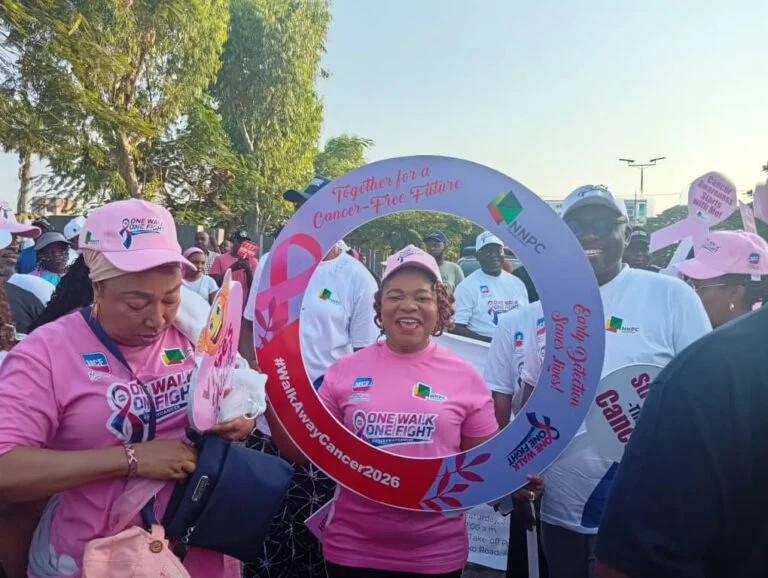
ABUJA, NIGERIA — The NNPC Foundation cancer screening programme has expanded from a few hundred people to thousands across Nigeria, alongside donations of radiotherapy and imaging equipment to public hospitals, an NNPC Ltd. executive said at a cancer awareness walk in Abuja on Saturday, the News Agency of Nigeria (NAN) reported.
Sophia Mbakwe, Executive Vice President for Business Services at NNPC Ltd., represented by Euginia Dominion, Acting Managing Director of NNPC Foundation Ltd., spoke at the 12th #WalkAwayCancer campaign organised with the Medicaid Cancer Foundation. She said “early detection saved lives and access to healthcare should not be determined by economic circumstances” or geographical location.
Scale of NNPC Foundation cancer screening
In February 2024, the foundation provided free breast, cervical and prostate cancer screening to 291 people at the Federal Medical Centre, Jabi, in Abuja. In October 2024, it expanded screening to 3,150 people across Nigeria’s six geopolitical zones, in partnership with the Federal Ministry of Health and Social Welfare, according to NAN.
NNPC Ltd., through its joint venture with Renaissance, donated a linear accelerator radiotherapy machine to the National Hospital, Abuja. More than 2,000 patients have benefited, and treatment costs fell by 80 per cent, the company said. In November 2025, the joint venture committed to maintaining the machine.
The foundation also reported free eye cancer screening and awareness sessions for more than 1,000 children in Akwa Ibom State in September 2025, with the Akanimo Cancer Foundation. It rehabilitated patient wards with a combined capacity of 102 beds at the National Orthopaedic Hospital, Igbobi, in Lagos, commissioned in April 2026, and handed over two 1.5 Tesla MRI machines, one to Nnamdi Azikiwe University Teaching Hospital, Nnewi, in May 2026, and one to the National Orthopaedic Hospital, Dala, Kano, in June 2026.
Its cataract outreach recorded 6,028 successful surgeries between December 2024 and May 2025, and another phase is due to begin before the end of 2026. This year’s walk was held under the theme “One Walk; One Fight” and drew NNPC and Medicaid Cancer Foundation officials, government representatives, health professionals, development partners, survivors and advocates.
Why screening and radiotherapy matter
Cancer is a growing cause of death in Nigeria. The National Institute for Cancer Research and Treatment has estimated between 102,000 and 127,763 new cancer cases and about 72,000 to 79,542 cancer deaths each year, NAN reported in a separate story last month. Many patients are diagnosed at a late stage, when treatment is harder and more expensive.
Screening can find cervical cancer at a pre-cancerous stage that can be treated simply, and can detect breast and prostate cancers earlier. But screening only saves lives if people who test positive can reach diagnosis and treatment quickly. That is why investments in radiotherapy and imaging are important alongside NNPC Foundation cancer screening drives.
Radiotherapy is needed for a large share of cancer patients, yet Nigeria has relatively few working machines for its population, and breakdowns can force patients to travel long distances or wait for weeks. The 80 per cent reduction in treatment costs reported at the National Hospital suggests how much equipment availability affects what patients pay.
Corporate and philanthropic investment can fill gaps, but it also raises questions of sustainability. Machines need maintenance contracts, trained physicists and radiographers, and steady power. The joint venture’s commitment to maintenance addresses one of those needs.
The NNPC Foundation cancer screening campaigns cover breast, cervical and prostate cancers, three of the most common cancers in Nigeria. Cervical cancer is largely preventable through HPV vaccination and screening, while breast and prostate cancers are more treatable when found early.
The foundation’s other health work, including cataract surgery outreach, ward rehabilitation and MRI donations, shows a broader pattern of corporate investment in hospital infrastructure. Such investments are most effective when they are coordinated with government plans, so that equipment goes where it is most needed and staff are trained to use it.
Cancer care also overlaps with Nigeria’s workforce challenges. Nurses’ leaders said last week that Nigeria has only about 300 trained oncology nurses, and that only two institutions train them.
For individuals, the advice from cancer specialists is consistent: know the warning signs, attend screening where available, and seek care promptly for unusual lumps, bleeding, persistent pain or weight loss.
NAN’s report did not give figures on how many cancers were detected through the foundation’s screening campaigns or how patients were referred for treatment.
Why it matters: Screening only saves lives when treatment follows, so pairing free checks with radiotherapy and imaging investment strengthens Nigeria’s cancer care chain.
Breast Cancer Screening in Nigeria: Where to Go and Costs Breast cancer screening in Nigeria confuses people for a simple reason: nobody tells you which test you need. A woman of 32 asks for a mammogram and is told she does not need one. A…
Newly Diagnosed With Breast Cancer? Your First 30 Days Guide If you have just been newly diagnosed with breast cancer, start here. You do not need to understand everything today. You need to know what to do next, and in what order. This guide breaks…
Foundation Aims to Reach 5,000 Nigerian Girls With… ABUJA, NIGERIA — A Nigerian foundation has launched a campaign to improve menstrual health for girls, aiming to reach 5,000 girls across the country with menstrual health education, books and hygiene support by 28 May…
Over 120 Million Nigerians Grapple with Poor… A staggering 60% of Nigerians, totaling over 120 million individuals, are reported to suffer from poor dentition and jaw issues, according to the Nigerian Association of Orthodontists (NAO). This revelation comes amid growing concerns over…