Ask a Nigerian where they get health advice and the honest answer is often a WhatsApp group. That habit is why the WhatsApp AI health assistant has become one of the most watched ideas in African digital health. It meets people inside an app they already open dozens of times a day, it needs no new download, and it works on modest phones and patchy data. The harder question is not whether these tools can be built. It is whether they can be built safely enough to deserve the trust people give them.
Why WhatsApp, and why now
Most African health apps die in the app store. They ask users to download something new, create an account, remember a password and return often enough to form a habit. Each step loses people. A chat assistant on WhatsApp removes almost all of that friction. The interface is a conversation, which suits people who prefer voice notes and short messages to forms and menus.
Two shifts made the idea practical. The first is the arrival of large language models that can understand informal questions, mixed languages and spelling errors, and answer in plain speech. The second is the WhatsApp Business Platform, which lets organisations run verified, automated accounts at scale. Put together, they allow a single service to answer thousands of health questions an hour in several languages, at any time of night.
What the evidence actually shows
The record so far is encouraging but thin, and it is worth being precise about it.
Malawi offers one of the largest real-world examples. Its Ministry of Health launched a COVID-19 WhatsApp chatbot in May 2020 so citizens could report symptoms, register as possible cases and get verified information. A retrospective analysis published in the Journal of Medical Internet Research in 2026 found the service was accessed 818,426 times, with usage rising and falling alongside the epidemic waves. The same study recorded 38% downtime over the pandemic, the longest stretch coinciding with the national vaccine rollout. A companion usability study found that 80% of participants said they would use it again.
That pairing is the lesson in miniature. Demand was real and large. Reliability was the weak point, and it failed at exactly the moment people needed it most.
A wider review of language AI for public health in Africa, reported in 2025, found that most tools existed only in English or French and that few had moved beyond laboratory development. The researchers identified only one system in operation with a measurable public health effect. In Nigeria, a randomised pilot trial of a WhatsApp HIV information chatbot has been running at the Infectious Disease Institute, University College Hospital, Ibadan, testing whether the tool supports patients starting treatment. Results from trials like this will matter far more than product launches.
The honest summary is that the WhatsApp AI health assistant has proven it can attract users. It has not yet proven, at scale, that it changes health outcomes. Anyone claiming otherwise is ahead of the data.
The risks the WHO wants builders to take seriously
In January 2024 the World Health Organization published guidance on the ethics and governance of large multimodal models in health, with more than 40 recommendations for governments, technology companies and providers. Its central concern applies directly to chat assistants: these models can produce statements that are false, incomplete or biased while sounding completely confident.
For a health chatbot, that risk takes specific forms:
Confident errors. A wrong dose or a missed danger sign delivered in a friendly tone can be more harmful than no answer at all.
Automation bias. Users, and sometimes health workers, stop questioning an answer because a machine gave it.
Language gaps. A model that performs well in English may degrade quietly in Yoruba, Hausa or Pidgin, and the user will not know.
Privacy exposure. Health conversations are sensitive data. In Nigeria they fall under the Nigeria Data Protection Act 2023, which requires a lawful basis, purpose limitation and security safeguards.
Fragile infrastructure. As Malawi showed, a service that goes down during a surge does damage to trust that is slow to repair.
None of these is a reason to avoid the technology. Each is a design requirement.
Five safety layers for a WhatsApp AI health assistant
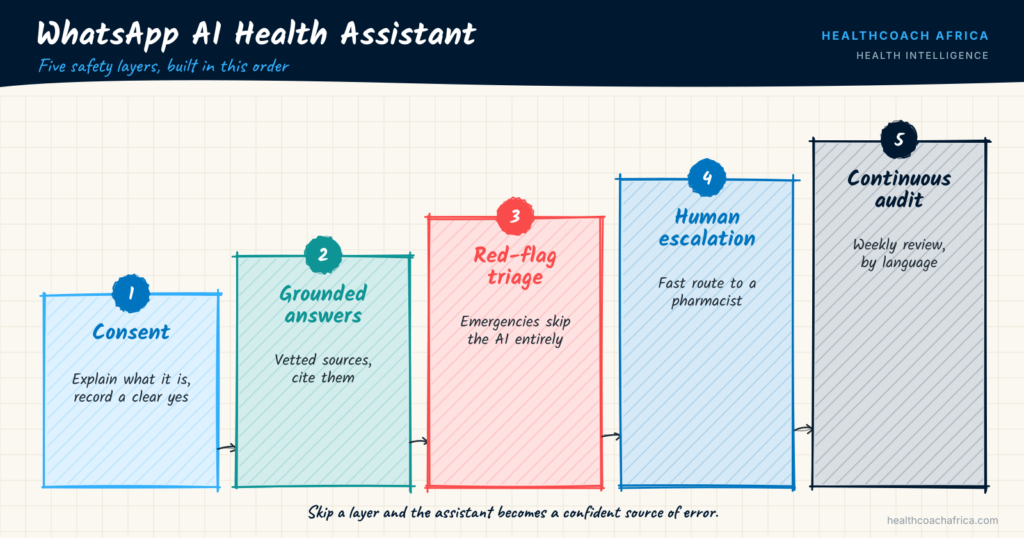
Drawing on the WHO guidance and the deployments above, a responsible WhatsApp AI health assistant needs five layers working together.
Five safety layers every WhatsApp AI health assistant needs, from consent to human escalation
Consent at the door. The first message should explain in plain language what the assistant is, what it is not, how data will be used, and how to stop. Consent should be recorded, not assumed.
Grounded answers. Responses should be drawn from vetted clinical sources, such as national treatment guidelines and product labels, rather than whatever the model recalls. Retrieval-based designs that cite their source reduce invented answers considerably.
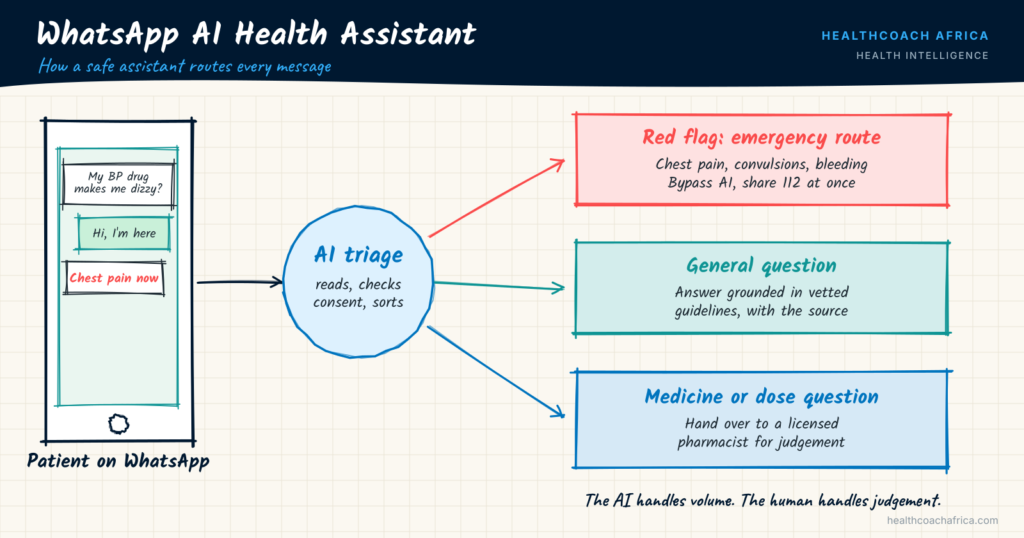
Red-flag triage. Certain words and symptom patterns, such as chest pain, convulsions, heavy bleeding, a child who cannot drink or suicidal thoughts, should bypass the AI entirely and trigger an immediate referral message with emergency numbers. A 2026 South African preprint testing a hybrid design found that adding a rule-based safety layer on top of the AI sharply improved how consistently urgent cases were flagged, compared with the AI working alone.
A human behind the screen. Every assistant needs a clear, fast route to a licensed professional. For medicine questions, that professional is a pharmacist. The AI handles volume; the human handles judgement.
Continuous audit. Teams should review samples of conversations every week, track errors by language, and publish what they find. Uptime should be monitored as closely as accuracy.
What this looks like in practice
HubPharm Africa, the sister company of HealthCoach Africa, built Afiya on these principles. Afiya is an AI health companion on WhatsApp that answers questions in more than 50 languages and has been used by over 15,000 people across 31 countries. It does not diagnose. When a question involves a specific medicine, a dose or a worrying symptom, it routes the user to a licensed pharmacist rather than guessing.
That routing is the point. The value of a WhatsApp AI health assistant is not that it replaces professionals. It is that it filters, educates and escalates, so that the scarce time of pharmacists and doctors goes to the people who need it most.
Questions to ask before you trust one
Whether you are a patient, an HMO or a hospital considering a partnership, five questions will separate serious tools from risky ones:
Who reviews the medical content, and how often?
What happens when I describe an emergency?
Can I reach a qualified human, and how quickly?
Where is my data stored, and who can see it?
In which languages has the tool actually been tested?
If a provider cannot answer clearly, treat its advice with caution.
From the HubPharm pharmacy desk. A chatbot can tell you what a medicine is for. It takes a pharmacist to check it against everything else you take. If you have a prescription question that an app could not settle, send the code HC-HT01 on WhatsApp to +234 705 050 5001 and a licensed HubPharm pharmacist will pick it up, or start with Afiya at +234 816 053 3715.
The bottom line
The WhatsApp AI health assistant is a genuine opportunity for Africa because it fits how people already communicate. Its success will depend less on how clever the model is and more on the unglamorous work around it: grounding, triage, human escalation, privacy and uptime. Build those well, and a chat window becomes a front door to real care. Skip them, and it becomes one more source of confident misinformation.
Ndemera I, Hsieh YTS, Chirwa K, Ngwira S, et al. Describing a national chatbot deployed by the Ministry of Health in Malawi during the COVID-19 pandemic: retrospective data analysis. J Med Internet Res. 2026;28:e80960. doi:10.2196/80960
Ngwira S, Wu TSJ, et al. Prospective acceptability and usability of a WhatsApp chatbot for epidemic response in Malawi: a convergent mixed-methods study. JMIR Preprints, 2026. https://preprints.jmir.org/preprint/83397
Pilot RCT and interview study on an HIV chatbot in Nigeria. ClinicalTrials.gov NCT06814041.
Nkosi-Mjadu BE. Design and preliminary safety validation of a hybrid deterministic-AI triage system for multilingual primary healthcare: a WhatsApp-based vignette study in South Africa. medRxiv, 2026. doi:10.64898/2026.04.21.26349781
Federal Republic of Nigeria. Nigeria Data Protection Act, 2023.
Please follow and like us:
Views:72
Related Posts:
7 Science-backed Strategies To Replace Bad Habits… The truths about replacing habits. What does it takes to change habit? You just have to learn proven strategies to rewire your brain. Let's face it. Stopping bad habit is challenging and developing good habits…
Diabetes in Nigeria: Why Blood Sugar Control Fails Diabetes in Nigeria does not usually fail in the clinic. Among people who reach a specialist and stay in care, control is often reasonable. It fails in the years before anyone tests you, and it…
Triple Negative Breast Cancer: What It Means for Treatment If your report says triple negative, you have probably already searched the phrase and found something frightening. Triple negative breast cancer is more aggressive than other types, and there is no point pretending otherwise. What…
Cancer Caregiver Support Tips: Caring Well Without… When someone is diagnosed with cancer, the whole family feels it. In Nigeria, most care happens at home, often led by a spouse, adult child or sibling. Caregivers manage medicines, cook special meals, travel to…