If your report says triple negative, you have probably already searched the phrase and found something frightening. Triple negative breast cancer is more aggressive than other types, and there is no point pretending otherwise. What most of those articles will not tell you is that it is also the type that responds best to chemotherapy, and that Nigerian women get this diagnosis far more often than the international pages assume.
This guide explains what the words mean, how the disease is treated, what is realistically available in Nigeria, and the three things within your control that actually change the outcome.
What triple negative breast cancer means on your report
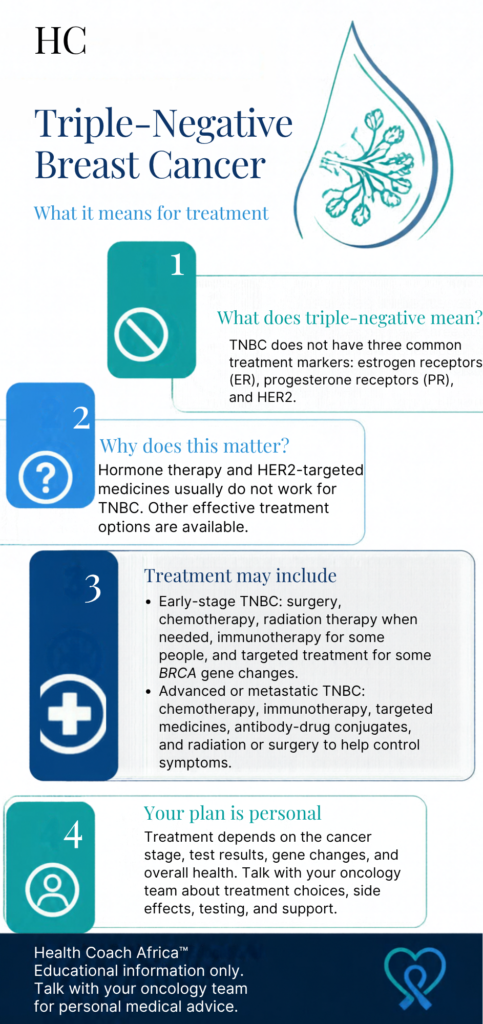
Every breast cancer gets tested for three markers using immunohistochemistry, written as IHC on request forms: the oestrogen receptor (ER), the progesterone receptor (PR), and HER2.
Triple negative means all three came back negative. Nothing is missing from your report, and nothing went wrong with the test. It is simply a description of what the cancer cells carry on their surface.
That matters because those receptors are what most breast cancer drugs attach to. Hormone therapy such as tamoxifen works on ER-positive cancer. Trastuzumab works on HER2-positive cancer. With none of the three present, neither will help you, so chemotherapy becomes the main systemic treatment rather than one option among several.
Here is the part worth holding onto. Triple negative tumours tend to grow quickly, and fast-growing cells are exactly what chemotherapy targets best. So this type often shrinks dramatically on chemotherapy, sometimes disappearing completely before surgery.
Why triple negative breast cancer matters more in Nigeria
A genomic study published in Nature Communications found that 43 percent of Nigerian breast cancers were triple negative, compared with 33 percent in a Black American cohort and 13 percent in a White American one.
Read that again. A Nigerian woman is more than three times as likely to have this subtype as the White American women most international articles are written for. It also appears younger here, and it arrives alongside our wider problem of late presentation, with about 76 percent of Nigerian patients already at stage III or IV by diagnosis.
So this is not a rare variant for us. It is close to half of all cases, and treatment advice copied from a British or American website may not fit what you are dealing with.
How triple negative breast cancer is treated
Chemotherapy, usually before surgery
For most stage II and stage III disease, treatment starts with chemotherapy rather than an operation. Doctors call this neoadjuvant therapy, and it does two useful things. It shrinks the tumour so that surgery is smaller and more likely to succeed, and it shows your team in real time whether the cancer is responding.
The goal is a pathologic complete response, meaning no cancer cells remain in the tissue removed at surgery. Patients who achieve that have markedly better long-term outcomes, which is why finishing the full course matters so much.
Immunotherapy
Since the KEYNOTE-522 trial, the international standard for stage II and III triple negative breast cancer has been pembrolizumab given alongside chemotherapy before surgery, then continued for up to a year afterwards. The regimen improves both complete response rates and overall survival.
Whether that is available to you in Nigeria is a separate question, addressed below.
Surgery and radiotherapy
Surgery follows chemotherapy, either breast-conserving surgery or mastectomy depending on tumour size, location and whether radiotherapy will be available to you afterwards. Radiotherapy usually follows breast-conserving surgery and often follows mastectomy in node-positive disease.
If cancer remains after chemotherapy
This is one of the most practically useful things in this guide. If cancer is still present in the tissue removed at surgery, additional treatment afterwards reduces the risk of recurrence.
For patients carrying a BRCA1 or BRCA2 mutation, olaparib is the preferred option. For everyone else, capecitabine is standard, and capecitabine matters enormously in the Nigerian context because it is taken as a tablet at home, it does not require an infusion chair, and it costs a fraction of the newer agents. Ask about it specifically.
If the cancer has spread
Treatment for metastatic triple negative breast cancer is moving quickly. Antibody-drug conjugates including sacituzumab govitecan and datopotamab deruxtecan have shown meaningful survival gains in recent trials and are entering international guidelines. Access in Nigeria is currently very limited, so raise clinical trials with your oncologist if you reach this stage.
What is realistically available in Nigeria
Being frank about this is more useful than listing drugs you cannot get.
Chemotherapy is available. The standard agents used in triple negative breast cancer, including anthracyclines, cyclophosphamide, taxanes, platinum agents and capecitabine, are obtainable in Nigeria. Supply and price fluctuate, which is a logistics problem rather than a clinical one.
Immunotherapy is difficult. Pembrolizumab is expensive and not widely accessible here, and NHIA coverage does not currently make a full year of it affordable for most families. Ask your oncologist directly what it would cost and whether any support or trial route exists, then plan around the answer rather than assuming.
Genetic testing is limited but growing. BRCA testing is not routine in Nigerian practice, though it is increasingly available through private laboratories and research programmes. It matters more in triple negative breast cancer than in other subtypes, both because BRCA mutations are more common in this group and because a positive result opens up olaparib and changes screening advice for your sisters and daughters.
The things that matter most are the cheapest. Starting treatment quickly, receiving the correct regimen, and completing every cycle on schedule are worth more to your outcome than any single expensive drug. That is where families here lose ground, and it is fixable.
Three things within your control
1. Confirm your receptor testing was done properly. Triple negative is a diagnosis of exclusion, so it depends entirely on the IHC being run and read correctly. If your report does not clearly state ER, PR and HER2 results, ask for them. If your hospital cannot run IHC, request the paraffin block, not just the slides, and have it sent to a laboratory that can.
2. Protect your treatment schedule. Chemotherapy works on a rhythm. Cycles delayed because a drug was out of stock, or because money ran short that week, reduce the benefit of the whole course. So before cycle one, confirm where every medicine will be sourced, what happens if it is unavailable on the day, and who to call when something goes wrong.
3. Ask two specific questions. Ask whether BRCA testing is available and worth doing in your case. And ask, if cancer remains after surgery, what additional treatment you will be offered. Knowing the answer to the second question in advance stops it becoming a crisis later.
What to ask your oncologist
Is my cancer confirmed triple negative on immunohistochemistry, and can I have that in writing?
Will I have chemotherapy before or after surgery, and why?
Which regimen, how many cycles, and over how many weeks?
Is pembrolizumab an option for me, and what would it cost?
Should I have BRCA testing?
If cancer remains after surgery, what happens next?
What are the warning signs during chemotherapy that mean I should call you immediately?
Common questions
Is triple negative breast cancer curable?
Yes, particularly at earlier stages. It is more aggressive than other subtypes, but it also responds strongly to chemotherapy, and patients whose tumours disappear completely before surgery do very well long term. Stage at diagnosis remains the single biggest factor, which is why speed matters more here than in slower-growing types.
Why can’t I take tamoxifen?
Tamoxifen blocks the oestrogen receptor, and triple negative breast cancer has no oestrogen receptor for it to block. Taking it would give you the side effects with none of the benefit. The same logic applies to trastuzumab, which needs HER2 to be present.
Does triple negative breast cancer come back more often?
Recurrence risk is higher in the first three to five years than for hormone-positive disease. However, the risk then falls, and after roughly five years it becomes lower than for some other subtypes. Completing your full treatment course is what most reduces that early risk.
Is triple negative breast cancer hereditary?
Not always, but BRCA1 mutations are more common in this subtype than in others. If you are triple negative, particularly if you are young or have relatives with breast or ovarian cancer, discuss genetic testing. A positive result would also mean your sisters and daughters need earlier screening.
Can I get pembrolizumab in Nigeria?
It is available in principle but expensive and not widely accessible, and a full year of treatment is beyond most families without support. Ask your oncologist for a costed answer for your specific case, and ask whether any clinical trial or access programme applies. Meanwhile, do not let uncertainty about immunotherapy delay the chemotherapy you can start now.
The part that is actually within reach
The gap between a good and a poor outcome in triple negative breast cancer in Nigeria is rarely about access to the newest drug. It is about starting on time, getting the right regimen, and finishing every cycle without interruption.
At HubPharm Africa that second part is our work. We source verified medicines, deliver them across Nigeria, coordinate refills so no cycle slips for a supply reason, and put a pharmacist on the other end of a phone when something changes. Across our programmes we have seen a 42 percent improvement in medication adherence, which in oncology is not a convenience metric.
If you or someone in your family has just been told triple negative, talk to our care team about a treatment supply plan before cycle one.
This article is for general information and does not replace advice from your own oncologist. Treatment decisions should be made with your treating team, based on your specific diagnosis.
References
Characterization of Nigerian breast cancer reveals prevalent homologous recombination deficiency and aggressive molecular features. Nature Communications, 2018.
Pembrolizumab for Early Triple-Negative Breast Cancer, KEYNOTE-522. New England Journal of Medicine.
Overall Survival with Pembrolizumab in Early-Stage Triple-Negative Breast Cancer. New England Journal of Medicine, 2024.
Triple negative breast cancer in 2026: antibody-drug conjugates, immunotherapy and biomarkers. Binaytara Foundation Cancer News, 2026.
Nigeria’s 6-year (2018–2023) stage distribution of breast cancer at diagnosis. ecancermedicalscience, 2025.
International Agency for Research on Cancer, Nigeria fact sheet, Global Cancer Observatory, 2024 estimates.
Please follow and like us:
Views:136
Related Posts:
Newly Diagnosed With Breast Cancer? Your First 30 Days Guide If you have just been newly diagnosed with breast cancer, start here. You do not need to understand everything today. You need to know what to do next, and in what order. This guide breaks…
How to Check for Breast Cancer at Home: 5 Simple, Safe Steps Most Nigerian women who find breast cancer find it themselves. Not at a screening centre, and not during a routine check-up, but in the shower or while dressing. So learning how to check for breast…
Breast Cancer Screening in Nigeria: Where to Go and Costs Breast cancer screening in Nigeria confuses people for a simple reason: nobody tells you which test you need. A woman of 32 asks for a mammogram and is told she does not need one. A…
Diabetes in Nigeria: Why Blood Sugar Control Fails Diabetes in Nigeria does not usually fail in the clinic. Among people who reach a specialist and stay in care, control is often reasonable. It fails in the years before anyone tests you, and it…