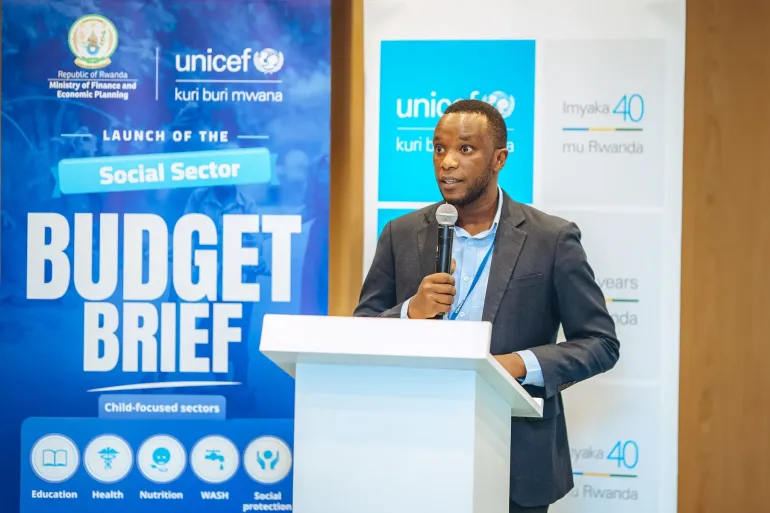
KIGALI, RWANDA — Rwanda’s 2026/27 Rwanda social sector budget allocates Frw 500.2 billion to health, with development partners financing close to half of the health budget, according to a Social Sector Budget Brief launched by UNICEF and the Ministry of Finance and Economic Planning (MINECOFIN) on 12 November.
The brief found that health, education, social protection and water, sanitation and hygiene together account for Frw 1,711.3 billion, or 22 per cent of the national budget, UNICEF said in a statement.
The brief, titled around Rwanda’s investment in children, examines whether spending in these four sectors is matching the government’s targets for child survival, nutrition, learning and protection, according to UNICEF.
What the Rwanda social sector budget brief shows
Rwanda has made strong progress on child health and nutrition, the brief said. Stunting among children under five fell from 33 per cent to 27 per cent, and under-five mortality fell from 45 to 36 deaths per 1,000 live births. The government aims to reduce under-five mortality to 20 per 1,000 by 2028/29.
Reaching that target would require under-five mortality to fall by almost half from the current level within a few years, a faster pace than in the recent past. As general background, the remaining deaths are increasingly concentrated among newborns, which calls for better care around birth and in the first weeks of life.
As general background, newborn deaths are often linked to complications of preterm birth, problems during labour and infections, many of which can be prevented with skilled care at delivery, essential newborn care and timely treatment.
Partners financing close to half of health spending is one of the most striking findings of the Rwanda social sector budget brief. As general background, that level of reliance means any reduction in external support could put pressure on services unless domestic resources increase.
Lieke van de Wiel, UNICEF Representative in Rwanda, and Jeanette Rwigamba of MINECOFIN spoke at the launch, UNICEF said.
The launch brought together government officials and partners to discuss how the budget can sustain progress for children, according to UNICEF’s statement on the Rwanda social sector budget brief.
Why domestic financing matters now
As general background, many African countries face reduced external health funding following cuts to international aid budgets over the past two years. Countries that rely heavily on donors for medicines, health workers and programmes are most exposed.
Rwanda has been widely recognised for its community health worker programme and its community-based health insurance scheme, Mutuelle de Santé, which covers most of the population. These systems have helped expand access to primary care, maternal services and childhood vaccines.
As general background, the community health worker network also plays a growing role in screening for hypertension and diabetes in some districts, showing how child health systems can be adapted to rising noncommunicable diseases.
The Rwanda social sector budget figures also matter for water, sanitation and hygiene, since clean water and safe sanitation reduce diarrhoeal disease, one of the main causes of child illness and a contributor to stunting.
Education spending, the fourth sector in the brief, also affects health in the long run, since better-educated mothers tend to have healthier children and use health services more often.
Sustaining those gains will require predictable financing. Options commonly discussed by health economists include increasing the share of the national budget allocated to health, improving efficiency, expanding insurance contributions and introducing health taxes on products such as tobacco and sugary drinks.
Nutrition remains a priority
Although stunting has declined, more than one in four Rwandan children under five remain stunted, according to the brief’s figures. Stunting reflects chronic undernutrition in early childhood and is linked to poorer learning, lower adult earnings and a higher risk of illness.
Malnutrition is also a major concern elsewhere in the region. In Nigeria, HealthCoach Africa has reported on rising deaths from severe acute malnutrition among children in the north.
Investments in maternal nutrition, breastfeeding support, diverse diets, clean water and sanitation, and growth monitoring through community health workers are among the interventions that reduce stunting.
As general background, many of these interventions are delivered through the same community and primary care platforms, so stable financing for those platforms supports several goals at once, from nutrition to immunisation and maternal care.
Using budget briefs
UNICEF produces budget briefs in many countries to help governments, parliamentarians and civil society track how much is spent on children and whether spending matches policy goals.
As general background, the Rwanda social sector budget brief can inform debate on future allocations, since briefs of this kind are designed to support evidence-based budgeting.
Why it matters: With partners funding nearly half of Rwanda’s health budget, aid cuts could threaten hard-won gains in child survival and nutrition.
Water, Sanitation & Hygiene in Africa: Health at Risk Access to clean water, proper sanitation, and good hygiene—often referred to as WASH (Water, Sanitation, and Hygiene)—is essential for good health and human dignity. Yet, millions of Africans still lack these basic necessities. According to…
Nigerians Still Pay 62% of Health Costs Out of… ABUJA, NIGERIA Nigeria out-of-pocket health spending fell from 71.7 per cent of total health expenditure in 2022 to 62.2 per cent in 2024, but households still pay most of the country’s health bill directly, officials…
Access to Clean Water and Sanitation in Africa Access to clean water and proper sanitation is a fundamental human right and a cornerstone of public health. Yet in Africa, millions of people still struggle to obtain safe drinking water and hygienic sanitation facilities.…
Cholera Symptoms and Prevention: A Practical Guide… ARTICLE TEXT Cholera outbreaks occur in Nigeria almost every year, often during the rainy season when floods contaminate wells and boreholes. Cholera can kill within hours if dehydration is not treated. Yet it is easy…