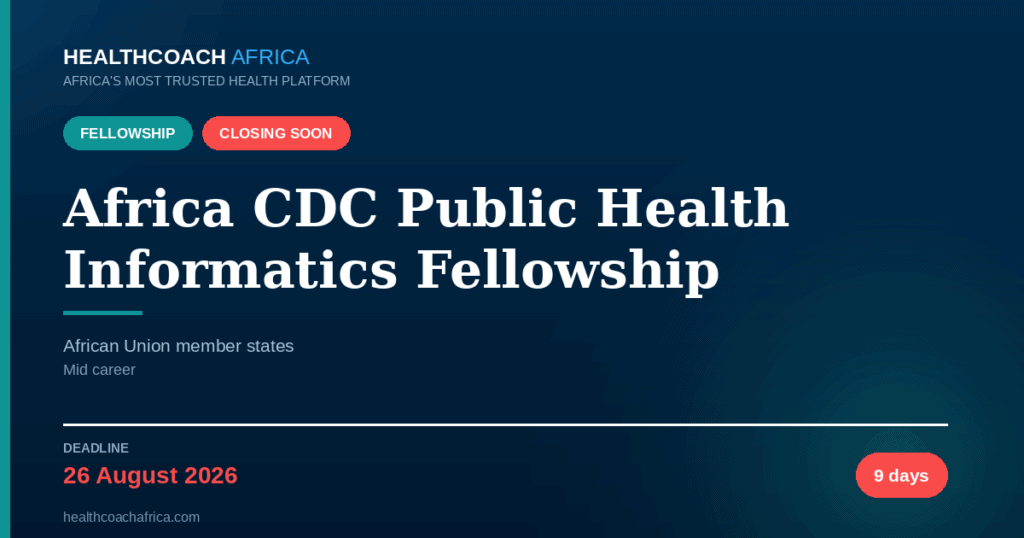
The third open track of the Africa CDC African Epidemic Service is public health informatics, and it closes on 26 August 2026 alongside the epidemiology and laboratory leadership tracks. If you sit at the intersection of health and data, this is the call to read this week.
What public health informatics means here
This is not a software developer role. Public health informatics is the discipline of turning surveillance data into decisions: designing the systems that collect case data, ensuring it flows from facility to district to national level without corruption or delay, building the dashboards that ministries actually use, and interpreting what the numbers mean for response. Across Africa the constraint is rarely the absence of data. It is data that arrives late, in incompatible formats, and without anyone trained to read it.
Who is eligible
The African Epidemic Service requires citizenship of an African Union member state, an age under 35 as defined by the African Union, current employment in an African country with written employer permission and a guarantee of return, a relevant graduate degree, recent postgraduate experience in Africa, and proficiency in at least one African Union official language. Verify the informatics-specific technical requirements on the call page, since the expected background differs from the clinical and laboratory tracks.
What it covers
Africa CDC funds all costs across the AES tracks: learning materials, travel, a stipend, hardware and software, and health insurance. The two year structure combines three months of didactic training in Addis Ababa with 21 months applied at a host site in a member state.
How to apply well
Applications are submitted online through the Africa CDC and African Union system and incomplete files are rejected without review. Assemble your passport, employer permission and return letter, two professional references, degree certificates and transcripts, a two page CV on the African Union template and a motivation statement of 500 words or fewer.
For an informatics application, evidence beats adjectives. If you have built a dashboard, cleaned a national dataset, integrated DHIS2 with a facility system or automated a reporting pipeline, name it and state what changed as a result. Reviewers are looking for people who have already made health data usable somewhere small, because that is the skill that scales.
Why this matters
Digital health roles in Africa are multiplying faster than the pipeline of people who understand both the clinical and the technical side. A continental informatics fellowship on your record puts you in a small group. For anyone building or working in African health technology, it is also the fastest way to learn how ministries actually make decisions, which is knowledge no amount of product experience substitutes for.
Common Thyroid Disorders Explained The thyroid gland is a small butterfly-shaped organ located in the neck, but despite its size, it plays a major role in regulating metabolism, growth, and overall health. When the thyroid doesn’t function properly, it…
Zoladex 3.6mg Implant (Goserelin): Uses,… Managing hormone-sensitive cancers and gynecological conditions requires consistent, targeted suppression of circulating sex hormones. This essential Zoladex 3.6mg implant guide details how this monthly goserelin injection works, clinic administration procedures, expected side effects, and critical…
WHO AFRO TDR Impact Grants 2026 Open for African Researchers Establishing an independent research track record is a critical milestone for early-career health scholars across Africa. The WHO AFRO Impact Grants 2026 program—a joint initiative between the World Health Organization Regional Office for Africa and…
UCT Mastercard Foundation Scholars Program Open for… For healthcare workers across Africa facing socio-economic barriers to advanced study, the UCT Mastercard Foundation Scholars Program offers a premier, fully funded route to postgraduate qualification. Hosted at the University of Cape Town—South Africa's leading…