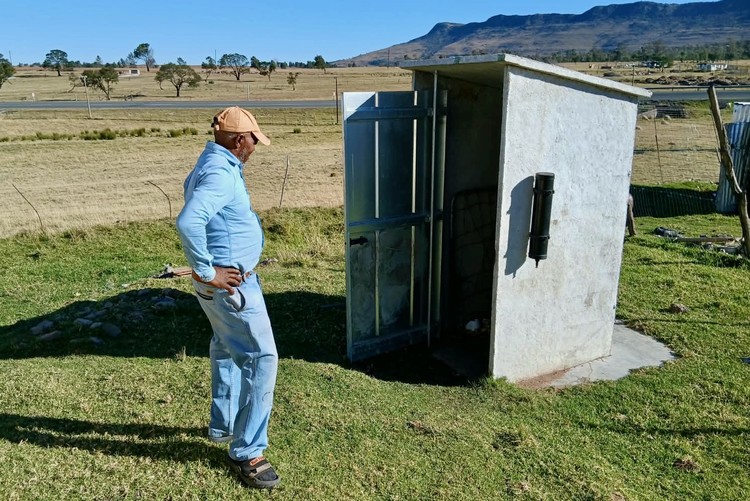
Residents of Ndlovini informal settlement in Cathcart, Eastern Cape, say Cathcart full pit toilets have been blocked or full for more than a year, forcing some to relieve themselves in open fields, GroundUp reported on 12 November.
Ndlovini has more than 500 homes, mostly mud houses and shacks, according to the report by Nombulelo Damba-Hendrik. Some residents have dug their own pit toilets.
How Cathcart full pit toilets became a crisis
Amathole District Municipality (ADM) spokesperson Sisa Msiwa said the municipality installed 40 pour-flush pit toilets in the area before 2021. Community leader Buyisile Booi said each was shared by five to seven families, and most residents were left out.
The toilets needed water from communal taps to flush, but the taps were sometimes dry for months. Residents were told ADM would empty the pits every year, but Booi said the municipality’s first attempt to empty some pits failed because it damaged the structures.
In 2023, the first 100 ventilated improved pit (VIP) toilets for wards 1 to 15 of Amahlathi Local Municipality were installed in Ndlovini. These are also now full. Former project community liaison officer Loyiso Dastile said some toilets were built on wet ground, which filled the pits quickly, and the contractor promised repairs but never made them.
Months of broken promises
Booi said he has asked ADM to empty the toilets since November 2025. He was told a truck had broken down in November 2025 and again in January. In March he was told a truck would be sent, but it never arrived, according to GroundUp.
Msiwa said the toilets were inspected to determine how to empty them and that the municipality is “in the process of appointing a service provider.” He acknowledged residents’ unresolved concerns about sanitation in Ndlovini.
The problems in Ndlovini reflect a wider backlog in rural sanitation. Many municipalities installed VIP toilets to replace the bucket system and open defecation, but did not plan or budget for regular emptying, leaving pits to fill up within a few years.
A 2025 ADM report presented at a town hall in Cathcart in October said 1,250 VIP toilets had been installed against a backlog of 1,496 units. Funds have run out, and the municipality is applying for more, the report said.
Why sanitation is a health issue
Full or broken toilets and open defecation spread disease. Faeces can contaminate water sources, soil and food, spreading diarrhoeal diseases such as cholera and typhoid, intestinal worms and hepatitis A. Children are especially vulnerable because they play outdoors and are more likely to become dehydrated from diarrhoea.
Lack of safe toilets also affects dignity and safety. Women and girls who must go to open fields, especially at night, face risks of harassment and assault, and some reduce how much they eat or drink to avoid needing the toilet.
Water and sanitation go together. Pour-flush toilets cannot work without water, and handwashing with soap, which prevents many infections, depends on a reliable supply.
South Africa’s Constitution recognises access to sufficient water as a right, and the country has national norms for basic sanitation, including safe, hygienic and accessible toilets for every household. Residents and activists have used these standards to press municipalities for action.
In informal settlements, high population density and limited space make sanitation harder to provide, and shared toilets often become dirty and unsafe when maintenance is irregular. Health workers report that diarrhoeal disease among children rises in such conditions, particularly in hot weather.
A national problem
GroundUp has reported widely on failing water and sanitation systems in South African municipalities, including sewage spills into rivers and drinking water problems, as voters went to the polls in municipal elections. A recent national assessment found most water authorities failing drinking water or sewage standards.
Pit-emptying services require trucks, trained staff and safe disposal sites, and many rural municipalities struggle to maintain them. Experts recommend planning for emptying when toilets are built, choosing designs suited to local soil and water conditions, and involving communities in maintenance.
Residents of Ndlovini say they want a clear timeline from the municipality. Until the Cathcart full pit toilets are emptied, families will continue to rely on open fields and makeshift pits, with risks for their health and safety.
For Ndlovini’s residents, the immediate need is for the Cathcart full pit toilets to be emptied and repaired, and for enough toilets to serve every household.
Why it matters: Full toilets and open defecation spread diarrhoeal disease and endanger women and children, making sanitation a front-line health service.
Blocked Fallopian Tubes Treatment: Your Options Explained Blocked fallopian tubes are one of the most common causes of female infertility in Nigeria and across sub-Saharan Africa. Many women do not know their tubes are damaged until they struggle to conceive. The tubes…
Western Cape Community Health Workers Take… CAPE TOWN, SOUTH AFRICA — Community health workers protest action in Cape Town has moved to the labour dispute body, with a union asking the Commission for Conciliation, Mediation and Arbitration (CCMA) to decide who…
Rhodes University Probes Campus Water After Gastro… MAKHANDA, SOUTH AFRICA — Rhodes University has launched a water probe with the Department of Water and Sanitation to establish whether its internal water system caused a gastrointestinal outbreak that sent more than 100 students…
Most South African Water Authorities Fail Drinking… CAPE TOWN, SOUTH AFRICA — More than half of South Africa’s water services authorities were rated bad or poor for municipal drinking water quality, or failed to submit required test results, according to a GroundUp…