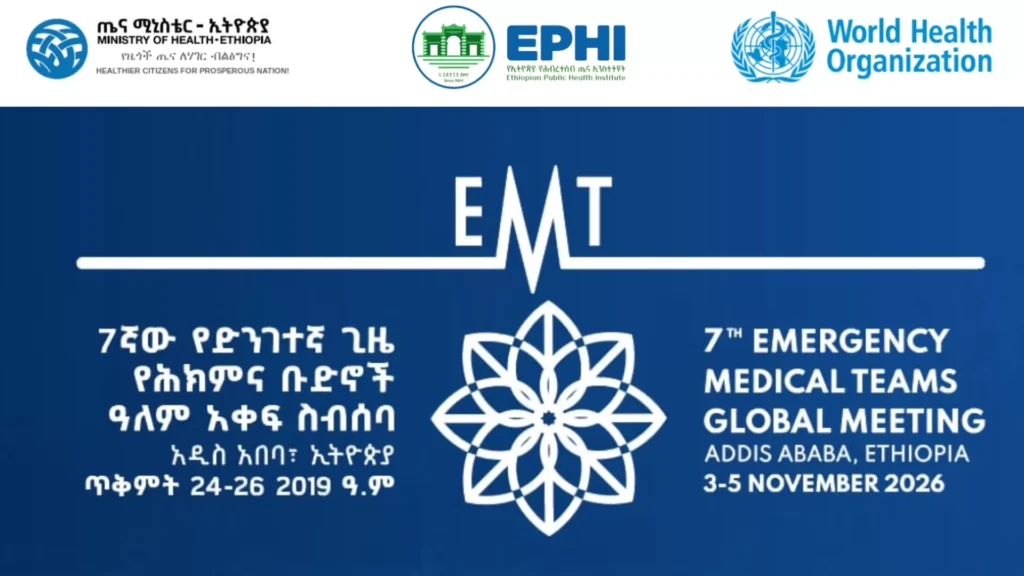
ADDIS ABABA, ETHIOPIA — More than 800 participants from over 100 countries are gathering in Ethiopia from 3 to 5 November for the seventh global Emergency Medical Teams meeting, the first held in the World Health Organization’s African Region, WHO said in a statement on 2 November.
The meeting is hosted by the Government of Ethiopia with WHO, with support from Macao SAR and the Robert Koch Institute. Participants include government representatives, health professionals, researchers and humanitarian partners. Discussions are guided by the EMT 2030 Strategy and focus on sustainable financing, quality standards, operational readiness and international cooperation.
What the Emergency Medical Teams meeting aims to do
Emergency Medical Teams (EMTs) are groups of health professionals, from doctors and nurses to logisticians, who deploy during disasters and outbreaks to provide care where local services are overwhelmed. WHO classifies teams that meet international standards so that governments can request help knowing what level of care a team can provide, and so that national teams can respond quickly at home.
EMTs range from small mobile teams providing outpatient care to field hospitals able to perform surgery and provide inpatient care. WHO’s classification system recognises these different types, as well as specialised cells for tasks such as infectious disease treatment.
“Strong national teams give countries more capacity to respond quickly and organize assistance according to local needs,” said Professor Francis Chisaka Kasolo, WHO Representative to Ethiopia. “Holding this meeting in the African Region brings countries’ experience directly into the global discussion.”
In September 2026, Ethiopia’s national EMT achieved WHO international classification, according to the statement. Thirty countries in the WHO African Region are developing national EMT capacities, supported by the Regional Framework on Emergency Medical Teams 2026 to 2030. A Regional EMT Training and Knowledge Hub in Addis Ababa supports training, simulation exercises and the exchange of expertise.
The Robert Koch Institute is Germany’s national public health institute. The regional framework is intended to guide how African countries develop national teams and support neighbours during cross-border emergencies, and Ethiopia’s newly classified team gives the host country a model to share at the meeting.
Why it matters during the Ebola outbreak
The Emergency Medical Teams meeting comes as the continent faces one of its largest Ebola outbreaks. The Bundibugyo outbreak, declared in the Democratic Republic of the Congo in May, has caused more than 10,000 confirmed cases, and Africa CDC warned last week that the continent was “not winning” the fight. Imported cases have been confirmed in Kenya, Nigeria and France, and Uganda recorded cases earlier this year.
In outbreaks such as Ebola, specialised teams can set up and staff treatment centres, train local health workers in infection prevention and control, and provide supportive care that improves survival. EMTs have also been deployed for floods, earthquakes, conflicts and cholera outbreaks across Africa in recent years.
Building national teams reduces reliance on international deployments, which can take time to arrive and may not understand local languages and systems. A trained national team that is ready to deploy within hours can contain an outbreak or treat disaster casualties before external help arrives.
Financing is one of the main challenges. Teams need equipment, supplies, transport, insurance and regular training, all of which require predictable funding. The meeting’s focus on sustainable financing reflects concern that many teams depend on short-term donor support.
Countries that build and fund their own teams can deploy them more quickly and keep their skills current between emergencies through regular exercises. National teams can also be offered to neighbouring countries, strengthening regional solidarity during crises that cross borders, as the current Ebola outbreak has done.
Hosting the Emergency Medical Teams meeting in Addis Ababa, which is also home to the African Union and Africa CDC, places African experience at the centre of global discussions on emergency response.
Quality standards are another theme. WHO classification requires teams to meet minimum standards for clinical care, self-sufficiency, logistics and coordination, so that they do not become a burden on the health system they are meant to support.
For countries such as Nigeria and Kenya, which have just managed imported Ebola cases, the meeting is an opportunity to share lessons on rapid response, isolation and contact tracing, and to strengthen regional mutual support.
African health ministers agreed at an extraordinary meeting last week to prepare every country for possible Ebola cases, coordinate cross-border responses and strengthen surveillance. National emergency medical teams are a practical part of that preparedness.
The statement did not say which African countries have WHO-classified teams besides Ethiopia, or whether new commitments would be announced at the Emergency Medical Teams meeting.
Why it matters: Trained national emergency teams can contain outbreaks and disasters within hours, reducing Africa’s dependence on slow international deployments.
Kenya Discharges Five Ebola Patients, Africa CDC… NAIROBI, KENYA — Kenya Ebola patients discharged on Tuesday included five people who had recorded repeated negative tests, while 46 contacts completed their 21-day quarantine, the Africa Centres for Disease Control and Prevention (Africa…
5 Critical Steps for Africa Emergency Medical Teams ADDIS ABABA, ETHIOPIA — Health ministers across 47 member states in the World Health Organization (WHO) African Region have officially adopted a strategic Africa emergency medical teams framework, committing every signatory nation to establish at…
Medicine Traceability in Nigeria: How a Barcode… A fake antimalarial looks exactly like a real one. The box, the blister and the colour of the tablet can all be copied. What cannot be copied easily is a unique digital identity that is…
Nigeria Faces Unprecedented Hunger Crisis, UN Warns Abuja, Nigeria — Nigeria is currently grappling with an unprecedented hunger crisis as the United Nations (UN) and humanitarian agencies warn of rising food insecurity across the country. Driven by conflict, economic challenges, climate change,…