A fake antimalarial looks exactly like a real one. The box, the blister and the colour of the tablet can all be copied. What cannot be copied easily is a unique digital identity that is checked at every step of the journey from factory to patient. That is the promise of medicine traceability in Nigeria, and after years of pilots it now has the force of law behind it. Understanding how it works matters to every pharmacist, distributor, hospital and patient who has ever wondered whether a pack is genuine.
The problem traceability is built to solve
The World Health Organization estimates that around one in ten medical products in low- and middle-income countries is substandard or falsified. When it began global reporting, 42% of the cases it received came from sub-Saharan Africa, and antibiotics and antimalarials were the most commonly reported products.
The human cost is measurable. Modelling cited by the WHO estimates that substandard and falsified antibiotics contribute to between 72,000 and 169,000 deaths from childhood pneumonia every year, and that poor-quality antimalarials cause up to 116,000 additional malaria deaths a year in sub-Saharan Africa. A 2025 review by researchers at Bahir Dar University, covering 27 studies and 7,508 samples across Africa, found that 1,639 samples failed at least one quality test. That is close to one in five.
Nigeria has fought this for decades through inspections, seizures and public alerts. Earlier technology helped too. A mobile authentication system, piloted in 2010 and rolled out in 2012 for antimalarials and antibiotics, let buyers send a scratch-card code by SMS to confirm a pack. But authentication answers only one question: is this pack real? Traceability answers a bigger one: where has this pack been, and should it be here at all?
From strategy to law
The policy foundations were laid in stages:
September 2019: NAFDAC co-hosted the second GS1 African Healthcare Conference in Lagos, where African regulators signed a call to action for an Africa Strategy for Pharmaceutical Traceability.
May 2020: The Federal Ministry of Health published the Nigeria National Pharmaceutical Traceability Strategy, built on global GS1 standards.
2021: NAFDAC tested traceability on COVID-19 vaccines, scanning barcodes at entry and through warehouses in more than 400 facilities across the 36 states and the FCT.
October 2024: The NAFDAC Pharmaceutical Products (Traceability) Regulations, 2024 were gazetted, creating binding legal duties.
2025: A pilot for maternal, newborn, child health and nutrition products began under the new regulations, onboarding manufacturers and extending pack-level tracking.
How medicine traceability in Nigeria works
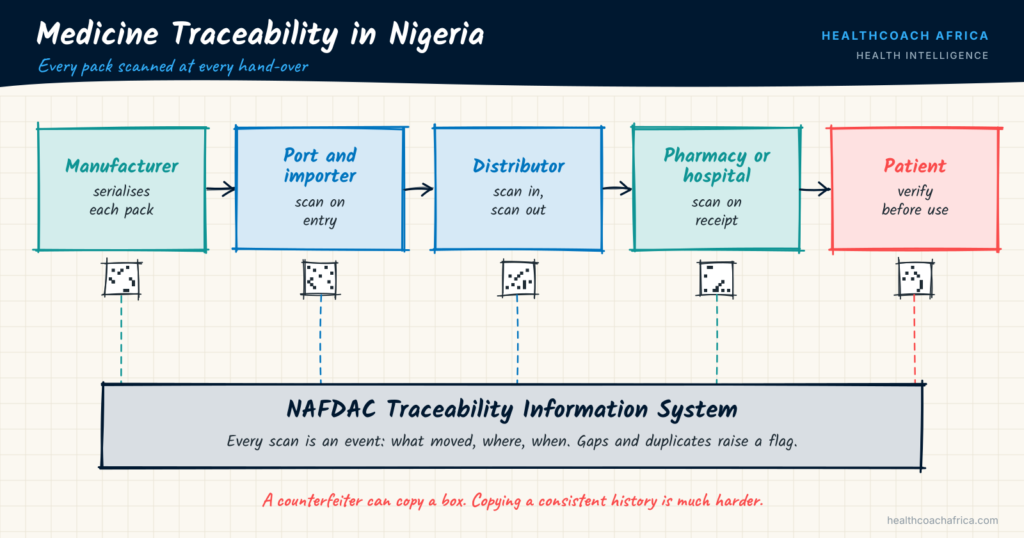
The system rests on three simple ideas: give every pack a unique identity, record every time it moves, and check those records against each other.
Anatomy of a GS1 DataMatrix code used for medicine traceability in Nigeria
What is inside the small square code on a traceable medicine pack.
A unique identifier on every pack. Under the 2024 regulations, each saleable unit must carry a unique identifier, encoded in a two-dimensional GS1 DataMatrix barcode. That small square typically holds four pieces of data: the Global Trade Item Number (GTIN), which identifies the product; the batch or lot number; the expiry date; and a serial number unique to that single pack.
Master data. Before products move, brand owners share legal, product and location information with NAFDAC so that every scanned code can be matched to a registered product and a known company.
Event data. Each time a pack changes hands, at the manufacturer, port, distributor, wholesaler, hospital or pharmacy, it is scanned. That scan records what moved, where and when. NAFDAC’s Traceability Information System stores these events, and its Scan2Verify mobile application lets health workers check a code against the agency’s register of approved products.
The power lies in the pattern. A serial number scanned in Kano and Lagos on the same afternoon is a red flag. A pack that appears at a pharmacy without ever passing through a registered distributor is a red flag. A code that does not exist in the master data is almost certainly fake. Counterfeiters can print a barcode; they cannot easily fake a consistent history.
What the regulations require
The 2024 regulations cover labelling, data carriers, traceability duties and penalties. Manufacturers and supply chain operators must label products to NAFDAC’s standard and share production, distribution and sales data with the agency. Penalties include fines and imprisonment for individuals, and fines of up to five million naira for companies. NAFDAC has signalled phased compliance rather than a single switch-on date, starting with priority product groups.
The honest challenges
Traceability is capital-intensive, and NAFDAC’s own leadership has said so. The obstacles are practical:
Cost of serialisation. Printing unique codes requires new packaging lines and software, a real burden for smaller local manufacturers already under pressure from currency costs.
Scanning at the last mile. The chain is only as strong as its weakest scan. Many patent medicine stores and rural outlets lack scanners, reliable power and training.
Fragmented distribution. Open drug markets and informal wholesalers move large volumes outside formal records.
Data discipline. A system that collects scans but does not analyse them in time catches nothing.
These are reasons to phase the rollout carefully, not reasons to doubt it. Countries that have implemented serialisation, from Turkey to the European Union, faced the same hurdles in their early years.
How Nigeria compares with the rest of Africa
Nigeria is not acting alone, and in several respects it is leading. The 2019 Lagos call to action for an Africa Strategy for Pharmaceutical Traceability was eventually signed by 25 African regulatory agencies and six health financing and donor organisations. When the Global Steering Committee’s Africa Traceability Group held its first meeting, it was NAFDAC that chaired it, with representatives from 15 African countries in the room. Zambia, Ghana and Mauritius have run their own GS1-based pilots, and regional harmonisation matters because medicines cross borders easily. A pack serialised to one standard in Lagos should be readable in Accra or Lusaka. If African regulators converge on the same GS1 data carriers and data-sharing rules, manufacturers serving several markets will pay for serialisation once rather than country by country, and counterfeiters lose the gaps between national systems that they currently exploit.
What it means for patients and pharmacies
For patients, the most useful habit is simple: buy medicines only from licensed pharmacies and check that the pack is intact, in date and properly labelled. As scanning spreads, verification tools will make it easier to confirm a product directly.
For pharmacies and hospitals, traceability is about to become part of doing business. Buying from registered distributors, scanning on receipt and keeping digital records will move from good practice to legal obligation. The pharmacies that build these habits early will be the ones insurers, hospitals and patients trust.
From the HubPharm pharmacy desk. Every medicine HubPharm dispenses comes through verified, licensed suppliers, and our pharmacists check batch and expiry before a pack leaves the shelf. Holding a pack you are not sure about? Send the code HC-HT02 with a clear photo of the box on WhatsApp to +234 705 050 5001, and a HubPharm pharmacist will help you check it and, if needed, source a verified replacement.
The bottom line
Medicine traceability in Nigeria turns a box of tablets into a record that can be checked. It will not end falsified medicines overnight, and its success depends on scanners reaching ordinary pharmacies, not just factories and ports. But it changes the economics of counterfeiting. When every genuine pack has a verifiable history, a fake one has nowhere to hide.
References
World Health Organization. A study on the public health and socioeconomic impact of substandard and falsified medical products. Geneva: WHO; 2017.
World Health Organization. WHO Global Surveillance and Monitoring System for substandard and falsified medical products. Geneva: WHO; 2017.
Adeyeye MC, Kayode J, Olasupo S. Traceability for strengthening supply chain systems and enhancing real-time visibility: focus of NAFDAC on advancing vaccines traceability in Nigeria. Ann Acad Med Siles. 2024.
Diabetes in Nigeria: Why Blood Sugar Control Fails Diabetes in Nigeria does not usually fail in the clinic. Among people who reach a specialist and stay in care, control is often reasonable. It fails in the years before anyone tests you, and it…
Malaria: Understanding Symptoms, Treatment,… In this article, we will discuss the symptoms, treatment and prevention of malaria. Furthermore, we will highlight global efforts and challenges in eradicating malaria in our world Malaria, a life-threatening mosquito-borne disease, continues to…
MIT Solve Global Health Challenge 2027: Apply for… Application are officially open for the MIT Solve Global Health Challenge 2027. This initiative by the Massachusetts Institute of Technology (MIT) seeks tech-driven, scalable solutions designed to improve access to quality healthcare, strengthen frontline workers,…
High Blood Pressure in Nigeria: Why Treatment Stops Working Most people who lose control of high blood pressure in Nigeria were never lost to the health system. They were diagnosed. They collected a prescription. Many even took the tablets for a while. Then something…