Checking your blood pressure at home is a simple way to keep track of your heart health. But getting an accurate reading depends on more than just putting on a cuff and pressing a button.
Small mistakes—such as talking during the measurement, crossing your legs, or using the wrong cuff size—can affect the result. The good news is that accurate home monitoring is easy once you know the correct steps.
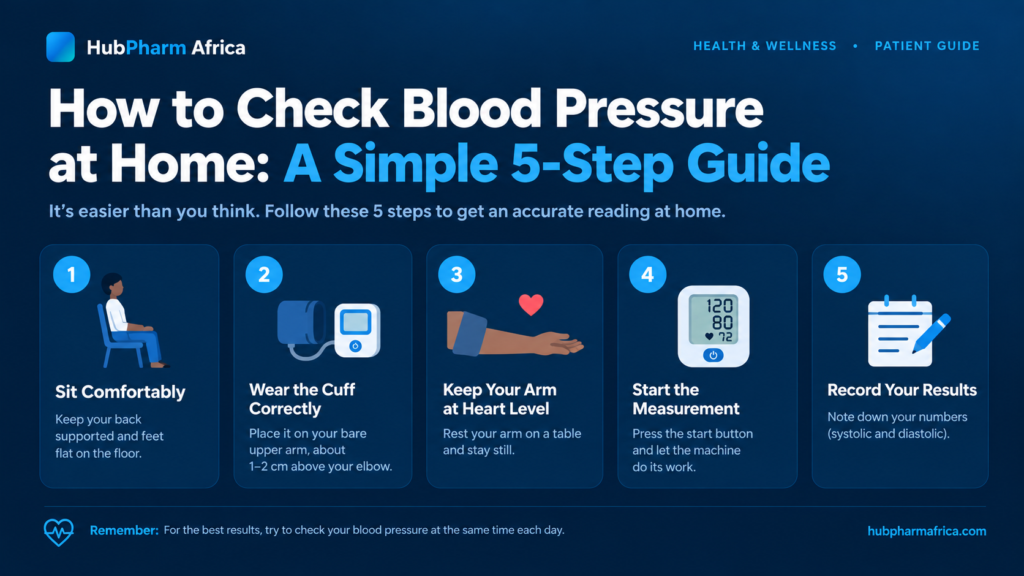
Here’s a simple 5-step guide you can follow.
1. Sit Comfortably and Relax
Before checking your blood pressure, find a quiet place to sit.
Sit in a chair with your back supported.
Keep both feet flat on the floor.
Don’t cross your legs.
Empty your bladder first if possible.
Rest quietly for at least 5 minutes.
Avoid talking or using your phone while preparing.
For the most reliable reading, avoid exercise, smoking and caffeinated drinks for about 30 minutes beforehand.
Think: Sit. Relax. Don’t rush.
2. Put the Cuff on Correctly
Use an automatic upper-arm blood pressure monitor rather than relying on wrist or finger devices, which are generally less reliable. Make sure the cuff is the correct size for your arm.
Place the cuff:
Directly against your bare skin
Around your upper arm
With the bottom of the cuff just above the bend of your elbow
Snugly—not painfully tight
Don’t place the cuff over your clothing.
3. Keep Your Arm at Heart Level
Rest your arm comfortably on a flat surface, such as a table.
Your upper arm and the middle of the cuff should be approximately at heart level.
Keep your hand relaxed, palm facing upward, and avoid moving or talking during the measurement.
This positioning matters because poor positioning can make your reading less accurate.
4. Start the Measurement
Now you’re ready to take your reading.
Press the monitor’s START button and allow it to inflate and deflate automatically.
Stay still and do not talk while the monitor is measuring.
Once the reading appears, you’ll normally see two main numbers:
Systolic / Diastolic
For example:
120 / 80 mmHg
The systolic number is the pressure when your heart contracts, while the diastolic number is the pressure when your heart relaxes between beats.
5. Record Your Results
Don’t rely on remembering your numbers.
Write down:
The date
The time
Your systolic reading
Your diastolic reading
Any relevant notes
It’s generally useful to take two readings about one minute apart and record the results. Your healthcare professional can tell you how frequently you should monitor based on your individual situation.
A single reading is only a snapshot. Keeping a record over several days can give you and your healthcare professional a much clearer picture of your blood pressure.
What If Your Reading Is High?
Don’t panic over one unusual reading.
Sit quietly and repeat the measurement correctly. If your readings are consistently high, discuss them with a healthcare professional.
If your monitor shows a reading above 180/120 mmHg, wait a few minutes and check again. If it remains that high, contact a healthcare professional promptly. If you also have symptoms such as chest pain, shortness of breath, weakness, difficulty speaking, or changes in vision, seek emergency medical care immediately.
And importantly, don’t stop or change prescribed blood-pressure medication based only on your home readings unless your healthcare professional tells you to.
Quick 5-Step Reminder
1. SIT → Back supported, feet flat, relax for 5 minutes. 2. CUFF → Bare upper arm, correct size, positioned properly. 3. POSITION → Arm supported at heart level. 4. MEASURE → Stay still and don’t talk. 5. RECORD → Take two readings and keep a log.
Healthy checks. Healthier you.
Regular home monitoring can help you understand your blood pressure and give your healthcare team useful information for managing your health. It doesn’t replace regular healthcare visits, especially if you have been diagnosed with hypertension
World Health Organization (WHO).Hypertension. Available at: WHO – Hypertension Fact Sheet. Accessed September 7, 2026.
National Heart, Lung, and Blood Institute (NHLBI).High Blood Pressure – Symptoms. Available at: NHLBI – High Blood Pressure Symptoms. Accessed September 7, 2026.
MedlinePlus.Measuring Blood Pressure. U.S. National Library of Medicine. Available at: MedlinePlus – Measuring Blood Pressure. Accessed September 7, 2026.
Please follow and like us:
Post Views:7
Related Posts:
Normal Blood Pressure Reading: What Your Numbers Mean You have two numbers and no idea what they mean. Worse, you searched them and found an American page telling you that 134 over 86 is Stage 1 hypertension, while your doctor in Lagos looked…
How to Check for Breast Cancer at Home: 5 Simple, Safe Steps Most Nigerian women who find breast cancer find it themselves. Not at a screening centre, and not during a routine check-up, but in the shower or while dressing. So learning how to check for breast…
Medical Record Officer at Solid Rock Hospital Since our beginning, our secret at Solid Rock Hospital (SRH) has been our foundation which was built based on the principles of Christ. We have continued in this pursuit, which equips us to serve our clients…
Optometric at Usman Dan Fodiyo University Teaching Hospital The Hospital, which started operating in the present Sokoto Specialist Hospital has witnessed transformations and growth since then. It is gratifying to note that its growth has translated into the provision of Tertiary Health care…