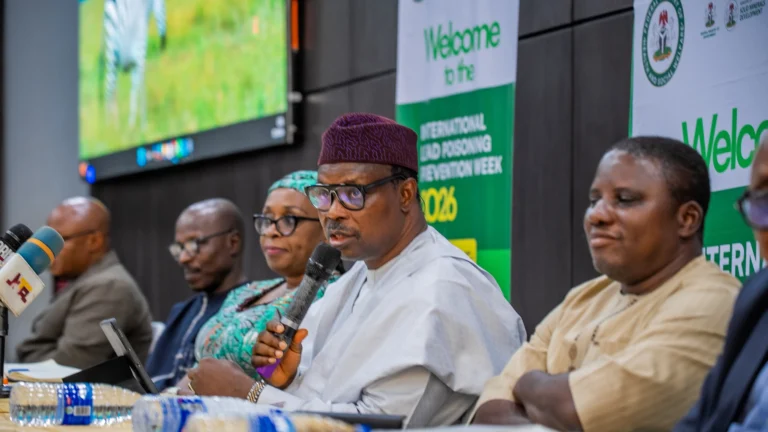
ABUJA, NIGERIA — The Federal Government of Nigeria estimates that approximately 80 million children nationwide are exposed to toxic heavy metals, officially inaugurating a five-year strategic initiative as lead poisoning in nigeria national elimination plan measures are rolled out to halt environmental contamination. Commemorating the 2026 International Lead Poisoning Prevention Week in Abuja, Minister of State for Health and Social Welfare Dr. Iziaq Salako warned that heavy metal exposure represents a severe, multi-systemic public health threat requiring immediate environmental intervention.
Operating under the theme “From Detection to Prevention,” federal authorities emphasized that pediatric heavy metal accumulation cannot be resolved through clinical chelation therapy alone, mandating a decisive shift toward source elimination and strict regulatory enforcement.
Strategic Benchmarks for Lead Poisoning in Nigeria National Elimination Plan
Data released by the Federal Ministry of Health, UNICEF, and technical partners outline the operational parameters of the national response:
Policy & Exposure Category
National Public Health Benchmarks
Exposed Pediatric Population
~80 million children estimated exposed nationwide
Strategic Execution Timeline
Five-Year Plan (2026–2030) supported by a 3-year costed roadmap
UNICEF Eradication Target
Global commitment to eliminate childhood lead poisoning by 2040
Priority State Clusters
Lagos, Ogun, Sokoto, and Zamfara targeted for tailored action plans
Technical Mechanics: Lead Poisoning in Nigeria National Elimination Plan
Understanding the biochemical pathways of heavy metal toxicity highlights why the lead poisoning in nigeria national elimination plan prioritizes primary prevention over reactive care:
Irreversible Neurodevelopmental Damage: Lead ions ($Pb^{2+}$) mimic calcium ($Ca^{2+}$) in biological systems, crossing the blood-brain barrier to disrupt synaptic plasticity, cause neuronal apoptosis, and permanently impair cognitive development and IQ.
Diverse Exposure Pathways: Investigations across priority states identified distinct local vectors: informal battery recycling in Ogijo (Ogun State), industrial pollutants in Lagos, traditional eyeliners (tiro), lead-glazed ceramics, and artisanal gold processing in Zamfara State.
Nutritional Blocking Mechanisms: Diets rich in calcium, iron, and vitamin C competitively inhibit intestinal absorption of ingested lead particles, serving as a primary nutritional defense for vulnerable pediatric populations.
Inter-Agency Collaboration, State Action Plans, and Regulatory Directives
To turn policy commitments into funded interventions, the Federal Government established an Inter-Agency Working Group on Lead Poisoning Prevention and Elimination alongside a costed three-year national roadmap. Dr. Salako urged municipal and state leaders across Lagos, Ogun, Sokoto, and Zamfara to rapidly publish localized control plans aligned with federal guidelines.
Technical partners, including Resolve to Save Lives and UNICEF, are expanding local blood-lead testing laboratory capacity, environmental surveillance infrastructure, and public awareness campaigns to detect contamination early.
Household Precautions, Economic Impact, and Long-Term Outlook
Regulators recommend simple, low-cost household precautions: keeping children away from battery recycling or painting sites, wearing protective gear when handling leaded materials, washing hands regularly, and wet-wiping floors rather than dry sweeping to prevent toxic dust aerosolization.
Addressing heavy metal toxicity protects future human capital, educational achievement, and workforce productivity across Africa’s most populous nation. As state governments prepare their respective operational frameworks, expanding blood-lead laboratory testing will remain critical to tracking progress under the lead poisoning in nigeria national elimination plan.
Why It Matters: Lead causes permanent brain damage in developing children; investing in early environmental prevention protects cognitive health, academic potential, and future economic productivity across Nigeria.
Nigeria Steps Up Efforts to Phase Out Lead-Based… ABUJA, NIGERIA — Nigeria’s Federal Government is stepping up efforts to end lead exposure and phase out lead-based paints in Nigeria by 2030, officials said at an event in Abuja on Tuesday marking the 2026…
NAFDAC Links Ondo State Deaths to High Methanol… AKURE, NIGERIA — The National Agency for Food and Drug Administration and Control (NAFDAC) has officially confirmed that an outbreak in Ondo State resulting in 48 deaths and multiple cases of permanent blindness was caused…
WHO Urges Strategic Investment to Close Global… GENEVA, SWITZERLAND — Addressing the who global childhood cancer gap requires urgent strategic investment in pediatric oncology infrastructure, according to a health directive issued by the World Health Organization on September 23, 2026. The UN…
Newly Diagnosed With Breast Cancer? Your First 30 Days Guide If you have just been newly diagnosed with breast cancer, start here. You do not need to understand everything today. You need to know what to do next, and in what order. This guide breaks…