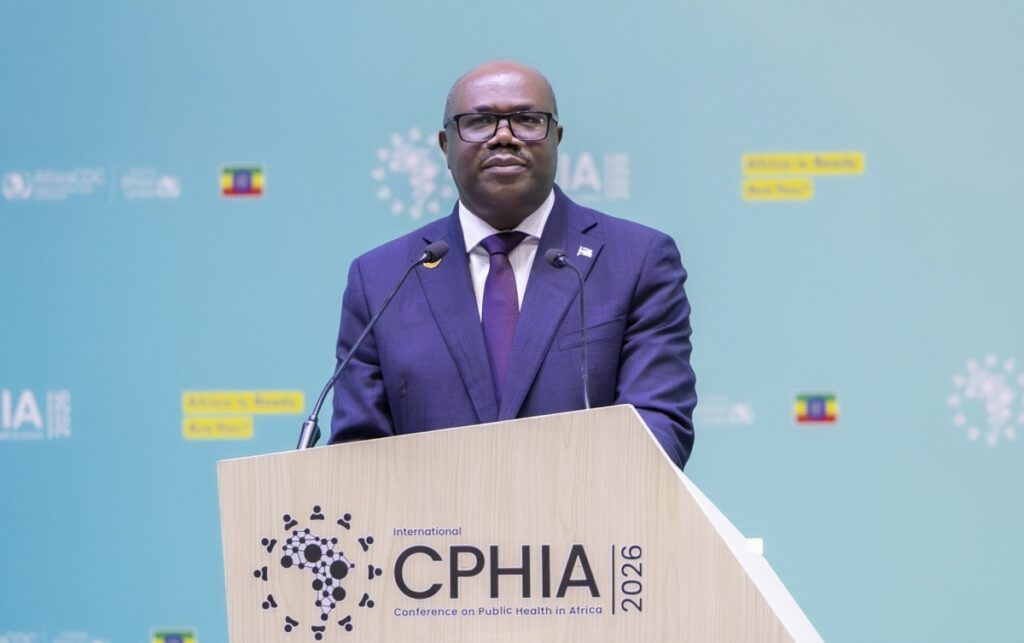
Rwanda’s Prime Minister Dr Justin Nsengiyumva has presented Rwanda community health insurance, Mutuelle de Santé, as a model for financing health care across Africa, speaking at the fifth International Conference on Public Health in Africa (CPHIA 2026) in Addis Ababa on 23 November, KT Press and The New Times reported.
“We can no longer rely on others to meet our most fundamental health needs,” Nsengiyumva said, according to KT Press. He spoke on behalf of President Paul Kagame, the African Union Champion for Domestic Health Financing.
How Rwanda community health insurance works
Mutuelle de Santé has covered about 89 per cent of Rwandans over its 25 years, KT Press reported. In 2026, Rwanda introduced an income-based contribution framework under which members fund 37 per cent of the scheme and the government and private sector share the remaining 63 per cent, according to the report.
Coverage now extends to cancer care, kidney transplantation and cardiac surgery, the Prime Minister said.
The extension of Rwanda community health insurance to such specialised services is notable because these treatments are expensive and, in many African countries, are available only to people who can pay privately or travel abroad.
“Government, households, and the private sector each have a part to play,” Nsengiyumva said.
Rwanda’s income-based contribution system places households in categories according to their economic status, with the poorest households receiving government support to pay premiums, as general background. Members pay a small co-payment when they use services, which helps fund the scheme while keeping care affordable.
The New Times reported that he called on African countries to take greater responsibility for financing their health systems, warning that declining external assistance poses a risk.
Results over 25 years
Since 2000, infant deaths in Rwanda have fallen from 107 to 27 per 1,000 live births, maternal deaths from 1,071 to 149 per 100,000 live births, and life expectancy has risen from about 50 to 70.5 years, according to figures cited by KT Press.
Nsengiyumva also cited Rwanda’s response to the 2024 Marburg outbreak, when community health workers screened more than 9.5 million people in a country of about 14 million. Rwanda brought what KT Press described as the third-largest Marburg outbreak on record under control within three months, with a 22 per cent case fatality rate.
Sierra Leone’s President Julius Maada Bio, who also spoke on financing, said his country’s five-year national health compact needs about $1.2 billion, with 30 per cent to be financed domestically, KT Press reported.
“Africa’s health sovereignty will depend as much on what we build together as on what each of us achieves alone,” he said, according to the Horn Diplomat, calling for cross-border cooperation.
Lessons for other countries
As general background, community-based health insurance schemes pool contributions from households, often stratified by income, so that members can access care without large payments at the point of service. Rwanda’s scheme is supported by a strong network of community health workers and health centres, and by government subsidies for the poorest households.
Many African countries, including Nigeria, Kenya and Ghana, are trying to expand health insurance coverage, but enrolment and regular contributions remain challenging, particularly among informal workers. Kenya’s Social Health Authority began a door-to-door registration drive this month, and Nigeria’s health insurance coverage has reached nearly 24 million people.
Adapting the Rwanda community health insurance model elsewhere would require reliable public funding to subsidise poorer members, efficient claims payment and services of sufficient quality that families see value in contributing.
As general background, Rwanda’s system also relies on performance-based financing for health facilities, a strong data system and close supervision of community health workers, which together help ensure that insured members receive the services they pay for.
Rwanda’s gains in child survival over the past two decades, alongside investment in nutrition, have been widely recognised, though challenges such as stunting remain, as HealthCoach Africa has covered in its reporting on malnutrition in Africa.
Nsengiyumva’s remarks came on the opening day of CPHIA 2026, where leaders urged African governments to move from declarations to concrete budgets for health.
Kagame’s role as AU Champion for Domestic Health Financing gives Rwanda a platform to promote its approach to other member states. As general background, the AU has adopted commitments on increasing domestic resources for health, including the Abuja Declaration target of 15 per cent of national budgets, which few countries meet.
Why it matters: Rwanda’s insurance covers nearly nine in ten people, offering a tested model as African countries seek to fund health without donors.
Africa’s Flagship Public Health Conference CPHIA… ADDIS ABABA, ETHIOPIA, The fifth International Conference on Public Health in Africa opened in Addis Ababa on Monday, 23 November, with CPHIA 2026 health sovereignty as its central theme, Fana Media Corporation reported, as African leaders…
CPHIA 2026 Delegates Call for Permanent Pandemic… ADDIS ABABA, ETHIOPIA, Speakers at the CPHIA 2026 conference in Addis Ababa have called for permanent pandemic preparedness Africa can sustain between outbreaks, rather than rebuilding emergency systems each time a new disease strikes, Africa…
Nigeria Issues Addis Ababa Travel Advisory After 16… Nigeria’s Ministry of Foreign Affairs has issued an Addis Ababa travel advisory after at least 16 Nigerians died from complications linked to the Ethiopian capital’s high altitude, Premium Times reported on 14 November. The Addis…
Experts Say Rwanda Must Speed Up Implementation of… KIGALI, RWANDA Rwanda needs to improve how it implements its Rwanda AMR action plan after fewer than four in 10 planned activities were carried out, health experts have said, The New Times reported on 24…