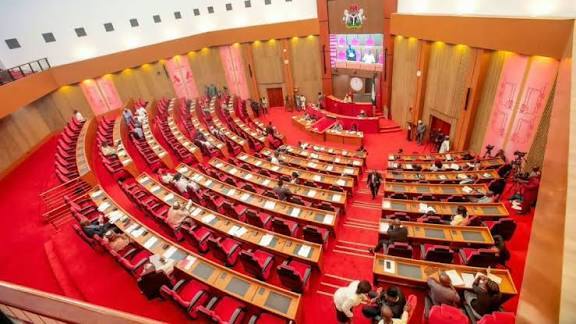
ABUJA, NIGERIA — Nigeria’s Senate has passed for second reading a Senate emergency treatment bill that would punish hospitals and health workers who delay care for emergency patients with up to six months in prison or a fine of up to N300,000, Premium Times and Daily Trust reported.
The bill, which seeks to amend the National Health Act, 2014, is sponsored by Senator Abdulaziz Yar’Adua (APC, Katsina Central). It passed second reading by voice vote on Wednesday, 4 November, and Senate President Godswill Akpabio referred it to the Senate Committee on Tertiary and Primary Health.
Yar’Adua said the amendment would ensure that every patient receives timely treatment “irrespective of their social status, wealth, influence or location.”
What the Senate emergency treatment bill requires
The Senate emergency treatment bill sets strict timelines for public and private facilities, according to the reports. Hospitals would have to assess and triage emergency patients within 15 minutes of arrival, and a trained, certified nurse could do this if no doctor is available.
Initial stabilisation, including oxygen, intravenous fluids, pain relief and preliminary diagnostic tests, would have to begin within 30 minutes. Once a life-threatening condition is identified, staff would be required to begin life-saving measures such as cardiopulmonary resuscitation, airway management and bleeding control immediately, P.M. News reported.
Patients who need admission would have to be assigned a bed within two hours, subject to availability. If a facility cannot admit a patient, it must resuscitate and stabilise them and begin referral within two hours, or as soon as the patient is stable enough to move. The transfer would have to be completed within three hours of arrival unless transport problems, insecurity or natural conditions prevent it, and an ambulance or other transport would have to be dispatched within 30 minutes of the referral decision.
Health workers in emergency care would need training and certification at intervals of no more than 18 months. The Medical and Dental Council of Nigeria and the Nursing and Midwifery Council of Nigeria would jointly develop a national emergency care curriculum.
The bill also offers protection to practitioners who document that they lacked resources, provided they follow referral protocols and report the circumstances, Premium Times said.
Deaths that shaped the debate
Premium Times listed cases that have fuelled public anger over emergency refusals, all described as reported. They include Bayo Ohu, a Guardian journalist shot in Lagos in 2009, who reportedly died on the way to another hospital after being refused treatment without a police report, and Moradeun Balogun, a 29-year-old podcast host stabbed in Lagos in 2019, who reportedly died at another facility after a similar refusal.
The paper also cited Ebenezer Ayeni, an Ibadan music producer who reportedly died about four hours after being shot in 2021 when two hospitals allegedly asked for a police report, and an unidentified boy injured in a road accident on the Bauchi-Jos highway who reportedly died after being turned away from ATBU Teaching Hospital, Bauchi, for lack of bed space. The hospital set up a committee to investigate.
Senate Whip Mohammed Monguno (APC, Borno North) supported the bill and lamented that some providers neglect emergency patients, leading to what Daily Trust described as “preventable deaths.”
The law already says no to refusals
Nigeria’s National Health Act, 2014 already states that no health worker or facility may refuse a person emergency medical treatment for any reason. The Compulsory Treatment and Care for Victims of Gunshots Act, 2017 also requires hospitals to treat gunshot victims without first demanding a police report or a deposit.
Enforcement has been weak. Families often say hospitals asked for payment before treatment, or that staff were unwilling to accept patients with injuries linked to violence. Many facilities, especially private ones, say they cannot afford to treat patients who may never pay, and public hospitals report shortages of beds, staff, oxygen and blood.
Experts say clear timelines can help, but only if facilities have the means to meet them. Emergency care depends on staffed and equipped units, functioning ambulances, a working referral network and a way to pay for care when patients arrive without money. Without these, penalties could push some facilities to avoid emergency cases altogether.
The bill now goes to committee for further work and a public hearing before it returns to the floor. A similar bill in the House of Representatives also passed second reading on Wednesday, so the two chambers will need to harmonise their versions before the Senate emergency treatment bill can be sent to the President.
Why it matters: Nigerians die when hospitals demand deposits or police reports first; enforceable timelines could save lives if facilities are resourced.
Reps Propose Licence Withdrawal for Hospitals That… ABUJA, NIGERIA — The House of Representatives has advanced a bill that proposes fines, licence suspension and licence withdrawal for hospitals that delay emergency treatment, along with criminal sanctions for health workers who abandon emergency patients,…
Nigeria’s Senate Advances Bill to Decriminalise… ABUJA, NIGERIA — The Senate of Nigeria has passed the Suicide Prevention Bill, 2024 (SB 730) through its second reading, advancing legislation that seeks to treat attempted suicide in nigeria as a medical emergency rather…
Nigerian Resident Doctors Pause Nationwide Protest… In a significant development, the Nigerian Association of Resident Doctors (NARD) has decided to temporarily suspend its planned nationwide daily protest after a closed-door meeting with key figures from the Senate on Tuesday. The doctors,…
Health Workers’ Warning Strike Disrupts Hospital… KATSINA, NIGERIA — Public healthcare delivery across Katsina State has been severely paralyzed following the commencement of a one-week warning strike declared by the Assembly of Health Professionals, forcing patients and caregivers to plead for…