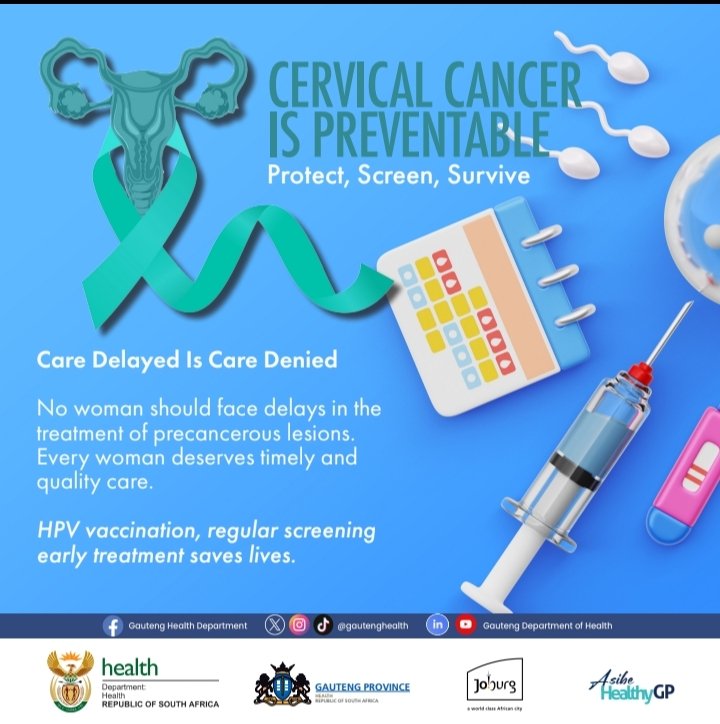
PRETORIA, SOUTH AFRICA — South Africa’s Department of Health has reaffirmed its commitment to eliminating cervical cancer as a public health threat by 2030 through its cervical cancer elimination strategy, SAnews reported on 17 November, World Cervical Cancer Elimination Day.
Cervical cancer remains a leading cause of cancer death among South African women even though it is largely preventable, the department said. An estimated 8,382 women were diagnosed in 2024, and roughly one woman died every 67 minutes.
Inside the cervical cancer elimination strategy
The Cervical Cancer Elimination Strategy 2026 to 2030 is a national roadmap towards WHO’s 90-70-90 targets: vaccinating 90 per cent of girls against human papillomavirus (HPV) by age 15, screening 70 per cent of women with a high-performance test at ages 35 and 45, and treating 90 per cent of women diagnosed with cervical disease.
The school-based HPV vaccination programme began in 2014. South Africa has moved from a two-dose to a single-dose schedule in line with updated WHO recommendations, made nine-year-old girls in private schools eligible and is planning to reach girls who are out of school, the department said. An earlier school campaign reached 428,395 girls in Grades 5 to 7, with 90.6 per cent coverage.
Screening and treatment
HPV DNA testing is being expanded to all provinces, and the department is working with the Clinton Health Access Initiative and Unitaid to scale up thermal ablation, a quick treatment for precancerous lesions. In September 2026, it secured 201 thermal ablation devices and 24 LLETZ machines used to remove abnormal tissue.
Integrated screen-and-treat pilots are running at Ceza Hospital in KwaZulu-Natal and Mofolo Community Health Centre in Gauteng. Between April and September 2026, screenings rose from 869 to 1,086 at Ceza and from 431 to 1,266 at Mofolo compared with the same period in 2025, the department said.
Women living with HIV face a higher risk of cervical cancer, and the department said it would keep assessing ways to strengthen prevention and care for them.
South Africa has one of the world’s largest populations of people living with HIV, which makes integrating cervical screening into HIV care a key part of the cervical cancer elimination strategy.
The cost of elimination
The full package is estimated to cost R3.1 billion a year, with about 77 per cent spent on treating invasive cancer, according to the department. Accelerating to reach the 90-70-90 targets by 2030 would require an additional R3.42 billion between 2027/28 and 2029/30.
Modelling projects that the accelerated scenario would avert about 19,500 cases and 15,900 deaths over 15 years compared with keeping current coverage. The department called for a “whole-of-society response” involving government, civil society, health professionals, the private sector and communities.
The cost figures show why prevention matters. Most of the current spending goes on treating invasive cancer, which is far more expensive than vaccination and screening, so investing earlier can save money as well as lives.
Why cervical cancer can be eliminated
As general background, almost all cervical cancers are caused by persistent infection with high-risk types of HPV. Vaccinating girls before they are exposed prevents most infections, while screening finds precancerous changes that can be treated before cancer develops. Together, these tools make cervical cancer one of the few cancers that can be eliminated.
WHO launched its global strategy for cervical cancer elimination in 2020, setting the 90-70-90 targets for 2030. The World Health Assembly has since designated 17 November as World Cervical Cancer Elimination Day.
In a column published this week, WHO Director-General Tedros Adhanom Ghebreyesus and co-authors wrote that 19 of the 20 countries with the highest cervical cancer burden are in the WHO African Region, and that women living with HIV face a six-fold higher risk.
In Nigeria, low HPV vaccine uptake and limited screening mean many women are diagnosed late, as HealthCoach Africa has reported on human papillomavirus and young girls. South Africa’s cervical cancer elimination strategy offers a model of how vaccination, screening and treatment can be combined and costed.
Women are advised to take up screening when offered and to seek care for unusual bleeding, discharge or pelvic pain, and parents are encouraged to vaccinate eligible girls.
Health workers say that fear and stigma still keep many women from screening, so community education and respectful, convenient services are as important as equipment and funding.
Integrating screening into routine visits, such as family planning and HIV clinics, can help reach women who would not otherwise come forward.
Why it matters: Cervical cancer kills a South African woman roughly every 67 minutes, yet vaccination and screening can make it a disease of the past.
Assessment Finds Poor Coordination and Funding Gaps… ACCRA, GHANA Ghana’s efforts to use digital technology to improve healthcare are being held back by poor coordination, inadequate funding, weak infrastructure and gaps in data protection, according to an assessment presented at a workshop…
South Africa’s Diabetes Targets Remain Out of Reach… JOHANNESBURG, SOUTH AFRICA — South Africa diabetes targets set for 2027 remain out of reach as patients struggle to get diagnosed, treated and supported, experts told Health-e News, in a report published on 11 November…
Diabetes in Nigeria: Why Blood Sugar Control Fails Diabetes in Nigeria does not usually fail in the clinic. Among people who reach a specialist and stay in care, control is often reasonable. It fails in the years before anyone tests you, and it…
South African Court Sets Aside Major Awards in R15.5… PRETORIA, SOUTH AFRICA — In a landmark judicial ruling on public health procurement integrity, a south african court sets aside the largest allocations of the National Department of Health’s R15.5 billion antiretroviral (ARV) tender following…