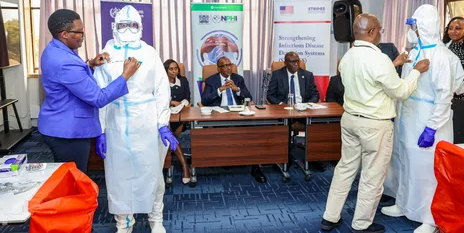
NAIROBI, KENYA — Kenya has activated heightened Kenya border health surveillance at points of entry following the spread of Mpox across 40 of its 47 counties, with 1,298 confirmed cases and 19 deaths recorded as of 6 September 2026, according to government officials. Authorities simultaneously strengthened measures for Ebola detection despite no confirmed cases, designating four laboratories for testing and stockpiling personal protective equipment.
Multi-agency teams have been trained to reinforce screening and monitoring protocols at informal crossing points and high-traffic transit corridors.
Geographical Distribution and High-Risk Zones
The Mpox outbreak has hit hardest in coastal and urban centers, causing widespread operational pressure on regional clinical facilities. Official data highlights significant cluster counts across major transport hubs and border points.
Diagnostic Readiness and Operational Control Measures
To prevent multi-pathogen strain on the national health grid, health authorities are expanding diagnostic capacity alongside Kenya border health surveillance enforcement. Four specialized laboratories are active for rapid Ebola screening while personal protective equipment reserves are distributed to front-line health units.
Field teams are prioritizing cross-border coordination to stem potential spillover into neighboring East African countries.
Why It Matters: Heightened Kenya border health surveillance mitigates regional transmission risks and protects national health infrastructure already managing multiple concurrent infectious outbreaks.
Kenya Heightens Infectious Disease Surveillance as… NAIROBI, KENYA — Kenya has intensified its health response across multiple viral threats as confirmed Mpox cases reached 1,298 with 19 deaths across 40 of its 47 counties. Establishing a comprehensive kenya infectious disease surveillance…
Kenyan Doctors Issue Strike Notice to 17 Counties… NAIROBI, KENYA — The Kenya Medical Practitioners, Pharmacists and Dentists Union (KMPDU) has issued a KMPDU doctors strike notice to 17 county governments, warning that doctors will stop work from 25 November 2026 unless agreed…
Ghana Steps Up Airport Ebola Screening After Kenya,… ACCRA, GHANA — The Ministry of Health (MoH) has activated heightened biosecurity surveillance, declaring that ghana steps up airport ebola screening across all ports of entry following confirmed viral importations in Kenya and Nigeria. Disclosing…
Ebola Transit Centre Burns in Congo Camp as Thousands Flee BUNIA, DR CONGO — Threatening regional epidemic containment, an ebola transit centre burns down at Kigonze displacement camp in eastern Democratic Republic of the Congo, forcing thousands of residents to flee and severely setting back…