Asthma is one of the most common long-term conditions in Nigeria, affecting children and adults alike. Most of the time, it can be well controlled with the right inhalers. However, asthma attacks still send many people to emergency rooms, and some are fatal. Most deaths from asthma can be prevented. Knowing the asthma attack warning signs, and what to do when they appear, can save your life or your child’s life.
What happens during an asthma attack
In asthma, the airways in the lungs are sensitive and inflamed. When they react to a trigger, three things happen. The muscles around the airways tighten, the lining swells and extra mucus is produced. Together, these narrow the airways and make it hard to breathe.
An asthma attack can build up slowly over hours or days, or come on suddenly within minutes. Slowly developing attacks give you time to act, if you recognise the early signs.
Common triggers in Nigeria
Triggers vary from person to person. Common ones include:
Dust, especially during the harmattan season
Smoke from firewood, charcoal, generators, cigarettes and bush burning
Colds, flu and other chest infections
Cold air and sudden weather changes
Strong perfumes, insecticide sprays and cleaning products
House dust mites, cockroaches, mould and pet hair
Exercise, particularly in cold or dusty air
Stress and strong emotions
Some medicines, such as aspirin and ibuprofen, in a small number of people
Learning your own triggers, and avoiding them where possible, reduces the number of attacks.
Early signs that asthma is getting worse
Before an attack, there are often early warnings that asthma control is slipping:
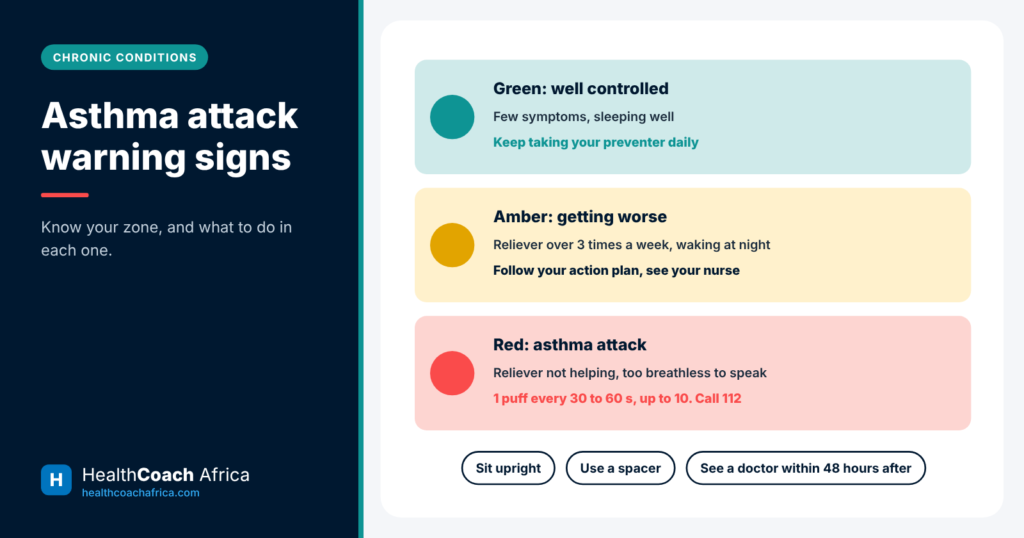
Needing your reliever inhaler more than usual, or more than three times a week
Waking at night with coughing, wheezing or a tight chest
Feeling breathless with activities you normally manage
Your peak flow reading dropping 1 below your usual level
A cold or chest infection affecting your breathing
If you notice these signs, follow your asthma action plan and contact your doctor or nurse. Acting early can stop an attack before it starts.
The main asthma attack warning signs
You are having an asthma attack if you have any of these:
Your reliever inhaler is not helping, or its effect lasts less than four hours
You are too breathless to speak, eat or sleep
Your breathing is getting faster and you cannot catch your breath
Your wheeze, cough or chest tightness is getting worse
Your peak flow reading is much lower than normal
In children, other asthma attack warning signs include complaining of a tummy ache, the skin between the ribs sucking in with each breath, and the child being unusually quiet or unable to play.
Signs of a life-threatening attack
Call for emergency help immediately if you notice:
Blue or grey lips or fingertips
Extreme difficulty breathing, or very little air movement
A “silent chest”, where wheezing stops because too little air is moving
Confusion, drowsiness or exhaustion
Collapse
These are signs that not enough oxygen is reaching the body.
What to do during an asthma attack
Follow these steps, based on widely used emergency advice:
Sit up straight. Stay calm and loosen tight clothing. Do not lie down.
Use your reliever inhaler. Take one puff of your blue reliever every 30 to 60 seconds, up to a maximum of 10 puffs. Use a spacer 2 if you have one.
Call for help. If you feel worse at any point, or you do not feel better after 10 puffs, call 112 or go to the nearest hospital immediately.
Repeat if needed. If help has not arrived after 15 minutes, repeat step 2.
If your asthma action plan gives different instructions, follow your plan. After any asthma attack, see your doctor within 48 hours, even if you feel better.
Asthma attack warning signs in children
Children cannot always explain how they feel. Parents, teachers and carers should watch for asthma attack warning signs such as:
Fast breathing or noisy, wheezy breathing
Coughing that will not stop, especially at night or after play
The skin between the ribs or at the base of the neck sucking in with each breath
Flaring nostrils
Difficulty speaking, feeding or playing
Unusual quietness, tiredness or a pale or blue colour
Give the child’s reliever with a spacer, following the same steps as for adults, and seek help quickly if there is no improvement. Make sure the school has a copy of the child’s action plan and a spare inhaler with a spacer.
Relievers and preventers
Asthma treatment usually involves two kinds of inhaler:
Reliever inhalers, often blue, such as salbutamol 3 . They open the airways quickly during symptoms.
Preventer inhalers, which contain a low dose of steroid, such as beclometasone 4 or budesonide. Taken every day, they calm inflammation and reduce the risk of attacks.
Some people use a single combination inhaler, containing both a preventer and a long-acting reliever, for daily use and for symptoms. Current international guidance advises against relying on a blue reliever alone, without any preventer treatment, because this raises the risk of severe attacks.
HUBPHARM PHARMACIST’S NOTE Studies consistently find that most people make at least one mistake with their inhaler. Book a free inhaler technique check with a HubPharm pharmacist by video call. Bring your inhaler and spacer, and we will watch you use them and correct each step.
Inhaler technique matters
Many people do not use their inhaler correctly, so much of the medicine never reaches the lungs. Ask your pharmacist or nurse to check your technique at every visit. For metered-dose inhalers:
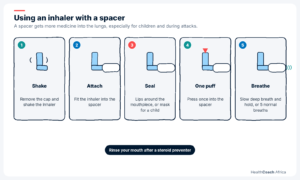
Shake the inhaler and remove the cap
Breathe out gently, away from the inhaler
Seal your lips around the mouthpiece
Press the inhaler once as you start a slow, deep breath in
Hold your breath for about 10 seconds, then breathe out slowly
A spacer, a plastic tube attached to the inhaler, makes it much easier to get the medicine into the lungs, especially for children and during attacks.
Five steps for using an inhaler with a spacer, to treat asthma attack warning signs early
Ask your pharmacist or nurse to check your technique at every visit.
Using a peak flow meter
A peak flow meter is a small, inexpensive device that measures how fast you can blow air out. When your airways narrow, the reading drops, often before you notice symptoms. Recording your peak flow each morning and evening shows trends and helps you spot asthma attack warning signs early.
To use it, stand up, take a deep breath, seal your lips around the mouthpiece and blow out as hard and fast as you can. Do this three times and record the highest number. Your doctor will tell you your personal best and the levels that should prompt action.
Your asthma action plan
An asthma action plan is a written plan, made with your doctor or nurse, that tells you:
Which medicines to take every day
How to recognise when asthma is getting worse
What to do when it gets worse
What to do in an emergency
Many plans use a traffic-light system. Green means asthma is well controlled. Amber means it is getting worse and you need to act. Red means an emergency. Keep a copy at home, in your bag and at your child’s school.
After an attack
An asthma attack is a sign that your asthma needs review. See your doctor or nurse within 48 hours, even if you feel well. If you were given steroid tablets, such as prednisolone, finish the course as prescribed. Your doctor will check your inhaler technique, adjust your preventer and update your action plan. Recognising the asthma attack warning signs that came before the attack helps you act sooner next time.
Myths about asthma
“Inhalers are addictive.” Inhalers are not addictive. Needing your reliever often is a sign that asthma is poorly controlled.
“Steroid inhalers weaken the body.” Preventer inhalers use very small doses that act directly in the lungs. They are safe for long-term use in children and adults.
“Asthma is only a childhood illness.” Asthma can start at any age, and adults with asthma still need regular treatment.
Measures how fast you can blow out. It warns of worsening asthma early.
2
Spacer
Over the counter
Plastic chamber that helps more medicine reach the lungs.
3
Salbutamol reliever inhaler
Prescription only
Opens the airways quickly. Needing it more than three times a week is a warning sign.
4
Preventer inhaler
Prescription only
Low-dose inhaled steroid, such as beclometasone or budesonide, taken daily.
To order any of these, or to ask a pharmacist a question first, message HubPharm on WhatsApp or visit hubpharmafrica.com. Prescription medicines are supplied against a valid prescription.
Coping With Panic Attacks: 6 Steps That Calm Your Body Fast Your heart pounds, your chest tightens and you are suddenly sure that something terrible is about to happen. Many people who rush to hospital convinced they are having a heart attack are in fact having…
Heart Attack Warning Signs: Act Fast and Save a Life Heart disease is rising in Nigeria, driven by high blood pressure, diabetes, smoking and changing lifestyles. A heart attack is a medical emergency in which every minute counts. The faster treatment starts, the more heart…
Migraine Triggers and Treatment: How to Take Back Control A migraine is much more than a bad headache. It is a neurological condition that can cause severe, throbbing pain, sickness and sensitivity to light and sound, often forcing people to lie down in a…
Gout Diet and Treatment: How to Stop the Attacks Gout causes some of the most intense pain a person can experience. An attack can turn a big toe hot, red and so tender that even a bed sheet feels unbearable. Gout is becoming more…