Every pharmacist in Nigeria has met this patient. A middle-aged man with high blood pressure, prescribed the right medicine by a good doctor, who stopped taking it after six weeks because he felt fine, ran short of money, or simply forgot. Months later he returns, this time with a stroke. We often describe that outcome as bad luck or poor discipline. I want to argue it is neither. Poor medication adherence in Africa is the most predictable failure in our health system, and it is one we have chosen not to design against.
A problem the WHO named two decades ago
In 2003 the World Health Organization published a report titled Adherence to Long-Term Therapies: Evidence for Action. Its conclusion was blunt. In developed countries, adherence among patients with chronic diseases averaged only about 50%, and it was lower still in developing countries. The report went further, suggesting that improving adherence might do more for health than any new medical technology.
One example in that report has stayed with me. In a study from Sudan, only 18% of patients who did not adhere to treatment achieved good blood pressure control, compared with 96% of those who did. Same disease, same medicines, completely different outcomes. The variable was whether the tablets were actually taken.
More than twenty years later, we have better drugs, better guidelines and better diagnostics. We have not solved this.
The Nigerian picture
Hypertension is the clearest illustration because it is common, silent and lifelong. A systematic analysis estimated that around 27.5 million Nigerian adults were living with hypertension in 2020, an age-adjusted prevalence of about one in three. Awareness has improved, but treatment and control rates remain low.
Studies from Nigerian hospitals show why. In Sokoto, a study of 605 hypertensive outpatients found that only 8.9% were fully adherent to their medicines, and forgetfulness was the most common reason given. In a primary care clinic in Eastern Nigeria, adherence was 42.9% and blood pressure control just 35%, with control strongly linked to adherence. Among elderly patients at a geriatric centre in Ibadan, about a third were non-adherent, citing reasons that included falling asleep before a dose, being too busy and medicines simply being unavailable.
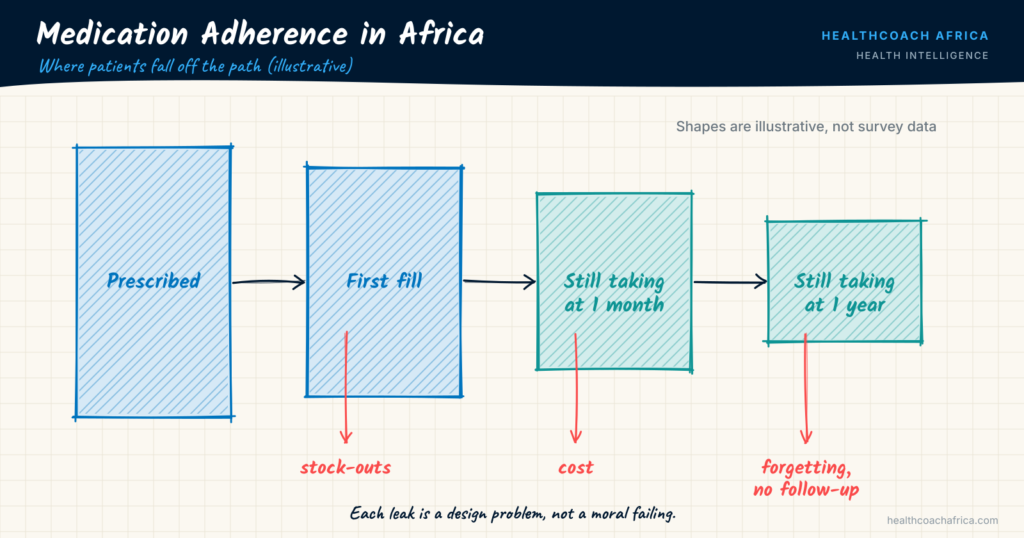
Read those reasons again. Forgetting. Being busy. The medicine not being there. None of these is a moral failing. Each one is a design problem.
Why we keep blaming the patient
The WHO report made a point that our system still ignores: patients are too often blamed for not following treatment, even though health workers and health systems strongly influence whether they do. We tell patients to comply, then send them into a market where the medicine may be out of stock, the price has doubled since last month, nobody reminds them of their refill and nobody notices when they stop.
Medication adherence in Africa is low not because Africans are uniquely careless, but because the path from prescription to sustained use is full of holes, and nobody is responsible for patching them. The doctor’s job ends at the prescription. The shop’s job ends at the sale. The patient is left to manage a lifelong condition alone.
Four pillars of medication adherence in Africa
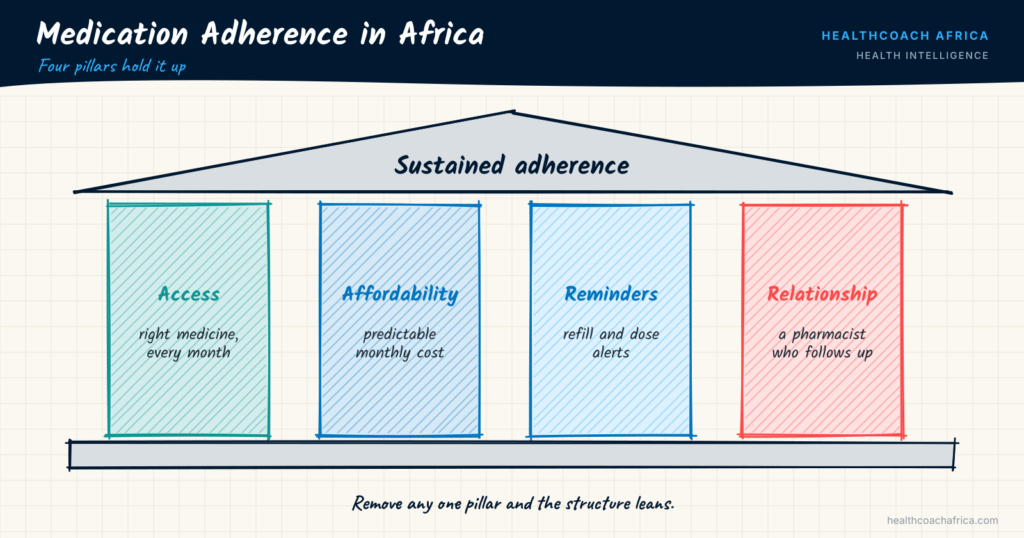
After years in community pharmacy, distribution and now chronic care, I have come to think of adherence as a structure resting on four pillars. Remove any one, and the whole thing leans.
Four pillars framework for improving medication adherence in Africa: access, affordability, reminders and relationship
The four pillars of adherence. Remove any one and the structure leans.
Access. The right medicine has to be available, every month, without a search across several shops. Stock-outs are the silent killer of adherence. Every time a patient is told to come back next week, some of them never do.
Affordability. Chronic care is a monthly bill that never ends. Patients ration tablets, skip refills or switch to cheaper unverified products when money is tight. Generic substitution with quality assurance, insurance coverage of chronic medicines and predictable monthly pricing all matter more than we admit.
Reminders. Forgetfulness is the most common reason for missed doses in study after study. A simple refill reminder, a dose alert or a weekly pill organiser costs little and does a great deal. Technology makes this cheap at scale.
Relationship. People keep taking medicines when someone they trust explains why it matters, answers their worries about side effects and notices when they drift. That someone is usually not a busy hospital doctor. It can be a pharmacist who knows them by name.
The economics we keep ignoring
There is a financial argument here that should persuade even those unmoved by the human one. A month of a generic antihypertensive costs a small fraction of a single night in a hospital stroke unit, let alone a lifetime of disability. Dialysis for kidney failure caused by uncontrolled diabetes or hypertension can bankrupt a family within months. Every patient who stops treatment is a deferred bill that someone, the family, the insurer or the state, will eventually pay at a much higher price. When we underinvest in adherence, we are not saving money. We are borrowing it at a ruinous rate of interest from our own future.
What we have seen when the pillars stand
At HubPharm Africa we built our chronic care service around these four pillars because we kept watching patients fall through the same holes. We guarantee verified medicines, deliver them on a monthly schedule, send reminders, and assign pharmacists who follow up when a refill is missed.
Across more than 10,200 patients and over 400,000 medicine packs dispensed, adherence among the patients we follow has improved by 42%, and 95% report being satisfied with the service. I share these figures with caution; they are our own programme data, not a randomised trial, and they come from a population that chose to enrol. But they are consistent with what the WHO argued in 2003: when the system takes responsibility for adherence, adherence improves.
What I am asking the system to do
To insurers and HMOs: pay for adherence, not only for consultations. A patient who takes their medicines for a year is far cheaper than one admitted with a stroke.
To policymakers: recognise pharmacist-led follow-up as a reimbursable clinical service, and measure adherence as a quality indicator in primary care.
To doctors: treat the prescription as the beginning of a handover, not the end of your role. Connect patients to someone who will follow them.
To patients and families: if a medicine is hard to get, too expensive or causing problems, say so. There is almost always a safer option than stopping quietly.
A note from HubPharm. If you or someone you care for takes medicines for blood pressure, diabetes, asthma or another long-term condition, you should not have to manage it alone. Send the code HC-TL02 on WhatsApp to +234 705 050 5001. A HubPharm pharmacist will review your prescription, set up monthly delivery and refill reminders, and stay in touch so that the medicine you were prescribed is the medicine you actually take.
The bottom line
We spend enormous effort diagnosing chronic disease and almost none making sure the treatment continues. Medication adherence in Africa is the treatment we keep forgetting to prescribe. It does not need a breakthrough drug. It needs a system that takes responsibility for the months after the prescription is written. Every stroke, amputation and kidney failure we prevent this way is a cost we do not have to carry later.
Views expressed are the author’s own. HubPharm programme figures are the company’s own reported data. The author is the founder of HubPharm Africa, a sister company of HealthCoach Africa within the HubCare Global group.
References
World Health Organization. Adherence to long-term therapies: evidence for action. Geneva: WHO; 2003.
Adeloye D, Owolabi EO, Ojji DB, et al. Prevalence, awareness, treatment, and control of hypertension in Nigeria in 1995 and 2020: a systematic analysis of current evidence. J Clin Hypertens. 2021;23(5):963-977.
Adisa R, Ilesanmi OA, Fakeye TO. Treatment adherence and blood pressure outcome among hypertensive out-patients in two tertiary hospitals in Sokoto, Northwestern Nigeria. BMC Cardiovasc Disord. 2018;18. doi:10.1186/s12872-018-0934-x
Iloh GUP, Ofoedu JN, Njoku PU, et al. Medication adherence and blood pressure control amongst adults with primary hypertension attending a tertiary hospital primary care clinic in Eastern Nigeria. Afr J Prim Health Care Fam Med. 2013;5(1).
Akande-Sholabi W, Ogini DE, Adebusoye L, Fakeye TO. Assessment of knowledge and reasons for medication non-adherence in ambulatory elderly patients with hypertension and diabetes mellitus in a geriatric centre in Nigeria. Int J Pharm Pract. 2021;29(Suppl 1):i4.
Please follow and like us:
Views:34
Related Posts:
High Blood Pressure in Nigeria: Why Treatment Stops Working Most people who lose control of high blood pressure in Nigeria were never lost to the health system. They were diagnosed. They collected a prescription. Many even took the tablets for a while. Then something…
Diabetes in Nigeria: Why Blood Sugar Control Fails Diabetes in Nigeria does not usually fail in the clinic. Among people who reach a specialist and stay in care, control is often reasonable. It fails in the years before anyone tests you, and it…
Living With Heart Failure: A Daily Guide for… Heart failure does not mean that the heart has stopped or is about to stop. It means that the heart is not pumping blood around the body as well as it should. It is a…
Normal Blood Pressure Reading: What Your Numbers Mean You have two numbers and no idea what they mean. Worse, you searched them and found an American page telling you that 134 over 86 is Stage 1 hypertension, while your doctor in Lagos looked…