A new baby is supposed to bring joy. Family and friends visit, pray for the child and tell the mother how lucky she is. So when a new mother feels empty, anxious or unable to cope, she often hides it. She may fear being called ungrateful, weak or spiritually attacked. Yet postpartum depression is a common medical condition, and it can be treated. Knowing the postpartum depression warning signs helps mothers, partners and families act early. This guide explains what to look for, how it differs from the baby blues and where to find help.
What is postpartum depression?
Postpartum depression, also called postnatal depression, is depression that develops during pregnancy or within the first year after birth. It affects more than one in ten women after childbirth. It can start a few weeks after delivery or several months later.
It is not caused by anything the mother did wrong. Hormone changes, lack of sleep, the physical recovery from birth and the huge life change of caring for a newborn all play a part. Stress at home, money worries and a lack of support make it more likely.
Baby blues or postpartum depression?
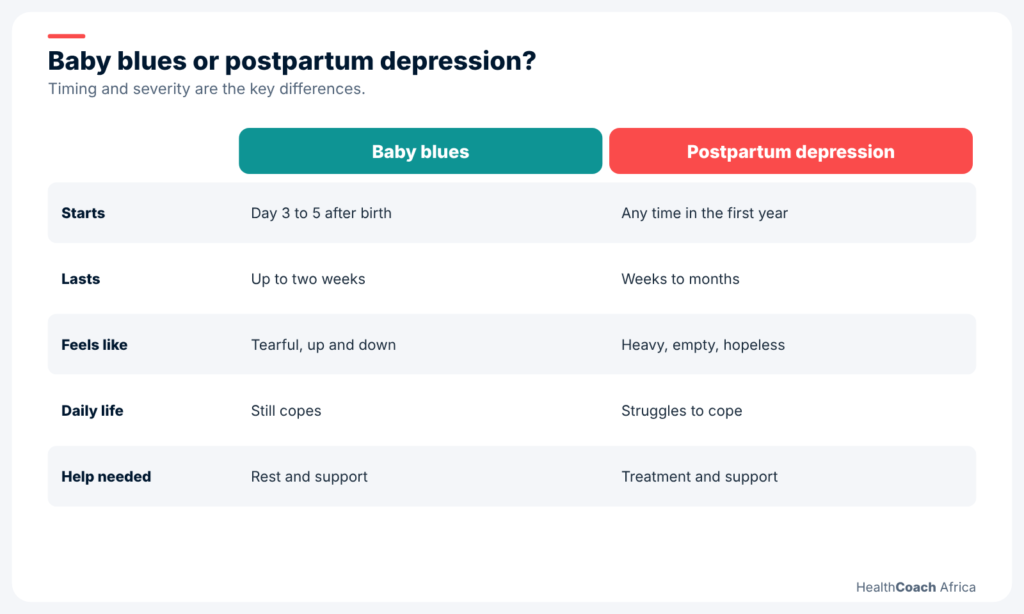
Comparison of baby blues and postpartum depression warning signs, including timing, severity and when to seek help
If low mood lasts beyond two weeks, talk to a health worker.
Many mothers feel tearful, irritable and overwhelmed in the first days after birth. This is called the baby blues. It usually starts around day three to five and settles within two weeks without treatment.
Postpartum depression is different. It lasts longer than two weeks, feels heavier and makes daily life difficult. If low mood continues beyond the second week, or appears later in the first year, it may be depression rather than the blues.
The main postpartum depression warning signs
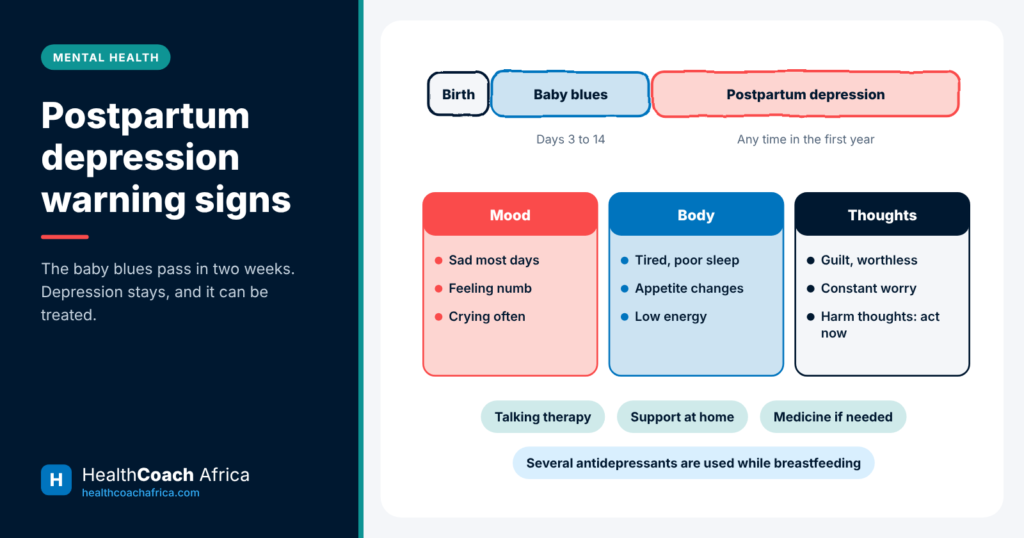
Watch for these postpartum depression warning signs in yourself or someone close to you:
Persistent sadness or low mood most of the day, on most days
Loss of interest or pleasure in things once enjoyed, including the baby
Feeling numb or disconnected from the baby or the family
Constant tiredness, even when the baby sleeps
Trouble sleeping, or sleeping too much
Changes in appetite, such as not eating or eating far more
Feeling worthless, guilty or like a bad mother
Constant worry or anxiety, including fear that something will harm the baby
Difficulty concentrating or making simple decisions
Withdrawing from family, friends and visitors
Irritability or anger that feels out of character
Frightening thoughts, including thoughts of self-harm
A mother does not need to have every sign. Two weeks of low mood or loss of interest, together with some of the other signs, is enough reason to seek help.
When it is an emergency
Some situations need same-day help. Contact a doctor or go to a hospital immediately if a mother:
Has thoughts of harming herself or her baby
Talks about death or not wanting to be alive
Seems confused, sees or hears things that others do not, or holds unusual beliefs
Becomes very agitated, cannot sleep at all or behaves in a way that is out of character
These may be signs of postpartum psychosis, a rare but serious condition that usually starts within the first few weeks after birth. It needs urgent treatment, but most women recover fully. Do not leave a mother alone if you are worried about her safety.
Who is at higher risk?
Any mother can develop postpartum depression. The risk is higher if she:
Has had depression or anxiety before
Had depression during pregnancy
Has little support from a partner or family
Experienced a difficult birth, loss of a baby or a baby admitted to special care
Is dealing with money problems, housing worries or relationship conflict
Faces violence or abuse at home
Is a teenager or did not plan the pregnancy
Fathers can become depressed too, particularly if their partner is depressed. Both parents deserve support.
Why mothers hide their feelings
In many Nigerian families, a new mother is expected to be grateful and strong. Some families interpret depression as laziness, a spiritual attack or a lack of faith. As a result, mothers may smile for visitors while struggling in private.
Health workers can help by asking every mother how she is feeling, not just how the baby is feeding. Families can help by listening without judging. Recognising postpartum depression warning signs as a health problem, not a personal failure, is the first step to recovery.
How postpartum depression is diagnosed
A doctor, nurse or midwife will ask about mood, sleep, appetite and thoughts. Many use a short questionnaire called the Edinburgh Postnatal Depression Scale. They may also check for physical causes, such as anaemia or thyroid problems, which can cause tiredness and low mood after birth.
Be as open as you can. Health workers ask these questions to help, not to judge or take the baby away.
HUBPHARM PHARMACIST’S NOTE
Many mothers delay treatment because they fear that antidepressants will harm their baby through breast milk. Several antidepressants, including sertraline, are commonly used during breastfeeding, and your doctor will choose carefully. Chat confidentially with a HubPharm pharmacist about any medicine you have been prescribed. Tell us your baby’s age and how you are feeding, and we will explain what to expect, how long it takes to work and which side effects to report. Your conversation stays private, and you can message at night, when worries often feel heaviest.
Treatment options
Postpartum depression responds well to treatment. Options include:
Support and self-care for milder symptoms, such as rest, help at home and regular meals
Talking therapy, such as cognitive behavioural therapy or counselling, individually or in a group
Antidepressant medicine for moderate1 or severe depression
Several antidepressants can be used safely while breastfeeding. Your doctor will choose one that suits you and your baby. Most take two to four weeks to start working. Do not stop them suddenly once you feel better. Talk to your doctor first.
How partners and families can help
Partners and relatives play a big role in recovery. Practical help makes a real difference:
Take over night feeds when possible, using expressed milk or formula if advised
Cook meals and help with housework
Care for older children
Encourage rest and short breaks outside the house
Go with her to appointments
Listen, and avoid saying “just be strong” or “other women cope”
Watch for postpartum depression warning signs that she may not mention herself, such as withdrawing or not eating.
Self-care for new mothers
Small steps help recovery alongside treatment:
Rest whenever the baby sleeps, even if housework waits
Eat regular meals and drink plenty of water
Go outside for a short walk each day if you can
Talk to another mother, a friend or a support group
Accept help when it is offered
Avoid alcohol and herbal products that have not been checked with a health worker
Myths about postpartum depression
“It is just the baby blues.” The baby blues pass within two weeks. Depression lasts longer and needs support.
“Good mothers do not get depressed.” Depression has nothing to do with being a good or bad mother.
“Medicine will harm breastfeeding.” Several antidepressants are compatible with breastfeeding.
“It will go away on its own.” Without treatment, it can last for months and affect the whole family.
Planning for the next pregnancy
Women who have had postpartum depression are more likely to have it again. This does not mean it will happen, but planning helps. Tell your antenatal team about your history early in the next pregnancy. Arrange extra help at home for the first months. Agree on a plan with your doctor about medicine and follow-up. Knowing the postpartum depression warning signs from experience means you can act quickly if they return.
For moderate or severe postpartum depression. Several are compatible with breastfeeding.
To order any of these, or to ask a pharmacist a question first, message HubPharm on WhatsApp or visit hubpharmafrica.com. Prescription medicines are supplied against a valid prescription.
Cox JL, Holden JM, Sagovsky R. Detection of postnatal depression: development of the 10-item Edinburgh Postnatal Depression Scale. Br J Psychiatry. 1987;150:782-786. https://doi.org/10.1192/bjp.150.6.782
Please follow and like us:
Views:56
Related Posts:
Signs of Postpartum Depression Every New Mother Should Know A new baby is expected to bring joy, so many mothers hide how they really feel. Yet studies in Nigeria have found depression in anywhere from about 15% to 45% of women after childbirth, depending…
Grief and Bereavement Support: Living Through Loss Losing someone we love is one of the hardest experiences in life. In Nigeria, families often come together quickly after a death, with visitors, prayers, ceremonies and long funeral preparations. When the crowds leave, many…
Tramadol and Codeine Addiction: Signs, Dangers and… Tramadol and codeine are opioid medicines used to relieve pain and, in the case of codeine, to suppress coughs. Used correctly for a short time, they are helpful. However, misuse has become a serious problem…
ADHD Signs in Children: Understanding Restless and… Every child is restless and distracted sometimes. But some children find it much harder than others to sit still, focus and control their impulses. They may be labelled stubborn, troublesome or lazy, and punished again…