A condom breaks. A pill is forgotten. Sex happens without protection, or without consent. In each case, there is still a short window in which pregnancy can be prevented. Emergency contraception in Nigeria is legal, sold in pharmacies and safe for most women. However, myths and delays mean that many women take it too late or use it in ways that fail. Here is what you need to know.
What it is and how it works
Emergency contraception refers to methods used after sex to prevent pregnancy. The pills work mainly by delaying the release of an egg. They do not end an existing pregnancy, and they do not harm a developing baby. In other words, emergency contraception is not abortion.
When you might need it
Emergency contraception in Nigeria is used in specific situations. Consider it if:
No contraception was used
A condom broke, slipped or was put on late
You missed two or more of your daily pills
You are late for your contraceptive injection
You vomited or had severe diarrhoea while relying on the pill
The withdrawal method failed
You were forced to have sex
In each case, the sooner you act, the better the result.
The three options
Three forms of emergency contraception in Nigeria are worth knowing about:
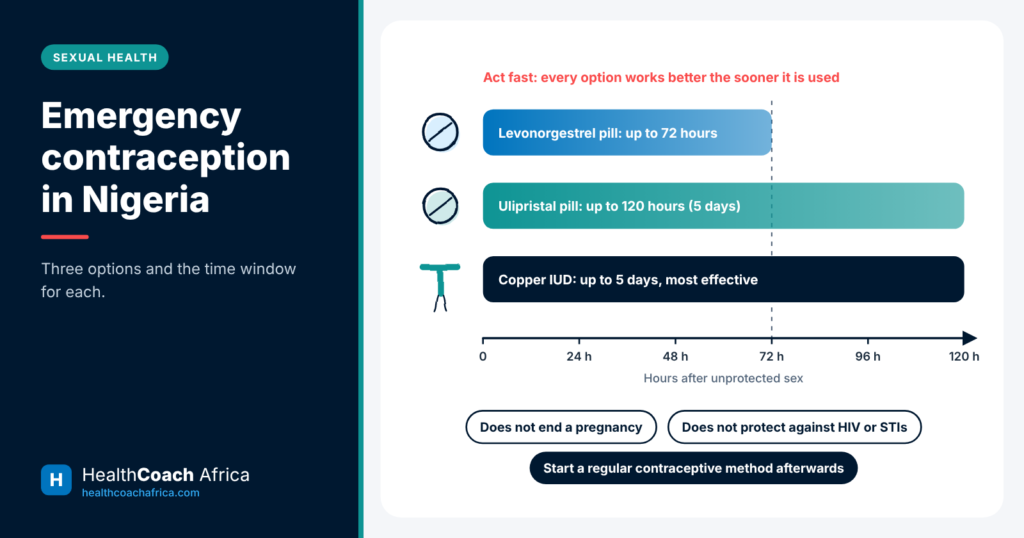
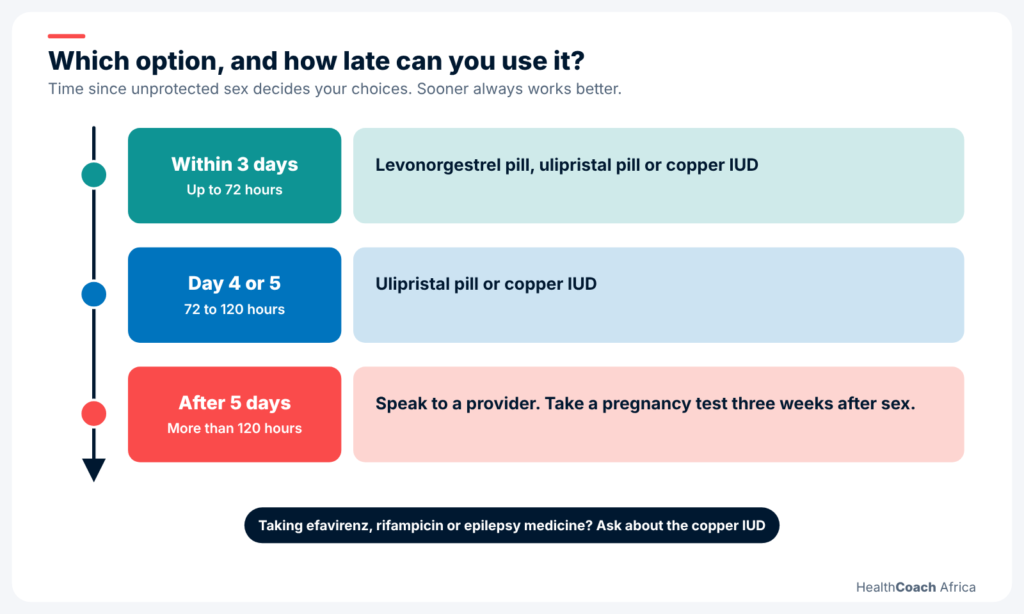
Levonorgestrel pill (1.5 mg). This is the most common option in Nigeria and is sold under several brand names. Take it within 72 hours of unprotected sex. The sooner you take it, the better it works.
Ulipristal acetate pill (30 mg). It works for up to 120 hours, or five days, and is more effective than levonorgestrel, especially after the third day. However, it is less widely stocked.
Copper IUD. A trained provider inserts it within five days. It is the most effective method, at over 99%, and it continues to protect you for years afterwards.
Where to get it
Access is one of the strengths of emergency contraception in Nigeria. Levonorgestrel pills are sold in community pharmacies and medicine shops without a prescription. Family planning units in primary health centres and general hospitals also supply them, often at little or no cost.
The copper IUD is fitted at family planning clinics, in many hospitals and by reproductive health charities. Call ahead to confirm that a trained provider is available that day.
You do not need to explain your reasons to anyone. Even so, a short conversation with the pharmacist is worthwhile, because your other medicines and the timing of your cycle affect which option is best.
How well does it work?
The pills prevent most expected pregnancies, but they are less reliable than regular contraception. For that reason, treat it as a backup, not a plan. They work less well if you have already ovulated. Levonorgestrel may also be less effective in women with a higher body weight.
In addition, some medicines weaken the pills. These include rifampicin for tuberculosis, efavirenz for HIV, some epilepsy medicines and St John’s wort. Therefore, tell the pharmacist about everything you take.
How to use emergency contraception in Nigeria safely
Act fast. Take the pill as soon as possible. Do not wait until morning.
Buy from a registered pharmacy. Check the NAFDAC number and the expiry date, because counterfeit products exist.
Repeat the dose if you vomit within two hours of levonorgestrel or three hours of ulipristal.
Use condoms until your next period. The pill does not protect you from sex that happens later in the same cycle.
Take a pregnancy test if your period is more than seven days late.
Start a regular method. Ask about implants, injections, daily pills or an IUD.
Your next period, and when to test
Most women get their period within a week of the expected date. It may be lighter or heavier than usual. Light spotting a few days after taking the pill is common, but it is not a period and does not prove that the pill has worked.
Take a pregnancy test if your period is more than seven days late, or three weeks after the unprotected sex if you are unsure of your dates. If the test is positive, see a doctor. The pill does not harm an established pregnancy.
Side effects
Side effects are mild and short-lived. They include nausea, headache, tiredness, breast tenderness, cramps and light spotting. These effects usually pass within a day or two and need no treatment. Your next period may also come a few days early or late. However, see a doctor urgently if you develop severe lower abdominal pain in the following weeks.
Starting regular contraception afterwards
Emergency contraception covers one act of sex. For ongoing protection, choose a regular method straight away.
After levonorgestrel, you can start the pill, injection or implant on the same day. Use condoms as well for the next seven days.
After ulipristal, wait five days before starting a hormonal method, because starting sooner can make ulipristal less effective. Use condoms in the meantime.
After a copper IUD, you are already protected for years.
Long-acting methods include implants, which last three to five years, injections every two or three months and IUDs, which last five to ten years. All are reversible, and fertility returns after you stop.
Breastfeeding and other health conditions
The pills used for emergency contraception in Nigeria are safe for nearly all women. This includes teenagers, women with high blood pressure or migraine, and those who cannot take oestrogen. No examination or blood test is needed first.
Levonorgestrel is safe while breastfeeding. With ulipristal, the usual advice is to express and discard breast milk for a week. If you take medicines for tuberculosis, HIV or epilepsy, tell the provider. A copper IUD or an adjusted dose may be recommended.
Four myths that put women at risk
“It causes infertility.” There is no evidence for this. Fertility returns straight away.
“I can use it as my regular method.” Repeated use is not dangerous, but it is less effective than regular contraception and causes irregular bleeding.
“It protects against HIV and other infections.” It does not. After unprotected sex with a partner whose status you do not know, ask about HIV prevention medicine (PEP) within 72 hours.
“Salt water, lime, alcohol or antibiotics will do the same job.” None of these prevents pregnancy, and some cause harm.
What men should know
Preventing pregnancy is a shared responsibility. A partner can help by buying the pill quickly, paying for it and supporting the woman’s choice of a regular method. Using condoms correctly every time remains the simplest way to avoid the emergency in the first place.
After sexual assault
Seek medical care immediately. A single visit can cover emergency contraception, HIV prevention, treatment for other infections and emotional support. Many states have sexual assault referral centres that provide this care free of charge. What happened is not your fault.
Frequently asked questions
Can I take the pill more than once in the same cycle?
Levonorgestrel can be repeated if needed. However, do not mix levonorgestrel and ulipristal within five days of each other.
Does it work if I am already ovulating?
It is much less effective at that point. A copper IUD still works and is the better choice.
Will it affect a future pregnancy or baby?
No. It leaves the body within days and has no lasting effect on fertility or on later pregnancies.
How soon can I have sex again?
You can, but you are not protected. Use condoms until your next period or until your regular method is working.
Is there an age limit?
No. It is safe for any woman or girl of reproductive age who needs it.
The bottom line
Emergency contraception in Nigeria is safe, legal and close at hand. It is a backup, not a routine. Use it quickly when you need it, then choose a regular method that fits your life.
Getting help
You should not have to feel ashamed when asking about emergency contraception in Nigeria. HubPharm pharmacists give confidential, judgement-free advice and can help you choose a long-term method. To learn more, read why condoms and education are key to safe sex, or see the World Health Organization’s fact sheet on emergency contraception.
Please follow and like us:
Views:120
Related Posts:
How to Track Ovulation: Find Your Most Fertile Days For couples trying for a baby, timing matters. A woman can only get pregnant on a few days in each cycle, around the time an egg is released. Knowing when those days fall can make…
Malaria Prevention in Pregnancy: Protecting Mother and Baby Pregnancy changes the body's defences, and malaria takes advantage of this. In Nigeria, where malaria is present all year round, pregnant women face a higher risk of infection and of serious complications. Fortunately, simple and…
IVF Treatment in Nigeria: A Step-by-Step Guide for Couples Infertility affects many Nigerian couples and often brings stress, stigma and family pressure. In vitro fertilisation, or IVF, has helped many of these couples to have children. The number of fertility clinics in Nigeria has…
The Art of Consent: Healthy Relationships When it comes to sexual health and relationships, one of the most important but often overlooked topics is consent. Healthy relationships are built on mutual respect, trust, and clear communication—and understanding boundaries plays a central…