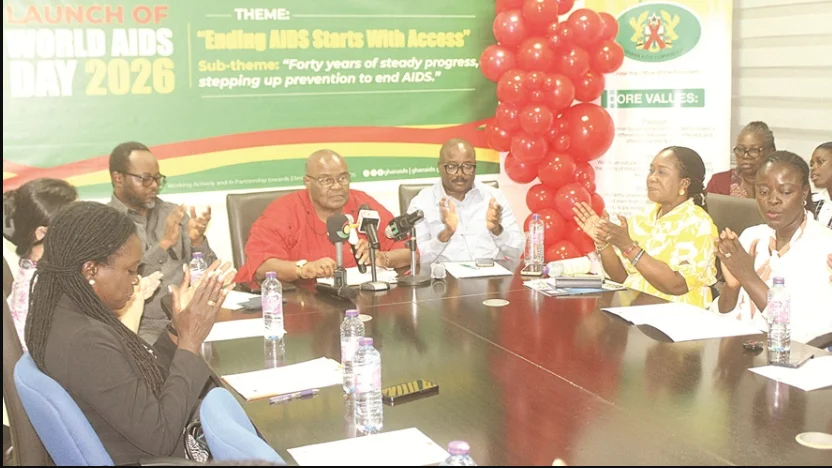
ACCRA, GHANA — The Ghana AIDS Commission (GAC) has urged Ghanaians to use free HIV self-test kits to learn their status and seek early treatment, as it launched activities for World AIDS Day 2026, the Ghanaian Times reported on 4 November.
The commission said the kits are available free at various public health facilities and can also be ordered online for delivery to people’s homes. It is also expanding access to condoms, pre-exposure prophylaxis (PrEP) and post-exposure prophylaxis (PEP), and intensifying public education to reduce new infections.
“Testing remains the entry point to HIV prevention and treatment,” said Dr Prosper Akanbong, Director-General of the GAC. “If you suspect an infection, take the necessary steps to test and seek treatment.”
How free HIV self-test kits work
An HIV self-test lets a person collect their own sample, usually a swab of the gums or a drop of blood from a finger prick, and read the result in private, typically within about 20 minutes. Free HIV self-test kits are designed for people who may avoid clinics because of stigma, distance, cost or busy working hours.
A reactive result is not a diagnosis. It must be confirmed with further testing at a health facility, where a person can be linked to counselling and treatment. A non-reactive result may need to be repeated if the person was exposed in the previous few weeks, because the test may not yet detect the infection.
WHO recommends HIV self-testing as an additional way to reach people who have never tested, including men, young people and key populations. Studies in several African countries have found that self-testing increases the number of people who learn their status, especially among men, who tend to test less often than women.
Home delivery may also help people living far from health facilities, young people worried about being seen at a clinic, and couples who want to test together. Programmes that distribute free HIV self-test kits often include a phone line or online support so that users can get help reading the result and finding the nearest clinic for confirmation.
Two themes for World AIDS Day 2026
The global theme for World AIDS Day 2026 is “Ending AIDS Starts with Access.” Ghana’s national theme is “40 Years of Steady Progress: Stepping Up Prevention to End AIDS.” World AIDS Day is marked each year on 1 December, and the launch begins weeks of awareness activities.
According to the photo caption in the Ghanaian Times, the launch was performed by Mr Kakra Essamuah.
Prevention tools beyond testing
PrEP is medicine taken by people who do not have HIV to lower their risk of infection, and it is highly effective when taken as prescribed. PEP is a short course of antiretroviral medicines started as soon as possible, and within 72 hours, after a possible exposure, such as condom failure, sexual assault or a needlestick injury in a health facility. Expanding access to PrEP and PEP gives people options beyond condoms.
Treatment is also prevention. People living with HIV who take antiretroviral therapy every day and keep their viral load suppressed can live long, healthy lives and do not transmit HIV to sexual partners.
This makes adherence, the habit of taking medicine consistently, central to HIV control. Missed doses, stock-outs and interruptions in care allow the virus to rebound and can lead to drug resistance.
Long-acting prevention options are also expanding globally, including injectable PrEP given every few months, which may help people who find daily pills difficult. Their arrival in Ghana will depend on regulatory approval, supply and cost.
Funding pressures and the road to 2030
Ghana, like many African countries, has relied heavily on international partners for HIV commodities and programmes. Changes in donor funding have increased pressure on governments to pay more for testing kits, antiretroviral medicines and prevention services from domestic budgets.
The global target is for 95 per cent of people living with HIV to know their status, 95 per cent of those diagnosed to be on treatment and 95 per cent of those on treatment to have suppressed viral loads. Self-testing is aimed at the first step, which is often where countries fall furthest behind.
Stigma remains a barrier. Fear of being seen at an HIV clinic or of a positive result becoming known can stop people from testing or starting treatment. Free HIV self-test kits that can be delivered at home are one way to reduce that fear.
The GAC did not publish new national HIV statistics at the launch, according to the report. Further campaign activities are expected in the run-up to 1 December, when the commission and partners usually release updated figures on new infections and treatment.
Why it matters: Private, free home testing can reach Ghanaians who avoid clinics, opening the door to treatment and prevention earlier.
HIV PrEP in Nigeria: A Practical Guide to HIV Prevention Nigeria has one of the largest numbers of people living with HIV in the world. Yet many new infections can now be prevented with a simple medicine. Pre-exposure prophylaxis, or PrEP, is medicine taken by…
Stopping HIV in its Tracks: The Role of PrEP and PEP HIV remains one of the most pressing public health challenges in Africa. According to UNAIDS, over 25 million people in Sub-Saharan Africa are living with HIV, and thousands of new infections occur every day. While…
STI Testing in Nigeria: A Confidential Guide to… Sexually transmitted infections, or STIs, are very common, and many cause no symptoms at all. That means you can have an infection, pass it on and develop complications without knowing. Testing is the only way…
World AIDS Day 2023: What You Need to Know World AIDS Day, observed annually on December 1st, is a significant event that raises awareness about HIV/AIDS and commemorates the progress made in the ongoing fight against this global health crisis. As we approach World…