ACCRA, GHANA — Ghana’s Ministry of Health has introduced Ghana Ebola traveller monitoring for up to 21 days for passengers arriving from countries with ongoing transmission of the Bundibugyo strain of Ebola, Citi Newsroom reported on 3 November.
The ministry issued the statement on Tuesday, 3 November, and said the measures were being implemented at Ghana’s international airports. Ghana has not recorded any confirmed Ebola case, and the ministry described the steps as precautionary.
“Passengers arriving from countries with ongoing transmission will be monitored for up to 21 days,” the statement said. The Ghana Health Service (GHS) will contact travellers for follow-up, and they must stay reachable and report any symptoms immediately.
How Ghana Ebola traveller monitoring will work
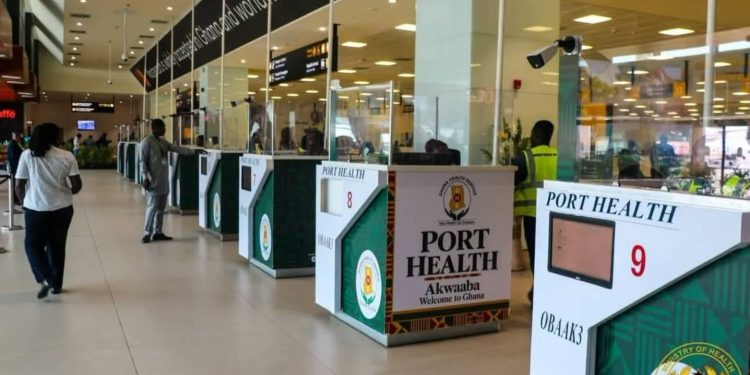
Under the new rules, Port Health officers will screen all arriving passengers, including temperature checks and reviews of health declaration forms and travel histories. Travellers must declare any visit to, or transit through, an Ebola-affected country in the previous 21 days, as well as any contact with a suspected or confirmed case.
Passengers with fever, vomiting, diarrhoea, severe weakness or unexplained bleeding will be referred for assessment and, where necessary, temporary isolation and medical care.
The ministry also placed duties on businesses. Hotels, conference venues and similar establishments must report guests from affected countries to the nearest district health directorate and keep their contact details.
Passengers who give false information, hide symptoms or refuse to cooperate with screening may face public health measures under Ghanaian law, the statement said.
Officials say Ghana Ebola traveller monitoring depends on accurate contact details. Travellers who change phone numbers or move between hotels after arrival may be difficult to reach, which is why establishments are being asked to keep records and report guests.
The regional outbreak behind the rules
Citing Africa CDC, Citi Newsroom reported that the outbreak has caused more than 5,300 deaths across Africa, most of them in the Democratic Republic of Congo (DRC), and that more than 10,400 cases have been confirmed since it was declared in May. The mortality rate is above 50 per cent.
Uganda and Kenya have also confirmed cases, with Kenya recording its first ever Ebola infections in October. Nigeria confirmed an imported case in Abuja on 20 October; that patient was later evacuated to Switzerland.
The Bundibugyo strain is one of several species of Ebola virus. Licensed Ebola vaccines and antibody treatments were developed against the Zaire strain, which caused the 2014 to 2016 West African epidemic, and are not approved for Bundibugyo, which makes early detection, isolation and supportive care more important.
Supportive care, including fluids, treatment of other infections and management of organ problems, improves survival for patients with any strain of Ebola. Getting suspected patients to a treatment unit early is therefore one of the most important steps a health system can take.
Why 21 days and why screening has limits
Twenty-one days is the maximum incubation period for Ebola, the time between infection and the first symptoms. A traveller who is infected but well on arrival may develop symptoms days later, which is why monitoring continues after the airport.
Airport temperature checks can miss people who are still incubating the virus or who have taken fever-reducing medicine. Follow-up calls, honest travel declarations and quick reporting of symptoms are what turn screening into an effective defence against infectious disease threats.
Ghana gained experience with this approach during the West African Ebola epidemic and the COVID-19 pandemic, when port health teams, isolation centres and contact tracers were set up across the country. The reporting duty on hotels and conference venues reflects the role that hospitality businesses play in tracing arriving guests.
Ghana Ebola traveller monitoring also relies on district health directorates, which will receive reports from hotels and venues and carry out follow-up. Health workers in clinics and hospitals are expected to ask feverish patients about recent travel, so that a missed case at the airport can still be picked up quickly.
Accra regularly hosts regional conferences, business travellers and visitors from across the continent, so the reporting rules for venues could affect a large number of arrivals during the monitoring period.
Avoiding fear and misinformation
The ministry urged the public to rely on official information from the Ministry of Health and GHS and to avoid spreading unverified reports. During past outbreaks, rumours and stigma have discouraged people from seeking care and led to discrimination against travellers and health workers.
Public health experts generally favour targeted monitoring over travel bans, arguing that bans encourage people to hide their travel history and use informal routes, which makes tracing harder.
Ghana Ebola traveller monitoring will remain in place while transmission continues in affected countries. The ministry did not say when it will review the measures, but further updates are expected as the regional outbreak changes.
Why it matters: Honest travel declarations and 21-day follow-up give Ghana its best chance of catching an imported Ebola case early.
Malaria Prevention for Travellers: Staying Safe on Your Trip Every year, many people travel to Nigeria for business, holidays, weddings, funerals and family visits. These include Nigerians who live abroad and return home. Malaria is present throughout Nigeria, all year round. Travellers who have…
Ghana Health Minister Says Country Is Ready for Any… ACCRA, GHANA — Ghana’s Health Minister Kwabena Mintah Akandoh has urged the public not to panic, saying Ebola preparedness in Ghana includes thermal scanners at the airport, electronic health declaration forms, laboratory testing and an…
Ghana Steps Up Airport Ebola Screening After Kenya,… ACCRA, GHANA — The Ministry of Health (MoH) has activated heightened biosecurity surveillance, declaring that ghana steps up airport ebola screening across all ports of entry following confirmed viral importations in Kenya and Nigeria. Disclosing…
Kenya Calls Saudi Ebola Travel Ban Punitive, Asks… NAIROBI, KENYA — Kenya has asked Saudi Arabia to lift a Saudi Ebola travel ban that suspends travel to and from the East African country, describing the measures as “disproportionate and not supported by scientific…