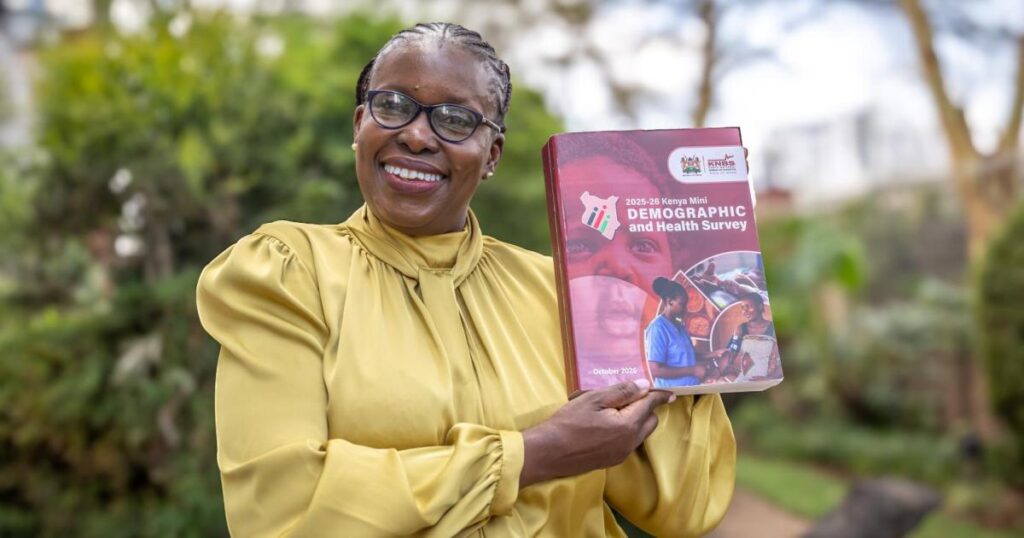
NAIROBI, KENYA — Most young children in Kenya are developmentally on track, but the share varies widely between counties, according to the first Kenya child development survey measures included in a national demographic and health survey, the World Health Organization (WHO) said.
The 2025-26 Kenya Mini Demographic and Health Survey, launched in Nairobi on 3 November, is the first national survey to measure child development from three months of age using WHO’s Global Scales for Early Development, according to WHO Africa.
What the Kenya child development survey found
The Kenya child development survey results show that 85 per cent of children aged 3 to 23 months and 83 per cent of children aged 24 to 59 months are developmentally on track. Among children aged 3 to 23 months, the on-track share ranges from 52 per cent in West Pokot to 97 per cent in Kakamega.
Data were collected from 5 November 2025 to 10 February 2026 from a nationally representative sample of 29,935 households. It is the eighth Kenyan demographic and health survey since 1989 and the first mini survey.
Prof. Amina Abubakar of Aga Khan University’s Institute for Human Development said the survey marks a shift. “For a long time, Kenya has tracked children’s survival and children’s growth,” she said, noting that the new measures look at how children are learning and developing.
Dr Makeba Shiroya, National Programme Officer for Child and Adolescent Health at WHO Kenya, said: “This data helps county policymakers target early-childhood support where it is needed most.”
Child survival and maternal care improve
The survey also shows progress on survival. Under-five mortality fell to 37 deaths per 1,000 live births, from 41 in 2022. In 2025, 91 per cent of births took place in a health facility, up from 88 per cent in 2022, and 72 per cent of women had at least four antenatal care visits in their most recent pregnancy, up from 66 per cent.
Dr Neema Rusibamayila Kimambo, WHO Representative to Kenya, spoke on behalf of the United Nations Resident Coordinator, Dr Gary Conille. “Behind every indicator is a person, a mother seeking safe care,” she said.
Dr Ouma Oluga, Principal Secretary of the State Department for Medical Services, said the government wants to improve lives, not only numbers. “We want to change the lives of the mothers, the children, the people who we read here as numbers,” he said.
The survey was funded by the Government of Kenya, the Gates Foundation, the Conrad N. Hilton Foundation, the Aga Khan University Institute for Human Development, UNICEF, UNFPA and WHO.
Why early development matters
The first years of life are a period of rapid brain development. Good nutrition, health care, responsive caregiving, safety and early learning opportunities help children develop language, movement, thinking and social skills that shape school performance and adult health.
Children who fall behind early often struggle later, but support can make a difference. Growth monitoring, play and talking with babies, early stimulation programmes, treatment of illness and nutrition support can all help children catch up.
Child growth and nutrition remain central. Stunting, caused by poor diet and repeated infections, affects both height and brain development, and is more common in arid and poorer counties. West Pokot, where the on-track share was lowest, is among Kenya’s more remote counties, with long distances to health facilities.
The wide county gap suggests that national averages can hide areas of great need. County governments, which run most health services in Kenya, can use the results to target early childhood programmes, community health promoters and parenting support.
Kenya has expanded its community health promoter programme in recent years, and health officials have suggested that these workers could help track development and advise caregivers during home visits, especially in remote counties.
Using the data
The Global Scales for Early Development were designed by WHO to allow countries to measure child development in a consistent way across settings, which makes it possible to compare progress over time and between populations.
The tool relies on caregiver reports and simple observations of skills such as babbling, walking, following instructions and playing with others, which makes it practical for large household surveys rather than requiring clinic-based assessments.
Experts say the next step is to link the data to services, including integrating developmental checks into routine child health visits, training community health workers to support caregivers, and expanding early childhood education.
The Kenya child development survey gives policymakers a new baseline. Future surveys will show whether investment in counties with the lowest scores narrows the gap.
Why it matters: Early development shapes learning and lifelong health, and county gaps show where Kenyan children need more support.
Lagos HIV Survey Finds Treatment Gains but Large Testing Gap LAGOS, NIGERIA — Only 58.3 per cent of people living with HIV in Lagos know their status, according to the Lagos HIV impact survey, even though most of those diagnosed are on treatment and virally suppressed,…
Kwara Penta-3 Vaccine Coverage Rises to 50.4 Per… ILORIN, NIGERIA — Child immunisation in Kwara has improved markedly, with coverage of the third dose of the pentavalent vaccine rising from 34.9 per cent in 2024 to 50.4 per cent in 2025 to 2026,…
Kenyan Doctors Issue Strike Notice to 17 Counties… NAIROBI, KENYA — The Kenya Medical Practitioners, Pharmacists and Dentists Union (KMPDU) has issued a KMPDU doctors strike notice to 17 county governments, warning that doctors will stop work from 25 November 2026 unless agreed…
WHO Says One in Four Adolescents Had No Active Days… GENEVA, SWITZERLAND — About one in four adolescents worldwide did not reach 60 minutes of physical activity on any day in the previous week, the World Health Organization (WHO) said on 4 November, warning that…