In many northern and central Nigerian states, malaria cases rise sharply during the rainy season. Young children are hit hardest, and many die each year. Seasonal malaria chemoprevention, often called SMC, is a campaign that gives children monthly antimalarial medicine during the high-risk months. It has saved many lives across the Sahel. This guide offers seasonal malaria chemoprevention explained in simple terms for parents and caregivers.
Why the rainy season matters
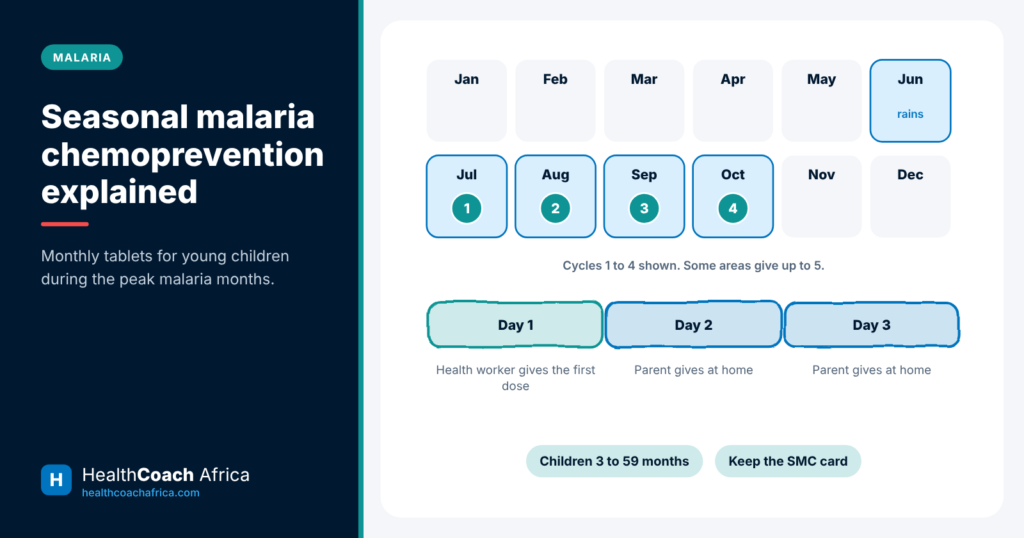
In the Sahel and savanna zones of Nigeria, most malaria transmission happens in a few months. Rain creates pools of water where mosquitoes breed. Cases climb quickly from about July and peak towards the end of the rains. During these months, young children can have several bouts of malaria. Some develop severe anaemia, convulsions or coma. Seasonal malaria chemoprevention explained in one sentence: it protects children exactly when the danger is greatest.
What SMC is
SMC means giving children a full treatment course of antimalarial medicine once a month during the rainy season, whether or not they are sick. The medicine clears any parasites already in the blood and protects the child for about four weeks. By giving it every month during the peak season, children are protected when malaria risk is highest.
The World Health Organization recommends SMC in areas where malaria transmission is highly seasonal.
Which children receive SMC?
In Nigeria, SMC campaigns usually target children aged 3 to 59 months, that is, from three months up to their fifth birthday. These children are at the greatest risk of severe malaria and death. Some campaigns elsewhere have extended the age range.
Children who are very sick, who are allergic to the medicines, or who are already taking certain drugs, such as co-trimoxazole, may not be given SMC. The health worker will check.
Where SMC is given in Nigeria
SMC is mainly delivered in states with a short, intense rainy season, especially in the north. The number of states has grown over the years. If you live in one of these areas, you will usually hear announcements from community leaders, health workers or radio before each campaign.
The medicines used
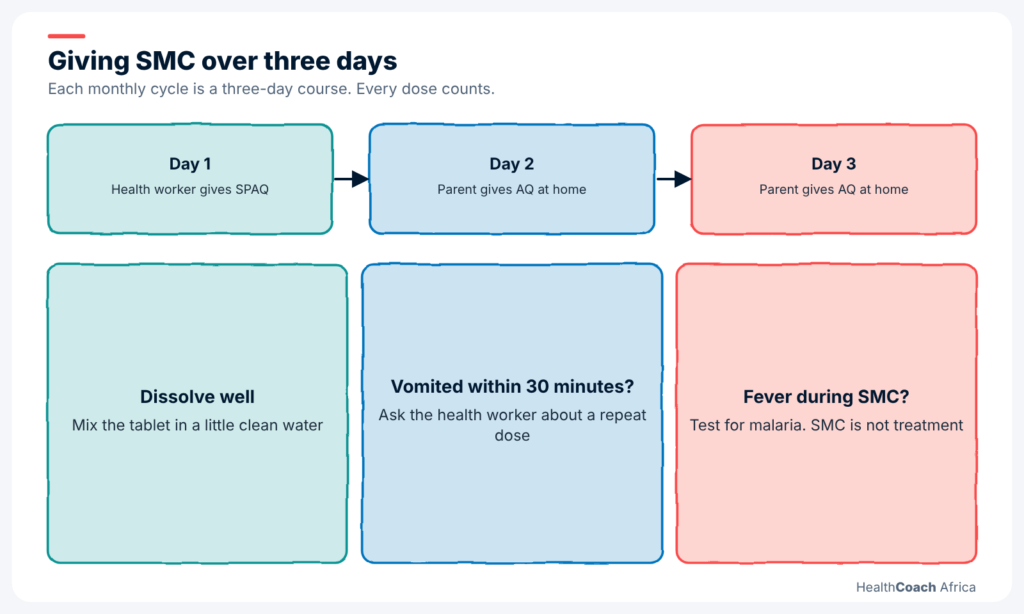
The most common SMC medicines are sulfadoxine-pyrimethamine, often called SP, combined with amodiaquine. Together they are known as SPAQ 1 .Each monthly cycle lasts three days:
Day 1: the community health worker gives the first dose of SP and amodiaquine, usually under direct observation
Day 2: the parent gives the second amodiaquine tablet at home
Day 3: the parent gives the third amodiaquine tablet at home
Completing all three days is essential. The day 1 dose alone does not give full protection.
How many cycles?
SMC is usually given in four or five monthly cycles, starting at the beginning of the rainy season and continuing until the end of the high-transmission period. Each cycle is about one month apart. Children should receive every cycle to stay protected throughout the season.
Seasonal malaria chemoprevention explained: giving the tablets
The tablets are dispersible, which means they dissolve in water. To give them:
Wash your hands.
Put the tablet in a clean cup with a small amount of clean water.
Let it dissolve, then mix gently.
Give it to the child slowly, with a spoon if needed.
Offer breast milk or food afterwards if the child is hungry.
If the child vomits within 30 minutes, the dose should be repeated. Contact the health worker for a replacement tablet.
Three-day dosing steps with seasonal malaria chemoprevention explained for parents
Keep the SMC card safe and show it at every cycle.
Seasonal malaria chemoprevention explained: common questions
Can my child take SMC if they are sick? A child who is very ill should be taken to a health facility instead. The health worker will advise.
What if we miss a cycle? Ask the community health worker whether your child can catch up. Do not double doses on your own.
Can SMC be given with other medicines? Tell the health worker about any medicines your child takes, especially co-trimoxazole.
Is SMC the same as treatment? No. SMC prevents malaria. A child with confirmed malaria needs full treatment.
Does my older child need SMC? Most campaigns target children under five, who are at the highest risk.
Possible side effects
Most children have no problems. Some may experience:
Vomiting
Mild stomach upset
Fever
Tiredness
These usually pass quickly. Seek medical help if the child develops a skin rash, yellow eyes, severe vomiting, or seems very unwell.
Tips for giving the home doses
Giving the day 2 and day 3 doses at home is the parent’s responsibility. Small tips make it easier. Give the dose at the same time each day. Mark the days on a calendar. Keep the tablets in a cool, dry place out of children’s reach. If the child refuses, try a little sugar water or breast milk after the dose. Ask an older sibling or relative to help hold a small child gently. Praise the child afterwards. Completing all three days is the heart of seasonal malaria chemoprevention explained by health workers.
HUBPHARM PHARMACIST’S NOTE Dispersible SMC tablets taste bitter, and many children spit them out. Mixing with a little clean water, giving slowly with a spoon and offering breast milk or a small snack afterwards helps. Message a HubPharm pharmacist if your child vomits a dose or develops a rash, or if you are unsure how to give days two and three.
SMC does not replace other protection
SMC greatly lowers the risk of malaria, but it does not prevent every case. Children should still:
Sleep under an insecticide-treated net 2 every night
Be tested promptly for any fever
Receive full treatment if malaria is confirmed
Receive the malaria vaccine where it is available
What to do if a child has fever during SMC
A child receiving SMC can still get malaria, or another illness. If your child develops a fever, take them to a health facility for a malaria test. Do not assume the fever is a side effect. Tell the health worker that your child is receiving SMC.
How well does it work?
Studies across the Sahel have shown that SMC can prevent most cases of malaria in children during the months it covers. It also reduces severe malaria and deaths. Its impact depends on reaching every eligible child and completing all doses in every cycle.
The role of community health workers
SMC is delivered door to door or at fixed points by trained community health workers. They register children, give the first dose, explain how to give the remaining doses and record each cycle on a card. Welcoming them, and asking questions, helps the campaign succeed.
Working with your community
SMC campaigns depend on trust. Community leaders, religious leaders, women’s groups and schools all help spread the word. If you have questions or concerns, ask the health worker rather than relying on rumours. Encourage neighbours with young children to take part. When most children in a community are protected, malaria cases fall for everyone. Seasonal malaria chemoprevention explained clearly to every household is how campaigns reach every child.
Keep the SMC card safe
Each child usually receives a card that records the date of each cycle. Keep it with the child’s other health records. Show it to health workers at each visit. It helps them know which cycles your child has completed.
Myths about SMC
“SMC is only for sick children.” SMC is given to healthy children to prevent malaria.
“If my child is already protected by SMC, a net is not needed.” Nets add important protection, especially between cycles.
“Only the first dose matters.” All three days are needed for each cycle to work.
Getting help
Seasonal malaria chemoprevention explained simply comes down to this: every eligible child, every cycle, all three days. Learn more about protecting families in our article on malaria and maternal and child health.For malaria test kits, children’s treatments, insecticide-treated nets or advice on giving medicines to young children, message a HubPharm pharmacist or chat with Afiya on WhatsApp.
Medicines and products in this article
#
Medicine or product
What to know
1
SPAQ (sulfadoxine-pyrimethamine plus amodiaquine)
Given free in SMC campaigns
Monthly three-day course for children 3 to 59 months during the rainy season.
2
Insecticide-treated net
Free in campaigns, also sold
Still needed every night during and between SMC cycles.
To order any of these, or to ask a pharmacist a question first, message HubPharm on WhatsApp or visit hubpharmafrica.com. Prescription medicines are supplied against a valid prescription.
Mosquito Control at Home: Protecting Your Family… Mosquitoes are more than a nuisance. In Nigeria, the Anopheles mosquito carries malaria, which kills many children every year. Other mosquitoes spread dengue, yellow fever and other infections. Much of the fight against mosquitoes happens…
Cholera Symptoms and Prevention: A Practical Guide… ARTICLE TEXT Cholera outbreaks occur in Nigeria almost every year, often during the rainy season when floods contaminate wells and boreholes. Cholera can kill within hours if dehydration is not treated. Yet it is easy…
Malaria: Understanding Symptoms, Treatment,… In this article, we will discuss the symptoms, treatment and prevention of malaria. Furthermore, we will highlight global efforts and challenges in eradicating malaria in our world Malaria, a life-threatening mosquito-borne disease, continues to…
Cancer Caregiver Support Tips: Caring Well Without… When someone is diagnosed with cancer, the whole family feels it. In Nigeria, most care happens at home, often led by a spouse, adult child or sibling. Caregivers manage medicines, cook special meals, travel to…