Malaria killed an estimated 610,000 people worldwide in 2024, according to the World Health Organization. In Africa, about three out of every four of those deaths were children under five, and Nigeria carried close to a third of the global toll. Severe malaria in children can turn a playful toddler into a critically ill patient in less than 24 hours. Knowing the danger signs allows parents to act in time.
Why young children are most at risk
Adults who grow up in malaria areas build partial immunity after many infections. Young children have not yet had that chance. Babies are partly protected by their mother’s antibodies for the first few months, but this protection fades. Therefore, the parasite multiplies quickly in their blood and can damage the brain, lungs and kidneys. It also destroys red blood cells, which causes severe anaemia. Children who are malnourished or who have sickle cell disease face an even higher risk.
How simple malaria becomes severe
Severe illness rarely appears without warning. In most cases, it follows a fever that went untreated, or was wrongly treated, for more than a day or two. During that time the parasites multiply and begin to block small blood vessels.
The main complications are:
Cerebral malaria, which affects the brain and causes convulsions or coma
Severe anaemia, as red blood cells are destroyed
Low blood sugar, which can itself cause convulsions
Breathing difficulty, as acid builds up in the blood
Kidney injury
Early clues are often subtle. A child who stops playing, refuses food or seems unusually quiet may be getting worse. Trust your instinct as a parent.
Eight danger signs of severe malaria in children
Take your child to hospital immediately if a fever comes with any of these signs:
Unable to drink or breastfeed
Vomiting everything
Convulsions
Unusual sleepiness, difficulty waking or loss of consciousness
Fast or difficult breathing
Very pale palms, lips or inner eyelids
Dark, cola-coloured urine or yellow eyes
Extreme weakness, such as being unable to sit or stand
Any one of these means the illness is no longer simple malaria.
What to do immediately
Go to the nearest hospital now. Do not wait until morning.
Do not give herbal mixtures. They delay care and can harm the liver and kidneys.
Protect a convulsing child. Lay the child on one side and put nothing in the mouth, including a spoon, onion or palm oil.
Cool the child gently. Remove heavy clothing and sponge with lukewarm water.
Keep breastfeeding if the child is able to suck.
Tell the health worker about every medicine already given.
Take the child’s health card and any test results with you.
What to expect at the hospital
Hospitals can feel overwhelming, so it helps to know how severe malaria in children is managed. The team will weigh your child and take a small blood sample. This checks for malaria parasites, blood sugar and the blood level.
Treatment then starts without delay. A drip may be set up, and the first injection is given immediately. Further injections usually follow after 12 and 24 hours, then once a day until the child can swallow.
If the blood level is very low, a transfusion may be needed, and relatives are sometimes asked to donate. Most children stay in hospital for several days. Ask questions freely, and tell the nurses at once if you notice a change.
How severe malaria is treated
In hospital, the first treatment is artesunate given by injection for at least 24 hours. Once the child can swallow, the doctor completes the treatment with a full three-day course of artemisinin-based combination therapy (ACT).
In addition, the team may give glucose, fluids, oxygen, medicine to stop convulsions or a blood transfusion for severe anaemia. In remote communities, a trained health worker may give artesunate as a suppository before sending the child to hospital. With prompt treatment, most children recover fully. Afterwards, the doctor may ask you to return for a blood check, because anaemia can develop in the weeks after treatment.
After your child comes home
For severe malaria in children, leaving hospital is not the end of treatment. To support a full recovery:
Finish every dose of the malaria tablets, even when the child seems well.
Give blood-building medicines if they were prescribed.
Offer nourishing food and plenty of fluids, since appetite returns gradually.
Return for the follow-up visit, usually within one to two weeks, so that the blood level can be rechecked.
Come back sooner if fever returns, the child becomes pale or very tired, or the urine turns dark. After cerebral malaria, also watch for new problems with hearing, speech, walking or behaviour, and report them early. Most children recover completely, but those who do not benefit from early therapy.
Giving malaria medicine correctly
Many cases of severe malaria in children begin with medicine that was given wrongly. Follow these rules:
Dose by weight. Ask the pharmacist to confirm the dose, and do not guess from an adult pack.
Follow the timing. With the most common treatment, the second dose is given eight hours after the first, then twice a day for the next two days.
Give it with milk or food.
Repeat a dose that is vomited within 30 minutes. If the child vomits again, go to hospital.
Use the right medicine. Do not treat with chloroquine or with leftover tablets.
Check that it is genuine. Buy from a licensed pharmacy and look for the NAFDAC number.
Dispersible tablets made for children dissolve in a little water and are easier to give.
Preventing severe malaria in children
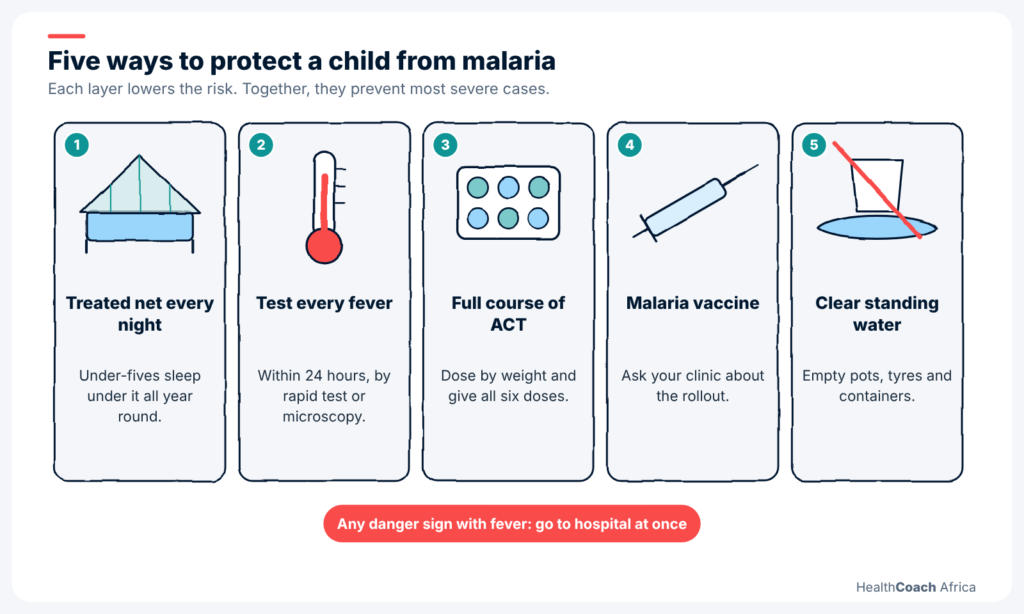
Use a treated net every night. Every child should sleep under an insecticide-treated net, all year round.
Test every fever within 24 hours. If malaria is confirmed, give the complete course of ACT. Do not stop when the fever goes down.
Use seasonal prevention. In eligible states, health workers give children aged 3 to 59 months preventive medicine each month during the rainy season.
Ask about the malaria vaccine. Two vaccines, RTS,S and R21, are now recommended for young children, and Nigeria is introducing vaccination in phases.
Reduce mosquitoes. Clear stagnant water and keep door and window nets in good repair.
Common mistakes
Many parents treat a fever at home with paracetamol alone, or give half a course of malaria medicine left over from a previous illness. Others assume that “teething” explains the fever. However, teething does not cause high fever, and an incomplete dose allows the parasite to return stronger. When in doubt, test. Similarly, a negative test at a medicine shop does not rule out other serious infections, so a child who remains unwell still needs a doctor.
Other illnesses that look like malaria
Not every fever is malaria. Pneumonia, meningitis, blood infection, measles and typhoid can all begin in the same way, and some are equally urgent. Therefore, a negative malaria test in a sick child is not reassurance. It is a reason to see a doctor quickly.
Frequently asked questions
Can my child get malaria again soon after treatment?
Yes. Treatment clears the current infection but gives little lasting protection. A net every night remains essential.
Is the malaria vaccine enough on its own?
No. It lowers the risk of illness and death, but it works alongside nets, testing and prompt treatment.
My child had a convulsion with fever. Is it epilepsy?
Usually not. However, any convulsion with fever needs a hospital assessment on the same day to rule out cerebral malaria and meningitis.
Can I give herbal mixtures together with the tablets?
No. They can cause vomiting, interfere with the medicine and harm the liver or kidneys.
How quickly should the fever settle?
It usually improves within two days of correct treatment. If it does not, return to the health facility.
What every caregiver should remember
Severe malaria in children moves fast, but so can you. Test every fever within a day, give the full course of the correct medicine and go straight to hospital if any danger sign appears. Share this list with grandparents, nannies and anyone else who looks after your child.
Getting help
Severe malaria in children is preventable, and early testing is the most important step. HubPharm pharmacists can advise on malaria tests, correct ACT doses for your child’s weight and insecticide-treated nets. For more, read our article on malaria and maternal and child health or the World Health Organization’s malaria fact sheet.
Please follow and like us:
Views:74
Related Posts:
Work-Life Balance for African Parents: Tips That Work Parenting has always been demanding, but in today’s fast-paced Africa—where parents juggle careers, side hustles, extended family responsibilities, and raising children—the challenge of achieving work-life balance is greater than ever. Urbanization, long commutes, digital distractions,…
Malaria Vaccine for Children: A Guide for Nigerian Parents For generations, Nigerian parents have relied on nets, drugs and prayer to protect their children from malaria. Now there is another tool. In December 2024, Nigeria introduced a malaria vaccine into its routine childhood immunisation…
Alarming Study Reveals 13.4 Million Premature Births… A groundbreaking study published in The Lancet has unveiled a deeply concerning global health issue: an estimated 13.4 million babies were born prematurely in the year 2020, equating to one in ten infants worldwide being…
Positive Discipline: Raising Respectful Children in Africa Parenting is one of the most important responsibilities in society, and in Africa, it has traditionally been a communal duty shaped by culture, values, and respect for elders. From village life to urban households, discipline…