For generations, Nigerian parents have relied on nets, drugs and prayer to protect their children from malaria. Now there is another tool. In December 2024, Nigeria introduced a malaria vaccine into its routine childhood immunisation programme, starting in Kebbi and Bayelsa states. This guide explains how the malaria vaccine for children works, who can receive it, the dose schedule and what to expect after each injection.
Why children need extra protection
Young children have not yet developed immunity to malaria. As a result, they are most likely to develop severe malaria, with complications such as severe anaemia, convulsions and coma. Nigeria carries the largest share of the world’s malaria burden, and children under five account for most malaria deaths.
Existing tools, including nets, seasonal preventive medicines and prompt treatment, save many lives. However, they are not enough on their own. A malaria vaccine for children adds an extra layer of protection.
Two vaccines, one goal
The World Health Organization has recommended two malaria vaccines for children living in areas with moderate to high malaria transmission:
RTS,S/AS01, recommended in 2021 after a large pilot programme in Ghana, Kenya and Malawi
R21/Matrix-M, recommended in October 2023
Both vaccines target the malaria parasite in the early stage of infection, before it reaches the liver and multiplies. Nigeria’s programme uses the R21 vaccine 1 .
How well does it work?
According to the World Health Organization, R21 reduced cases of malaria with symptoms by about 75% in the year after the first three doses in areas with seasonal malaria. In areas where malaria occurs year-round, the reduction was about two thirds. A fourth dose a year later helps to maintain protection.
In the pilot programme for the earlier RTS,S vaccine, there was a substantial drop in deaths from all causes among children old enough to receive it. This shows that the impact goes beyond preventing mild illness.
No vaccine gives complete protection. The malaria vaccine for children works best alongside nets and prompt testing and treatment.
The dose schedule in Nigeria
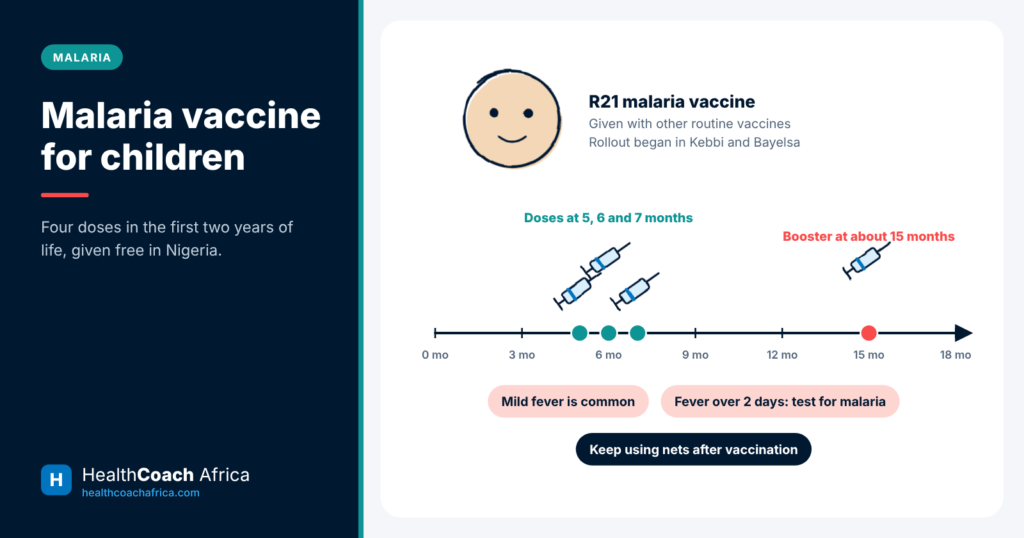
The R21 vaccine is given as four injections:
First dose: at 5 months of age
Second dose: at 6 months
Third dose: at 7 months
Fourth dose (booster): at about 15 months
Children who miss the first dose at 5 months can still start later. Ask your health worker about catch-up doses. Completing all four doses is important, because protection is weaker after fewer doses.
Where to get it
The vaccine is given free of charge at public health facilities taking part in the programme, alongside other routine childhood vaccines. The rollout began in Kebbi and Bayelsa, with plans to expand to more states. Ask your local primary health centre whether the malaria vaccine for children is available in your area, and keep your child’s immunisation card up to date.
Who should get the malaria vaccine for children?
The vaccine is offered to young children in the age range set by the national programme, starting at 5 months. Children who are mildly unwell, for example with a cold, can usually still be vaccinated. Children with a high fever or serious illness should wait until they recover. Tell the health worker if your child has had a serious reaction to any previous vaccine.
Children living with HIV, sickle cell disease or malnutrition are at higher risk from malaria. They can receive the vaccine, and it is especially important that they complete all four doses.
Is it safe?
Millions of doses of malaria vaccines have now been given to African children. The most common side effects are mild and short-lived:
Pain, redness or swelling where the injection was given
Fever, usually within a day or two
Irritability or crying
Give paracetamol syrup 2 at the correct dose for your child’s weight or age if they have a fever or seem uncomfortable. Offer extra breastfeeds or fluids. Seek medical help if the fever is very high, lasts more than two days or your child has a fit.
HUBPHARM PHARMACIST’S NOTE Paracetamol syrups come in different strengths, so the same number of millilitres can mean a different dose. Tell a HubPharm pharmacist your child’s age and weight and the bottle you have at home. We will confirm the right dose before the vaccine visit. We can also send you a reminder before each of the four doses, so your child completes the full schedule on time and stays protected through the high-risk early years.
Fever after the vaccine or malaria?
Because fever can follow vaccination, parents sometimes wonder whether their child has malaria. If the fever starts more than two days after the injection, or lasts more than two days, take your child to a health facility for a malaria test. Do not assume it is a vaccine reaction.
Preparing for each vaccine visit
A little planning makes vaccination days easier:
Bring your child’s immunisation card to every visit
Breastfeed or comfort your child during and after the injection
Ask the health worker to write the date of the next dose on the card
Set a reminder on your phone for the next appointment
Keep paracetamol syrup at home in case of fever
If you move to another state, take the card with you. Health workers can continue the schedule. Missed doses can often be caught up, so do not give up if you fall behind.
Keep using nets and testing
The malaria vaccine for children does not replace other prevention. Continue to:
Put your child to sleep under an insecticide-treated net 3 every night
Take part in seasonal malaria chemoprevention campaigns if they run in your area
Clear stagnant water around the home
Test every fever before treatment, and give the full course of an artemisinin-based combination therapy if malaria is confirmed
Together, these measures give your child the best chance of a malaria-free childhood.
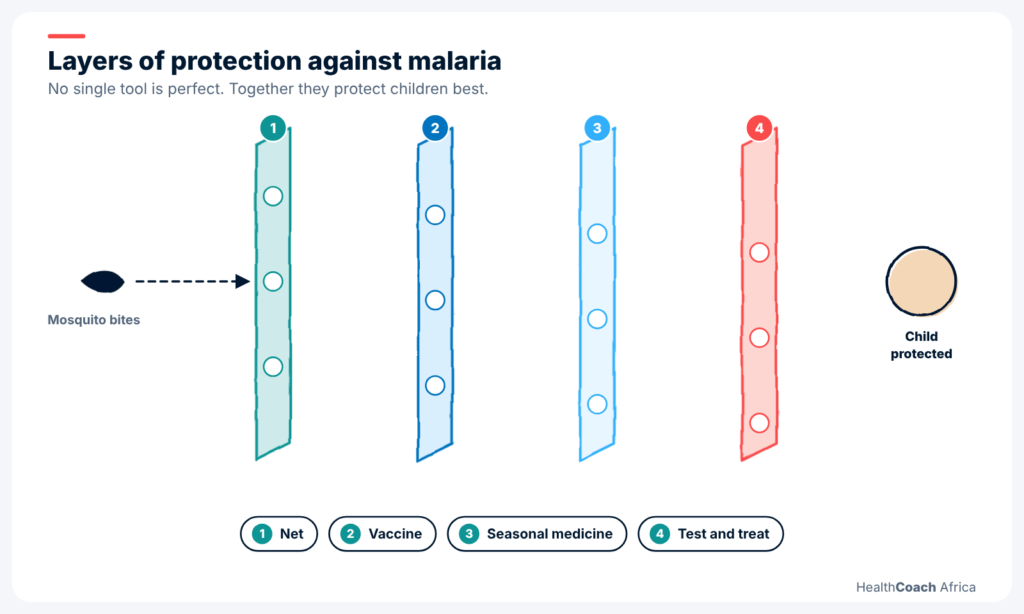
Layered diagram showing how the malaria vaccine for children works alongside nets and treatment
Each layer blocks some infections. The vaccine adds a new layer, it does not replace the others.
Common questions from parents
Can my child get the vaccine with other vaccines? Yes. It can be given on the same day as other routine childhood vaccines.
My child is older than 5 months. Is it too late? Not necessarily. Ask your health worker about the catch-up age range in your state.
Will it give my child malaria? No. The vaccine does not contain live parasites and cannot cause malaria.
Does my child still need the booster? Yes. The fourth dose keeps protection strong in the second year of life.
Why trust matters
Rumours about new vaccines spread quickly, especially on social media. Before believing a frightening story, check it with a health worker, a pharmacist or an official source such as the National Primary Health Care Development Agency. Community and religious leaders also play an important role in sharing accurate information about the malaria vaccine for children.
The bigger picture
The malaria vaccine for children is a major step forward, but the fight against malaria needs every tool working together. Gavi, the WHO and the Nigerian government are working to expand vaccine supply across more states. As more children receive the malaria vaccine for children, fewer families should lose a child to this preventable disease. Parents who share accurate information with neighbours help that progress happen faster. Health workers also want to hear your questions and concerns. Asking them openly, rather than relying on rumours, is the surest way to make a confident decision for your child.
Getting help
Talk to your health worker about the vaccine at your child’s next immunisation visit. For more on protecting children and mothers, read our article on malaria and maternal and child health. If you need help with fever medicine doses, malaria test kits or nets, message a HubPharm pharmacist or ask Afiya on WhatsApp.
Medicines and products in this article
#
Medicine or product
What to know
1
R21/Matrix-M malaria vaccine
Free at participating public facilities
Four doses at 5, 6 and 7 months, with a booster at about 15 months.
2
Paracetamol syrup
Over the counter
For fever or discomfort after vaccination. Dose by weight or age and check the strength on the bottle.
3
Insecticide-treated net
Free in campaigns, also sold
Still essential after vaccination. Children should sleep under one every night.
To order any of these, or to ask a pharmacist a question first, message HubPharm on WhatsApp or visit hubpharmafrica.com. Prescription medicines are supplied against a valid prescription.
Severe Malaria in Children: 8 Danger Signs Every… Malaria killed an estimated 610,000 people worldwide in 2024, according to the World Health Organization. In Africa, about three out of every four of those deaths were children under five, and Nigeria carried close to…
Mosquito Control at Home: Protecting Your Family… Mosquitoes are more than a nuisance. In Nigeria, the Anopheles mosquito carries malaria, which kills many children every year. Other mosquitoes spread dengue, yellow fever and other infections. Much of the fight against mosquitoes happens…
Insulin Injection Technique Tips: Getting Every Dose Right Insulin is a life-saving medicine for people with type 1 diabetes and many people with type 2 diabetes. Yet the way insulin is injected can make a big difference to how well it works. Poor…
Malaria in Young Children: How to Spot It, Treat It… For many Nigerian parents, a hot child means malaria. Sometimes it is. Sometimes the fever is caused by a cold, an ear infection, pneumonia or typhoid. Malaria in young children can be mild one day…